John's readers did not need an explanation of the beast rising from the sea. They had already seen its parts in Daniel 7. As Richard Bauckham notes, the sea beast "draws together the whole sequence of world empires in Daniel 7 into a single eschatological embodiment of evil." The daniel 7 beasts revelation 13 connection is one of Scripture's clearest cases of one prophet building directly on another.
Daniel gets cited constantly in Revelation studies, yet the two visions are rarely placed side by side. Revelation's beast represents Daniel's four beasts reassembled into one final composite kingdom, and seeing that source text is often what makes the daniel 7 beasts revelation 13 connection click for readers who have felt stuck on this chapter. There's no shame in needing the two texts laid out together before the pattern becomes clear. Many careful readers have needed exactly that.
This article maps the Daniel 7 beasts to Revelation 13 verse by verse, explains what the combination signals, and answers common questions readers bring to this passage. For a broader look at the chapter itself, see Revelation 13's meaning and its two beasts.
Quick Answer: Revelation 13's beast is a composite of Daniel 7's four beasts. John gives it the leopard's body, the bear's feet, the lion's mouth, and the fourth beast's ten horns, compressing four successive empires into one final figure that embodies every God-opposing power in history.
Definition: The beast in Revelation 13 represents a composite of Daniel's four beasts, combining every past empire's opposition to God into one final embodiment of worldly power.
Key Scripture: "Now the beast which I saw was like a leopard, his feet were like the feet of a bear, and his mouth like the mouth of a lion" (NKJV Revelation 13:2).
Context: John writes to churches under Roman imperial pressure, using imagery his audience already knew from the Septuagint version of Daniel.
This vision works by borrowing rather than invention. John takes imagery his readers already knew from Daniel and intensifies it, showing that the persecution facing first-century churches belonged to a much older pattern of God-opposing power. The result functions as both warning and reassurance: the beast is terrifying, yet its authority is inherited, measured, and already scheduled for removal. That balance of honesty and hope runs through the rest of this study. The sections below trace the source vision in Daniel, show how John reassembles it, and explain what that combination means for readers today.
Key Takeaways
- Four beasts, one body: Daniel's lion, bear, leopard, and fourth beast supply the parts of Revelation 13's single monster (NKJV Daniel 7:4-7; NKJV Revelation 13:1-2).
- Same sea, same chaos: Both visions begin with beasts rising from a churning sea, a Hebrew symbol of chaos opposed to God (NKJV Daniel 7:2-3; NKJV Isaiah 27:1).
- Same arrogant mouth: Daniel's little horn speaks "pompous words" and Revelation's beast speaks "great things and blasphemies" (NKJV Daniel 7:8; NKJV Revelation 13:5).
- Same borrowed authority: The repeated phrase "was given" limits the beast's reign in both texts (NKJV Daniel 7:25; NKJV Revelation 13:5,7).
- Same verdict: Daniel's court strips the beast's dominion, guaranteeing that Revelation 13's terror is time-limited (NKJV Daniel 7:26).
Key Evidence
- Body parts match directly: "the beast... was like a leopard, his feet were like the feet of a bear, and his mouth like the mouth of a lion" (NKJV Revelation 13:2) draws on Daniel's leopard, bear, and lion described individually in NKJV Daniel 7:4-6.
- Ten horns match directly: Daniel's fourth beast has "ten horns" (NKJV Daniel 7:7), and John's beast likewise has "ten horns" (NKJV Revelation 13:1).
- Arrogant speech matches directly: Daniel's horn speaks "pompous words" (NKJV Daniel 7:8), and Revelation's beast is given "a mouth speaking great things and blasphemies" (NKJV Revelation 13:5).
- Limited authority matches directly: Daniel's beast is given dominion "for a time and times and half a time" (NKJV Daniel 7:25), and Revelation's beast is "given authority" for a bounded period (NKJV Revelation 13:5,7).
- Scholarly confirmation: Richard Bauckham describes the sea beast as drawing "together the whole sequence of world empires in Daniel 7 into a single eschatological embodiment of evil," and G.K. Beale treats Daniel 7 as the controlling Old Testament background for Revelation's beast imagery.

Daniel's Four Beasts: The Source Vision
Any study of the daniel 7 beasts revelation 13 connection starts in Daniel's night vision. "The four winds of heaven were stirring up the Great Sea. And four great beasts came up from the sea, each different from the other" (NKJV Daniel 7:2-3). The Hebrew word for beast, חֵיוָה (chevah), simply means "living creature," but here it establishes a pattern: empires rise from chaos like beasts from a churning ocean.
Daniel describes them briefly. A lion with eagle's wings comes first, followed by a bear raised on one side, then a leopard with four wings and four heads, and finally a fourth beast with iron teeth and ten horns (NKJV Daniel 7:4-7). Tradition identifies these as Babylon, Media-Persia, Greece, and Rome. Every major interpretive school, whether preterist, historicist, futurist, or idealist, accepts Daniel 7 as the source imagery even while disputing exactly who each beast represents today.
The horns matter too. Daniel 7:23-24 tells us "the ten horns are ten kings," using the Hebrew קֶרֶן (qeren), a term for delegated ruling power under a larger kingdom. Daniel 7 gives us four beasts in sequence, each one a different empire trampling God's people, and each one answerable to the Ancient of Days. That resolution arrives in Daniel 7:9-14, where the Ancient of Days seats the court and gives everlasting dominion to "One like the Son of Man." G.K. Beale treats this scene as the controlling Old Testament background for everything Revelation later does with beast imagery. For Daniel's wider prophetic framework, see what Revelation says about the Antichrist.
The Composite Beast of Revelation 13
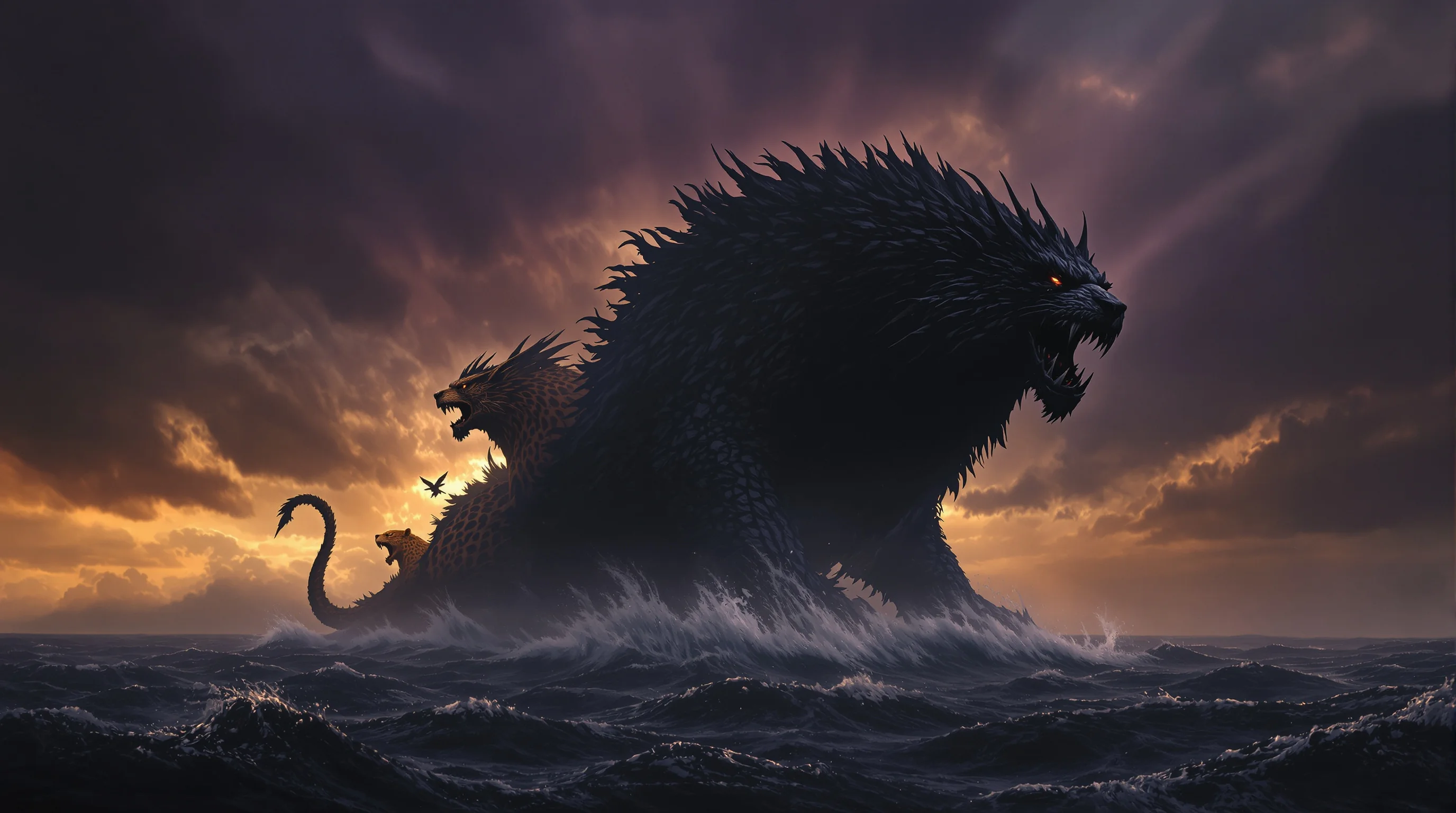
The daniel 7 beasts revelation 13 relationship becomes visible the moment John describes his beast's anatomy. He sees "a beast rising up out of the sea, having seven heads and ten horns... like a leopard, his feet were like the feet of a bear, and his mouth like the mouth of a lion" (NKJV Revelation 13:1-2). The Greek θηρίον (thērion) means "wild beast, savage animal," a fitting label for a creature built from four different predators.
Notice the order is reversed. Daniel moves from lion to bear to leopard chronologically, while John moves backward from leopard to bear to lion, tracing history from his own present back toward Babylon. The seven heads add up across Daniel's beasts (one for the lion, one for the bear, four for the leopard, one for the fourth beast), and the ten horns come directly from Daniel's fourth beast.
Placement in the narrative matters as well. Revelation 12:17 shows the dragon going to war against the woman's offspring, and Revelation 13 answers how: through a sea beast wielding political power and an earth beast wielding religious and economic pressure. John fuses Daniel's four beasts into one, showing that every empire's cruelty now stands in a single body. Craig Koester observes that John's Daniel-literate readers would have understood this composite figure as intensifying what they already knew about opposition to God's kingdom, not as some unfamiliar creature appearing out of nowhere. For more on this figure's identity, see what is the beast of Revelation?
The Two Visions Side by Side
A simple mapping makes the daniel 7 beasts revelation 13 borrowing unmistakable.
- Bodies: leopard, bear's feet, lion's mouth (NKJV Daniel 7:4-6) appear together in NKJV Revelation 13:2.
- Horns and mouth: ten horns and pompous speech (NKJV Daniel 7:8,24) match NKJV Revelation 13:1,5.
- Limits and end: authority "given" for a set time (NKJV Daniel 7:25-26) matches NKJV Revelation 13:5,7.
What the Combination Signals for Readers Today
Reading the daniel 7 beasts revelation 13 link as one continuous story changes how believers hear the chapter. First, it signals continuity: the same spiritual conflict Israel faced under pagan empires continues into the church age. Second, it signals intensification. Compressing four beasts into one figure communicates cumulative weight, not novelty; this is every empire's arrogance concentrated in a single body.
Third, it signals limitation. The repeated divine passive "was given" in Revelation 13:5,7 means the beast operates only inside boundaries God permits, echoing Daniel 7:25's beast receiving power "for a time and times and half a time." Fourth, it signals a guaranteed verdict. Daniel 7:26 already announced that the court sits and takes dominion away, so Revelation 13's outcome is settled before the chapter even begins.
The historical setting sharpens this. Roman emperors in Asia Minor claimed titles like "divine" and "son of god" on coins and monuments, and trade guilds tied commerce to pagan rites, the backdrop behind Revelation 13:17's buying and selling restriction. Revelation 13:10 calls believers to "the patience and the faith of the saints," an active perseverance grounded in God's sovereignty rather than passive resignation. Daniel already told us how the story ends, which is why Revelation 13 can describe a monster without inviting panic. Treating this passage as a puzzle for naming a modern figure misses its pastoral purpose. Richard Bauckham's description of the beast as a single eschatological embodiment of the whole empire sequence captures why John's first readers found comfort here rather than dread. For readers wanting to trace this imagery across Revelation's full narrative, Revelation Explained: Verse by Verse examines each occurrence in its immediate context.
Why This Vision Matters
Laying Daniel 7 beside Revelation 13 replaces speculation with a stable interpretive anchor. The daniel 7 beasts revelation 13 comparison shows believers facing cultural and economic pressure that they stand in a long line of the faithful who outlasted beastly powers before them. Revelation's hope rests on a settled outcome: the Son of Man receives everlasting dominion, and every beast's authority expires on God's own schedule. That settled ending is worth remembering whenever this chapter feels heavy.
Conclusion
The daniel 7 beasts revelation 13 connection is direct borrowing. John assembles one composite beast from Daniel's four, inheriting Daniel's imagery along with Daniel's verdict. That verdict matters for you as much as it did for John's first readers: the beast's authority is granted, measured, and revoked, so faithfulness rather than fear is the fitting response to this vision. Whatever pressure you face today, you are reading this passage from the same vantage point Daniel and John once offered their own communities, standing on a verdict already settled in God's favor. For a deeper verse-by-verse exploration of Revelation's symbols and structure, see Revelation Explained: Verse by Verse by Richard French.
Sources
- Daniel 7:1-27 (NKJV)
- Revelation 12:17-13:18 (NKJV)
- Isaiah 27:1; Ezekiel 28-29; Psalm 74:13-14 (NKJV)
- G.K. Beale, The Book of Revelation: A Commentary on the Greek Text (NIGTC)
- Craig Koester, Revelation: A New Translation with Introduction and Commentary (Anchor Yale Bible)
- Richard Bauckham, The Theology of the Book of Revelation
- Grant Osborne, Revelation (Baker Exegetical Commentary on the New Testament)
- Robert Mounce, The Book of Revelation (New International Commentary on the New Testament)