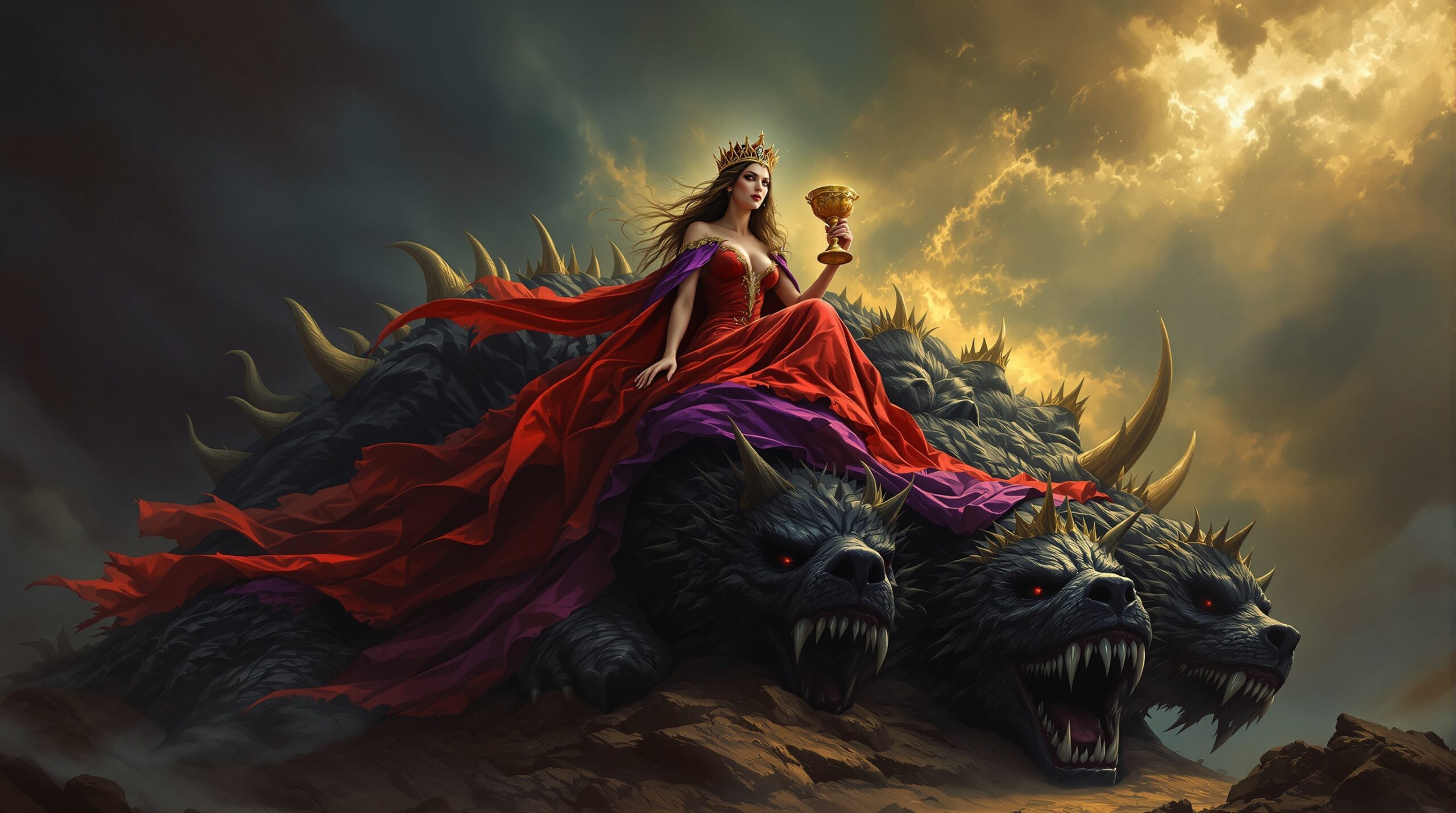
A woman dressed in scarlet and purple sits on a seven-headed beast, holding a golden cup filled with abominations—this is one of Scripture's most vivid and disturbing images, yet it reveals essential truth about spiritual warfare and God's ultimate justice. Revelation 17 unveils the "mystery" of Babylon, exposing the seductive alliance between corrupt religious-economic systems and godless political power that has persecuted believers throughout history. The meaning of Revelation 17 is not merely symbolic theater but practical wisdom for Christians facing pressure to compromise with worldly systems. This vision assured first-century believers under Roman persecution that seemingly invincible powers face certain judgment, and it continues to guide believers today in discerning between God's kingdom and counterfeit alternatives.
Quick Answer: The meaning of Revelation 17 centers on God's judgment of "Babylon the Great"—a symbolic woman representing corrupt worldly systems (religious, political, economic) that seduce nations into idolatry and persecute God's people. She rides a beast symbolizing political power, but both face certain destruction as Christ, the "Lord of lords and King of kings," will overcome them.
Definition: The harlot Babylon in Revelation 17 symbolizes worldly systems that oppose God through seduction rather than direct force, offering prosperity while demanding spiritual compromise.
Key Scripture: "These will make war with the Lamb, and the Lamb will overcome them, for He is Lord of lords and King of kings; and those who are with Him are called, chosen, and faithful" (NKJV Revelation 17:14).
Context: This vision assured persecuted first-century believers that Rome's power was temporary and assured all believers that faithfulness to Christ leads to victory.
The meaning of Revelation 17 is not about distant future events but about recognizing patterns of spiritual warfare that persist across history. This vision functions as both warning and comfort. It warns that worldly systems will fail under divine judgment, exposing the fragility of material security. Yet it also demonstrates God's sovereignty over even catastrophic events, with the beast's ultimate destruction showing that divine limits constrain evil's reign. Sections that follow will examine what the harlot and beast represent, how their unstable alliance works, and what this means for believers navigating worldly pressures today.
Key Takeaways
The harlot "Babylon" symbolizes worldly systems that oppose God through seduction rather than direct force, offering prosperity while demanding spiritual compromise
The beast represents godless political power that temporarily allies with corrupt religious-economic influence
The relationship is unstable—the beast eventually turns on the harlot, revealing how evil systems contain seeds of their own destruction
"Mystery" indicates symbolic meaning—this is spiritual Babylon, not a literal geographical city
Christ's victory is certain—believers who remain faithful share in the Lamb's triumph over all opposing powers
The Vision of the Harlot and Beast
Understanding the meaning of Revelation 17 begins with John's guided vision of a woman seated on a scarlet beast with seven heads and ten horns. The woman is "arrayed in purple and scarlet, and adorned with gold and precious stones and pearls, having in her hand a golden cup full of abominations and the filthiness of her fornication" (NKJV Revelation 17:4). Her forehead bears the title: "MYSTERY, BABYLON THE GREAT, THE MOTHER OF HARLOTS AND OF THE ABOMINATIONS OF THE EARTH" (NKJV Revelation 17:5). The term "mystery" signals that this Babylon is symbolic rather than literal—God is revealing hidden spiritual reality behind earthly systems. As Robert Mounce observes, "The term 'mystery' indicates that Babylon is not to be understood literally but symbolically. John is not predicting the fall of a rebuilt Mesopotamian city but revealing the spiritual reality behind all earthly opposition to God." Most disturbing, John sees the woman "drunk with the blood of the saints and with the blood of the martyrs of Jesus" (NKJV Revelation 17:6). The metaphor of intoxication suggests insatiable bloodlust—she derives pleasure from destroying believers. The beast she rides "was, and is not, and will ascend out of the abyss" (NKJV Revelation 17:8)—a satanic parody of Christ's death and resurrection, deliberately contrasting with God "who is and who was and who is to come" (NKJV Revelation 1:8).
The Harlot's Identity
The woman represents corrupt worldly systems—religious, political, and economic—that seduce through material prosperity while promoting idolatry.

Counterfeit bride: Contrasts with Christ's pure bride in Revelation 19 and 21
Old Testament background: Echoes Jeremiah 51:7 where Babylon holds "a golden cup in the LORD's hand, that made all the earth drunk"
First-century reference: Original audience recognized Rome, built on seven hills, clothed in imperial purple and scarlet
The Unstable Alliance and Coming Judgment
Revelation 17 reveals a temporary but doomed partnership between the harlot and beast. "The ten horns which you saw are ten kings who have received no kingdom as yet, but they receive authority for one hour as kings with the beast. These are of one mind, and they will give their power and authority to the beast" (NKJV Revelation 17:12-13). This coalition of political powers unifies in opposition to God, but their authority is brief—"one hour" indicates divine limitation on evil's reign. The alliance contains seeds of its own destruction: "And the ten horns which you saw on the beast, these will hate the harlot, make her desolate and naked, eat her flesh and burn her with fire" (NKJV Revelation 17:16). Grant Osborne notes, "The beast and harlot represent an unholy alliance between political tyranny and economic seduction that characterizes worldly power throughout the church age. Yet this alliance contains the seeds of its own destruction, as verse 16 makes clear." Despite their apparent power, the outcome is certain: "These will make war with the Lamb, and the Lamb will overcome them, for He is Lord of lords and King of kings; and those who are with Him are called, chosen, and faithful" (NKJV Revelation 17:14). The threefold description—called, chosen, faithful—emphasizes that perseverance ensures participation in Christ's triumph.
Why the Beast Destroys the Harlot
The beast eventually turns on the woman he once carried, illustrating how evil systems ultimately betray each other.
Competing powers: Religious-economic influence competes with political authority for ultimate control
Historical pattern: Rome's fall to barbarian invasions; political powers rejecting ecclesiastical control during Reformation
Eschatological fulfillment: Future Antichrist eliminating competing religious systems to demand exclusive worship
What This Vision Means for Christians Today
Understanding the meaning of Revelation 17 equips believers to resist worldly seduction and trust Christ's sovereignty. The harlot's attractive appearance—gold, jewels, pearls—masks her poisonous cup. Christians must discern what systems and values oppose God's kingdom despite appearing prosperous and culturally prestigious. As G.K. Beale writes, "Babylon symbolizes the worldly city opposed to the heavenly city throughout history, finding particular expression in first-century Rome, but not exhausted by that reference." The passage warns against spiritual adultery—seeking security, prosperity, or identity from worldly systems rather than God. Just as ancient Israel trusted political alliances instead of God (NKJV Isaiah 31:1), Christians face pressure to find ultimate security in economic prosperity, political power, or cultural acceptance. Revelation 17 reveals these temptations as spiritual prostitution. For persecuted believers, the chapter offers profound encouragement. Though the woman is "drunk with the blood of the saints" and the beast makes war with the Lamb, Christ's victory is certain. Those who remain "called, chosen, and faithful" share in His triumph. The vision cultivates appropriate detachment from worldly systems. Recognizing that political powers and economic structures are temporary and often aligned against God's purposes frees Christians from naive optimism and despairing pessimism. Believers can engage culture as "resident aliens" (NKJV 1 Peter 2:11)—living faithfully within earthly systems while recognizing ultimate allegiance to God's kingdom. The chapter calls Christians to four specific responses: spiritual discernment in recognizing seductive but poisonous systems, resistance to spiritual adultery through exclusive devotion to Christ, courage in persecution knowing that faithfulness leads to victory, and appropriate detachment from temporary worldly structures. These responses remain relevant whether one views Babylon in Revelation as describing first-century Rome, future end-times events, or timeless spiritual realities.
Why This Vision Matters
The meaning of Revelation 17 exposes the seductive power of worldly systems, helping Christians resist compromise by revealing that seemingly invincible powers face certain judgment. This vision assures persecuted believers that their faithfulness matters eternally and their oppressors' authority is temporary. By exposing the unstable alliance between corrupt religion and godless politics, this chapter calls every generation to worship rightly, resist courageously, and trust Christ's victory completely.
Conclusion
The meaning of Revelation 17 centers on God's judgment of Babylon—the corrupt worldly systems that seduce nations and persecute believers. The harlot riding the beast represents the temporary alliance between religious-economic seduction and political power, an alliance doomed to self-destruction. Yet above all earthly powers stands Christ, the "Lord of lords and King of kings," whose victory is certain and whose faithful followers share in His triumph. This vision calls Christians to discernment, faithfulness, and confidence in God's sovereign justice.
Sources
Revelation 14:8, 16:19, 17:1-18, 18:1-24, 19:1-8
Daniel 7:1-28, especially verses 7-8, 23-25
Jeremiah 51:6-9, 13, 41-49
Isaiah 47:1-15
Ezekiel 16:1-63, 23:1-49, 27:1-36
Beale, G.K. The Book of Revelation: A Commentary on the Greek Text (New International Greek Testament Commentary). Eerdmans, 1999.
Osborne, Grant R. Revelation (Baker Exegetical Commentary on the New Testament). Baker Academic, 2002.
Keener, Craig S. Revelation (NIV Application Commentary). Zondervan, 2000.
Mounce, Robert H. The Book of Revelation (New International Commentary on the New Testament), Revised Edition. Eerdmans, 1997.
Johnson, Dennis E. Triumph of the Lamb: A Commentary on Revelation. P&R Publishing, 2001.