Revelation chapter 1 opens with a Person, not a parade of beasts, seals or trumpets. Before any of those images appear, the text tells us plainly what this book is: "This is the Revelation of Jesus Christ, which God gave him to show to his servants the things which must happen soon" (WEB Revelation 1:1). That opening line sets the tone for everything that follows.
Many readers feel intimidated before they even reach chapter 2. It's okay to find this book challenging; faithful readers have wrestled with it for centuries, and its difficulty invites us to lean on God's wisdom rather than our own. Revelation chapter 1 quietly reassures us that this message was meant to be read aloud, understood and kept by ordinary believers (WEB Revelation 1:3). The chapter is not a riddle reserved for experts, and it is not a vague mood piece about hardship in general. It specifically identifies Jesus as its source and subject, and it gives us the vocabulary we need for the rest of the book.
In this article we'll walk the chapter in order: the prologue and blessing, the greeting and doxology, John's exile on Patmos, the vision of the Son of Man, and the comforting words about the keys, stars and lampstands.
Quick Answer: Revelation chapter 1 is the prologue to the book of Revelation. It names the book as a revelation of Jesus Christ, blesses those who read and keep it, and greets seven churches in Roman Asia. It records John's vision on Patmos of the risen Christ standing among seven golden lampstands and holding the keys of Death and Hades.
Definition: Revelation chapter 1 refers to the opening prologue of John's apocalypse, introducing the risen Christ as sovereign over the seven churches and over death itself.
Key Scripture: "I was dead, and behold, I am alive forever and ever. Amen. I have the keys of Death and of Hades." (WEB Revelation 1:18)
Context: Christ himself interprets the stars and lampstands in verse 20, showing that Revelation often explains its own symbols.
This opening vision shows why the book exists and how it works. Every judgment, seal and trumpet to come flows from the authority of a risen, reigning Christ rather than from random chaos. Readers meet him first as comforter and only then as judge, and that order shapes how the whole prophecy should be heard. Even the most frightening scenes ahead are meant to be read in the light of this opening scene. The sections below trace that sequence verse by verse, from the opening blessing through the vision on Patmos to the words "don't be afraid."
Key Takeaways
- Revelation of Jesus Christ: The Greek apokalypsis means "unveiling," and Jesus is both its source and its subject (WEB Revelation 1:1).
- A blessing for hearers: Revelation 1:3 blesses those who read, hear, and keep the prophecy.
- Christ's three titles: Faithful witness, firstborn of the dead, and ruler of the kings of the earth (WEB Revelation 1:5).
- The Son of Man: John's vision draws heavily on Daniel 7 and Daniel 10.
- Keys of Death and Hades: Christ's first words to the fallen John are "Don't be afraid" (WEB Revelation 1:17).
Key Evidence
- The book names itself: Verse 1 calls the book a revelation of Jesus Christ, which identifies its source and subject (WEB Revelation 1:1).
- The text expects public reading: The blessing in verse 3 assumes hearers and keepers in a gathered congregation (WEB Revelation 1:3).
- Christ interprets the symbols: Verse 20 explains the stars and lampstands directly (WEB Revelation 1:20).
- Old Testament roots: The imagery draws on Daniel 7, Daniel 10, Zechariah 4, and Isaiah 44:6.
- Christ's authority over death: He holds the keys of Death and Hades (WEB Revelation 1:18).

What Does Revelation Chapter 1 Say in Its Opening Verses?
Revelation chapter 1 opens like a title page before turning into a letter greeting. Verses 1 through 3 work as a title and blessing, while verses 4 through 8 form a greeting with a doxology, much like the opening of a Pauline epistle.
Verse 3 reads: "Blessed is he who reads and those who hear the words of the prophecy, and keep the things that are written in it, for the time is near." (WEB Revelation 1:3) This assumes the letter was read aloud to gathered congregations, not studied privately by specialists.
Grace comes from the One "who is and who was and who is to come," an echo of God's self-naming in Exodus 3:14. Verse 5 names Jesus as "the faithful witness, the firstborn of the dead, and the ruler of the kings of the earth" (WEB Revelation 1:5). Verse 6 adds that believers are made "a Kingdom, priests to his God and Father" (WEB Revelation 1:6), language drawn from Exodus 19:6. Taken together, this opening blends three genres: apocalypse (1:1), prophecy (1:3), and letter (1:4).
Revelation chapter 1 presents Jesus Christ as the faithful witness, the firstborn of the dead, and the ruler of the kings of the earth, identities that steadied persecuted believers. If you have ever felt pressure to bow to something bigger than your faith, these titles were written for you too.
"Alpha and Omega" and the Coming With the Clouds
Verses 7 and 8 close the greeting with Christ's coming and God's own self-declaration.
- Verse 7: "Behold, he is coming with the clouds, and every eye will see him, including those who pierced him," fusing Daniel 7:13 with Zechariah 12:10 (WEB Revelation 1:7).
- Interpretive views: readers connect this to judgment on Jerusalem, the second coming, or both, and honest interpreters disagree.
- Verse 8: explore this title further in What Does "Alpha and Omega" Mean in Revelation?
John on Patmos and the Lord's Day
John on Patmos introduces the setting for the entire vision. Verse 9 describes John as "your brother and partner with you in the oppression, Kingdom, and perseverance in Christ Jesus," writing from Patmos "because of God's Word and the testimony of Jesus Christ" (WEB Revelation 1:9).
Verse 10 tells us: "I was in the Spirit on the Lord's day, and I heard behind me a loud voice, like a trumpet." (WEB Revelation 1:10) Most interpreters read this phrase as Sunday, the day Christians gathered for worship, which suggests John received this vision in an act of worship even while isolated. For more on this phrase, see What Is the Lord's Day in Revelation 1:10?
Verse 11 records the command to write to seven named assemblies. The exact date of Revelation is debated among evangelical scholars, and that debate doesn't change what this chapter asks of its readers.
Maybe you've wondered whether a vision given in isolation still carries weight for a gathered church. John received his vision on the Lord's day, a setting of worship even in exile (WEB Revelation 1:9-10), and that suggests worship and exile aren't opposites.
The Seven Churches of Roman Asia
The seven cities named in verse 11 sat along a circular road through Roman Asia, in what is modern western Turkey.
- The cities: Ephesus, Smyrna, Pergamum, Thyatira, Sardis, Philadelphia, and Laodicea.
- Pressures: imperial cult temples stood in cities like Pergamum and Ephesus, and trade guild banquets often involved pagan sacrifice.
The Vision of the Son of Man in Revelation Chapter 1
Revelation chapter 1 reaches its center in John's vision of the glorified Christ. Verses 12 and 13 describe the scene: "Having turned, I saw seven golden lamp stands. And among the lamp stands was one like a son of man, clothed with a robe reaching down to his feet, and with a golden sash around his chest." (WEB Revelation 1:12-13)
Verse 14 continues: "His head and his hair were white as white wool, like snow. His eyes were like a flame of fire," recalling the Ancient of Days in Daniel 7:9 (WEB Revelation 1:14). Verse 16 adds: "He had seven stars in his right hand. Out of his mouth proceeded a sharp two-edged sword. His face was like the sun shining at its brightest." (WEB Revelation 1:16)
This imagery draws directly on Daniel 10:5-6, which supplies the linen robe, the gold belt, the fiery eyes, and the thunderous voice, while Zechariah 4 shapes the lampstand imagery. The letters in chapters 2 and 3 each reuse a detail from this vision, such as the sword, the eyes, or the keys, tying the whole book back to this opening scene. For a fuller look at this imagery, see What Is the Vision of the Son of Man in Revelation 1?
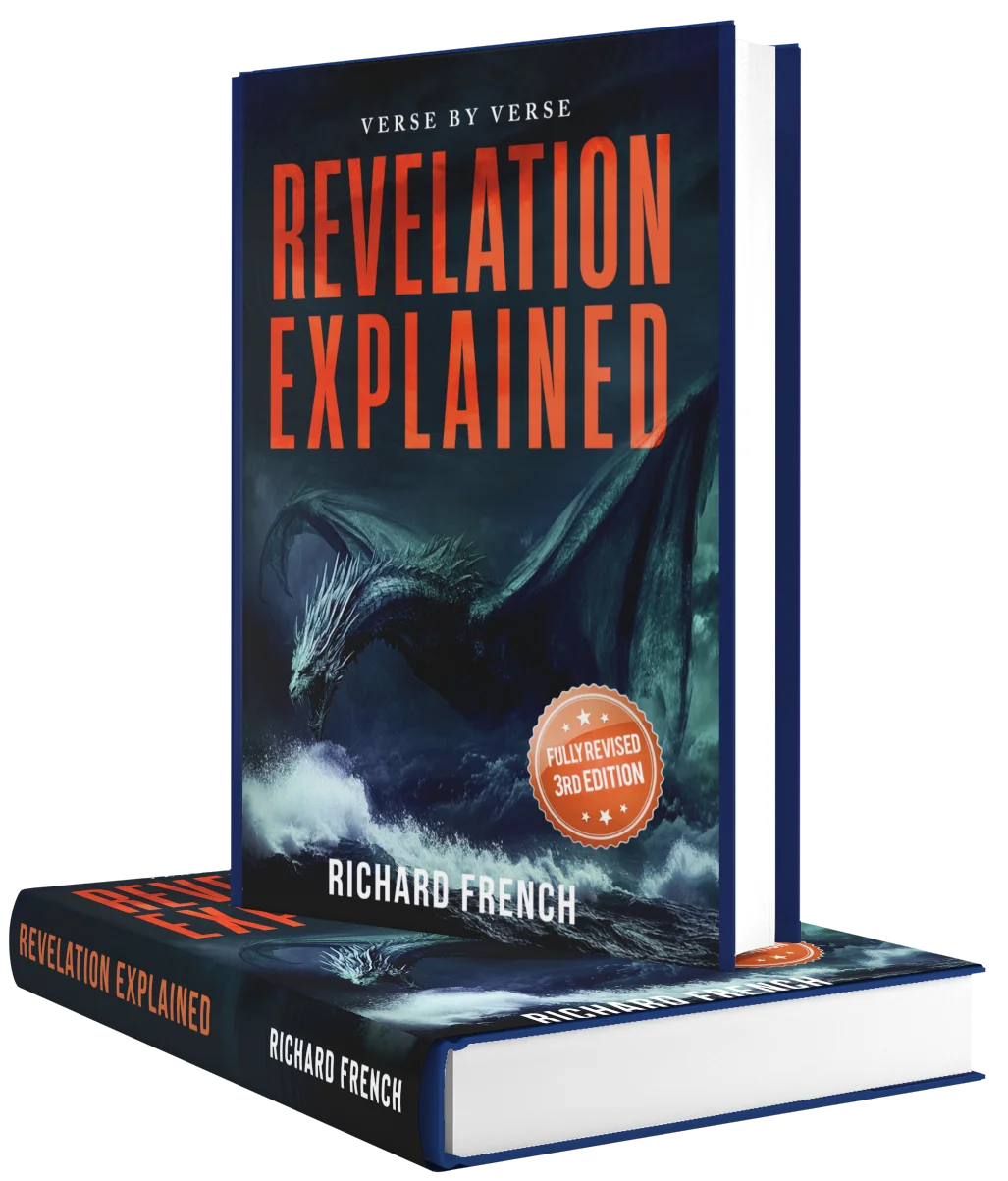
The Son of Man in Revelation 1 is the risen Jesus, described with imagery from Daniel 7 and Daniel 10, walking among his churches. For readers wanting to trace how this imagery develops across Revelation's narrative, Revelation Explained: Verse by Verse examines each occurrence in its immediate context.
"Don't Be Afraid": The Keys, Stars, and Lampstands
The vision's effect on John is immediate. Verse 17 tells us: "When I saw him, I fell at his feet like a dead man. He laid his right hand on me, saying, 'Don't be afraid. I am the first and the last.'" (WEB Revelation 1:17) That title echoes Isaiah 44:6 and 48:12, where God speaks these very words of himself.
Verse 18 continues: "I was dead, and behold, I am alive forever and ever. Amen. I have the keys of Death and of Hades." (WEB Revelation 1:18) A key in this context symbolizes authority and control, not a literal object. The scene follows a pattern familiar from Ezekiel 1 and 2, where a prophet falls down and is raised to receive a commission.
Careful readers have debated the meaning of verse 19 in real earnest. That debate doesn't affect the chapter's central comfort: the risen Christ holds the keys of Death and of Hades, so death itself is under his authority.
What the Seven Stars and Lampstands Mean
Something rare in Revelation appears in verse 20: Christ explains his own symbols directly.
- Verse 20: "The seven stars are the angels of the seven assemblies. The seven lamp stands are seven assemblies." (WEB Revelation 1:20)
- The angels debate: interpreters identify these figures as heavenly beings, human messengers, or personifications of the congregations themselves.
- Further reading: What Are the Seven Stars in Revelation?
Why This Vision Matters
The risen Christ walks among his churches and holds their messengers in his right hand (WEB Revelation 1:13, 1:16). Believers facing hardship can trust the One who holds the keys of Death and Hades (WEB Revelation 1:18). His fiery eyes and sharp sword also signal accountability, a theme the letters in chapters 2 and 3 develop further. The fitting response to all of this is worship, attentive listening, and keeping what is written (WEB Revelation 1:3, 1:17).
Conclusion
Revelation chapter 1 introduces the whole book through the risen Christ: faithful witness, firstborn of the dead, and ruler of the kings of the earth, standing among seven golden lampstands. When fear overtook John, Christ met him with a hand on his shoulder and the words "Don't be afraid" (WEB Revelation 1:17). You can approach the rest of this book the same way John did, with reverence rather than dread, trusting that the One who holds the keys of Death also holds your story. Resist the pull toward date-setting or speculation about current events; this chapter centers on Christ and invites you into faithful endurance. For a deeper verse-by-verse exploration, see Revelation Explained: Verse by Verse by Richard French.