For nearly two thousand years, Christians have read this chapter in three main ways. Perhaps you've heard a confident teacher insist that only one reading is possible, and wondered whether you were missing something. That disagreement can feel unsettling if you're new to studying Revelation, but it's okay to hold your conclusions loosely here. Faithful believers have debated the timing while agreeing on what matters most: Christ rules over Satan and death, the faithful are vindicated, and every person will face a just Judge.
Revelation chapter 20 finishes a story already underway, the final defeat of the dragon introduced back in chapter 12. We'll look at the chapter's three visions: Satan bound and the saints reigning (vv. 1-6), the final rebellion (vv. 7-10), and the great white throne (vv. 11-15). Then we'll survey the three millennial views fairly, without pushing you toward one.
Quick Answer: Revelation chapter 20 is John's vision of Satan bound for a thousand years, faithful believers reigning with Christ, a final rebellion crushed by fire from heaven, and the great white throne judgment of all the dead. It is the only passage in Scripture naming a thousand-year reign, and Christians read it in three main ways.
Definition: The thousand-year reign in Revelation chapter 20 represents the final stage of evil's defeat, moving from Satan's binding through his last rebellion to the judgment of every person before God's throne.
Key Scripture: "Blessed and holy is he that hath part in the first resurrection: on such the second death hath no power, but they shall be priests of God and of Christ, and shall reign with him a thousand years." (KJV Revelation 20:6)
Key Evidence: The chapter's three visions each begin with "And I saw" (vv. 1-3, 4-6, 7-15). The dragon bound in verse 2 is the same figure named as the deceiver of the whole world in Revelation 12:9, and he joins the beast and false prophet in the lake of fire in verse 10. The authority behind the binding traces to Christ, who holds the keys of death and hell (Revelation 1:18).
Context: Three views (premillennial, amillennial, postmillennial) differ on timing and whether the thousand years is literal, but all agree Christ wins and judgment is certain.
This vision answers a question every suffering believer eventually asks: does evil get the last word? The chapter functions as the hinge between the fall of Babylon and the beast in chapters 17-19 and the new creation in chapters 21-22. It shows Satan's power limited, then ended, while the faithful are secure. The sections below walk through the binding, the final revolt, the throne, and what believers have made of the thousand years across church history.
Key Takeaways
- Satan bound: An angel chains the dragon "that he should deceive the nations no more" (KJV Revelation 20:3).
- First resurrection: Those who share in it are "blessed and holy," and the second death has no power over them (KJV Revelation 20:6).
- Gog and Magog: John borrows these names from Ezekiel 38-39 to picture the nations' last revolt, which ends in a single verse.
- Great white throne: All the dead, "small and great," stand before God (KJV Revelation 20:12).
- Three views:
What Does Revelation Chapter 20 Say About Satan Bound and the Thousand Years?
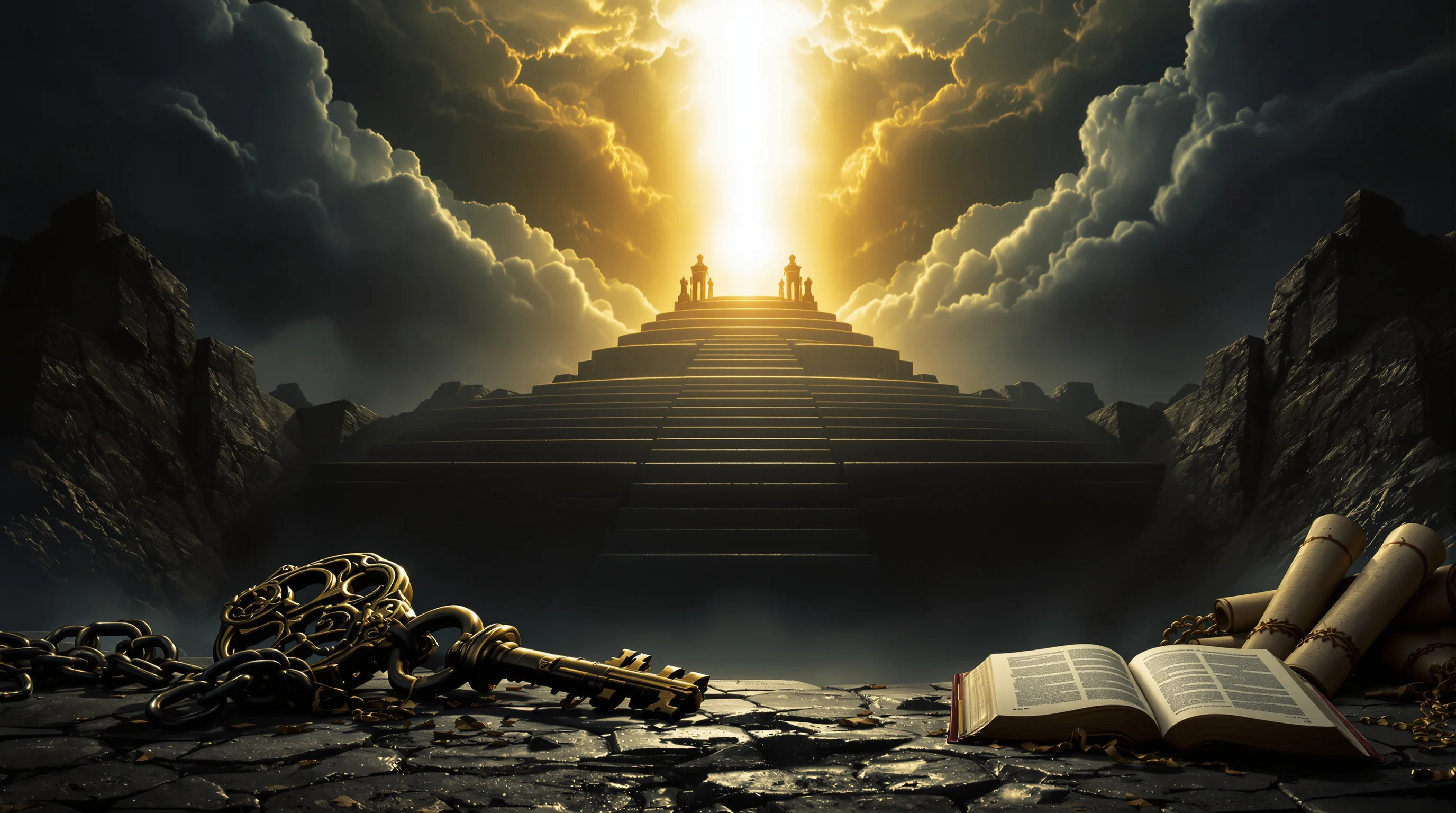
Revelation chapter 20 opens with an angel holding "the key of the bottomless pit and a great chain in his hand" (KJV Revelation 20:1). He seizes the dragon: "And he laid hold on the dragon, that old serpent, which is the Devil, and Satan, and bound him a thousand years" (KJV Revelation 20:2).
The binding has a stated purpose. It stops deception, answering Revelation 12:9, which calls Satan the one "which deceiveth the whole world" (KJV). The angel carries the key, but the authority behind it belongs to Christ himself: "I am he that liveth, and was dead; and, behold, I am alive for evermore, Amen; and have the keys of hell and of death" (KJV Revelation 1:18).
This vision works as both warning and comfort. Believers find comfort as well, since the chain rests in Christ's hands. Those who feel besieged by lies and pressure can know the accuser does not hold the final word.
Verse 4 shifts to thrones and judgment. Those who refused the beast's worship and mark "lived and reigned with Christ a thousand years" (KJV Revelation 20:4). The binding of Satan in Revelation 20 shows that the dragon who terrorized God's people in chapters 12 and 13 is handled with a single chain by heaven's authority. For more on what this binding means for believers today, see What Does It Mean That Satan Is Bound for a Thousand Years?
The First Resurrection and the Second Death
Verses 5-6 name the first resurrection and promise safety from the second death. Readers debate whether "they lived" in verse 4 describes bodily resurrection or the souls entering heavenly life and rule.
- Shared ground: all views agree the second death is final judgment, as verse 14 states plainly, "This is the second death" (KJV).
- Priestly role: "priests of God" echoes Exodus 19:6 and Revelation 1:6.
For a closer look at this debated phrase, see What Is the First Resurrection in Revelation 20?
Gog and Magog and the Great White Throne Judgment
Verses 7-9 describe a final rebellion. Satan is loosed to deceive "the nations which are in the four quarters of the earth, Gog and Magog" (KJV Revelation 20:8). The revolt ends as fast as it begins: "fire came down from God out of heaven, and devoured them" (KJV Revelation 20:9).
In Ezekiel 38-39, Gog is a leader and Magog a land under his rule. Verse 10 then closes the dragon's story: he joins "the beast and the false prophet" in the lake of fire (KJV). The beast and false prophet fell in chapter 19, the dragon falls here, and Death and Hades follow in verse 14, clearing the way for the new creation in chapters 21-22.
Verse 11 introduces the final scene: "And I saw a great white throne, and him that sat on it, from whose face the earth and the heaven fled away" (KJV Revelation 20:11). Revelation 20 settles the last battle in a single verse, showing that the outcome of the conflict between God and Satan was never in doubt. Explore this further in What Are Gog and Magog in Revelation? and What Is the Great White Throne Judgment?
The Books and the Book of Life
Two kinds of records appear at the throne. One tracks deeds; the other tracks names.
- The books: "the dead were judged out of those things which were written in the books, according to their works" (KJV Revelation 20:12).
- The Book of Life: "whosoever was not found written in the book of life was cast into the lake of fire" (KJV Revelation 20:15).
The scene echoes Daniel 7:10, where "the books were opened" before the Ancient of Days.
Understanding the Thousand Years in Its Original Context
The chapter contains three visions, each introduced by "And I saw": the binding (vv. 1-3), the reigning saints (vv. 4-6), and the final rebellion and judgment (vv. 7-15). Revelation often uses "I saw" to restate earlier scenes from new angles rather than to add a strict next step. Compare the battle language in 16:14-16, 19:19, and 20:8. This raises a real question among careful readers: does chapter 20 follow chapter 19 in sequence, or does it revisit the same conflict from a different vantage point?
Old Testament imagery runs throughout. "That old serpent" points back to Genesis 3. Thrones and judgment given to the saints echo Daniel 7:22. The imprisonment "in the pit" echoes Isaiah 24:21-22.
John wrote to seven churches in Roman Asia, traditionally dated to the 90s AD under Domitian, though some scholars favor a date near Nero's reign in the 60s. Pergamum is called the place "where Satan's seat is" (KJV Revelation 2:13). Trade guilds and the imperial cult pressed believers toward compromise, and beheading was a common Roman execution. For persecuted first-century believers, Revelation 20 promised that the martyrs who looked defeated are the ones who live and reign with Christ.
Three Views of the Millennium in Revelation Chapter 20
Revelation chapter 20 is the main source of the millennial debate. Three main positions have shaped Christian reading of this text.
Premillennialists hold that Christ returns, then reigns on earth for a literal thousand years. Dispensational premillennialists expect a distinct role for national Israel. Premillennialists themselves hold different views on rapture timing, and this article takes no side on that question.
Amillennialists read the thousand years as a symbol for the present church age, stretching between Christ's first and second comings.
The views differ on whether the thousand years is literal, whether "they lived" means bodily resurrection, and whether Satan's binding is total, given Peter's warning that "your adversary the devil, as a roaring lion, walketh about, seeking whom he may devour" (KJV 1 Peter 5:8). Revelation Explained: Verse by Verse reads this chapter as futurist, with Christ's reign following his return, while recognizing that faithful interpreters hold each of the three views. For a side-by-side comparison, see Premillennial, Amillennial, or Postmillennial? The Three Views of the Millennium.
Common Ground Across the Views
The views share more than their debates suggest.
- Christ's victory: Satan has already been defeated and his power to deceive is limited.
- Security: the faithful dead are secure in Christ.
- Shared future: all three expect a final judgment followed by the new creation in chapters 21-22.
All three also caution against setting dates for the thousand years, since the text does not invite that kind of calculation.
Why This Vision Matters
Believers who grieve their faithful dead can rest on the promise that the second death "hath no power" over those in the first resurrection (KJV Revelation 20:6). The chapter honors those who refused the beast's worship and calls readers to the same steady loyalty to Christ. The great white throne invites each reader to examine personal trust in Christ, while leaving the judgment of others to God's own book. Present trouble is real, but God's final verdict is already settled.
Conclusion
Revelation chapter 20 completes the defeat of evil. Satan is bound, then released, then thrown into the lake of fire. The faithful reign with Christ, and all the dead stand before the great white throne. If you still have questions about the thousand years, you're in good company, and there's no shame in holding them honestly. You can keep your view of the millennium with humility while trusting the chapter's promises with full confidence. Christ holds the keys, and you are safe in his hands. For a deeper verse-by-verse exploration, see Revelation Explained: Verse by Verse by Richard French, and for a fuller walk through what comes before and after this vision, explore The Millennial Kingdom: A Verse-by-Verse Study Guide.