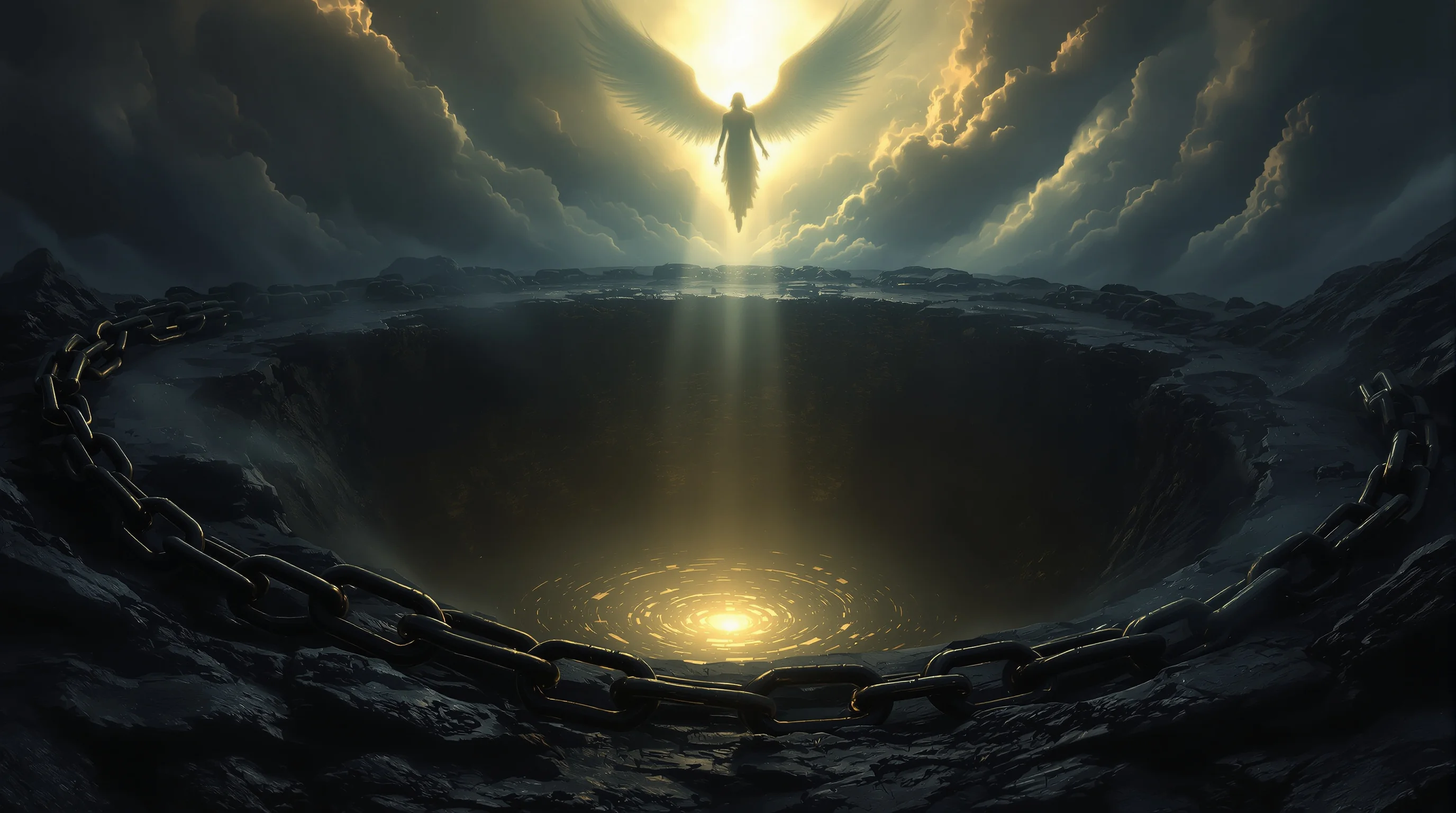
John watches an angel come down from heaven holding a key and a great chain, seize "that serpent of old," and lock him away in the abyss (Revelation 20:1-2). Every millennial debate in church history turns on what that chain actually does.
Most explanations jump straight into comparing amillennialism, premillennialism, and postmillennialism without first examining the binding itself, the detail Augustine addressed directly in City of God (Book XX), treating it as central to the whole debate. The idea of Satan bound for a thousand years specifically represents a stated limitation on one activity: deceiving the nations.
If you've felt lost trying to track the millennial debates, that confusion is common. Pastors and scholars have wrestled with this passage for centuries, and there's no shame in approaching it with honest questions. This article looks at what the text says about Satan bound for a thousand years, how each major view reads the chain, what "deceive the nations no more" limits, and what his eventual release signals about God's plan. The text itself gives us solid footing to start from.
Quick Answer: Satan bound for a thousand years means God decisively restrains the devil's power for a divinely set period, sealing him in the abyss so he cannot deceive the nations. The binding limits a specific activity, not Satan's existence, and it ends with a brief release before final judgment.
Definition: Satan bound for a thousand years in Revelation refers to a divinely imposed restraint on the devil's ability to deceive the nations, lasting for a fixed, divinely determined period before his temporary release and final defeat.
Key Scripture: "and cast him into the bottomless pit, and shut him up, and set a seal upon him, that he should deceive the nations no more, till the thousand years should be fulfilled" (KJV Revelation 20:3)
Context: Millennial positions differ over the timing and literalness of the thousand years, while agreeing the chain is held by God alone.
This vision assures suffering believers that evil's reach is measured, not limitless. It works by naming the exact activity God restricts, deceiving the nations, rather than claiming Satan vanishes from the world entirely. For readers facing pressure or confusion about prophecy, that distinction matters more than it might first appear. The sections below walk through the binding itself, the three millennial views that interpret it, and why the eventual release still points toward hope rather than fear.
Key Takeaways
Key Takeaways
- Forcible restraint: The Greek verb deo means to bind or fasten, showing Satan is seized by divine authority rather than withdrawing on his own.
- A stated purpose: The text limits one named activity, deceiving the nations (Revelation 20:3).
- Scope of debate: Osborne reads the binding as a literal post-return event, while Beale reads it as an inaugurated restriction.
- Temporary by design: The release in verse 7 proves the binding always had a fixed end.
- Pastoral purpose: Keener notes the first readers heard assurance that the powers behind Rome's pressure answer to God.
Key Evidence
- Textual detail: Revelation 20:1-3 stacks four verbs, seized, bound, cast, sealed, to show the restraint is deliberate and complete (Revelation 20:1-3).
- Scholarly support: Robert Mounce reads the sealing in verse 3 as a guarantee the restraint is total, not partial.
- Scholarly support: G.K. Beale argues the binding "represents a restriction of Satan's deceptive influence over the nations, allowing for the unhindered spread of the gospel."
- Scholarly support: Grant Osborne states "the binding of Satan must be a literal event following the parousia, inaugurating a literal reign."
- Historical pattern: Craig Keener notes that Revelation's first readers heard this passage as assurance that the powers behind Rome's pressure remained under God's timetable.

What the Text Says About Satan Bound for a Thousand Years
Revelation 20:1-3 describes an angel coming down "having the key of the bottomless pit and a great chain in his hand" (KJV Revelation 20:1). He lays hold of the dragon, binds him, casts him into the pit, shuts it, and sets a seal on it. Four actions stack on top of one another in a single sentence: seized, chained, imprisoned, sealed.
Satan bound for a thousand years describes four distinct actions of restraint compressed into one sentence, each performed by an angel acting under God's authority. That layering communicates thoroughness. This is not a loose containment but a deliberate, complete act of divine judgment.
In context, this scene follows immediately after the defeat of the beast and false prophet in Revelation 19:11-21, and it precedes the reign of the martyrs described in Revelation 20:4. The sequence matters. First the beast and false prophet fall, then the dragon himself is restrained. Readers familiar with Jewish apocalyptic writing would have recognized this as the completion of a judgment already underway.
The imagery also reaches back into the Old Testament. Isaiah promises that "the LORD with his hard and great and strong sword will punish leviathan, the fleeing serpent" (WEB Isaiah 27:1), and Genesis 3:15 foretells that the serpent's head would be crushed. Robert Mounce reads the sealing in verse 3 as a guarantee that the restraint is complete, not partial or symbolic in weakness.
The "Deceive the Nations No More" Qualifier
Verse 3 names exactly what the chain prevents, and the wording matters for every interpretation that follows.
- The limit stated: The Greek word planao means to lead astray or cause to wander, pointing to large-scale deception of nations.
- What is not said: The text never claims Satan ceases all activity, which is why warnings like 1 Peter 5:8 and Ephesians 6:12 remain in force.
- Why it matters: Every millennial view has to account for this narrow scope rather than a blanket removal of evil.
How the Three Millennial Views Read the Chain
Interpretive traditions diverge over when the chain is applied and how tightly it holds, even though they share the same text. Each reads the binding through a different lens on timing.
Amillennial readers hold that the binding began at the cross and resurrection, restraining Satan from preventing the gospel from reaching the nations during the present church age. G.K. Beale argues the binding "represents a restriction of Satan's deceptive influence over the nations, allowing for the unhindered spread of the gospel." Readers wanting the fuller case for the opposing view can see What Is Premillennialism? for contrast.
Premillennialists treat the binding as a future event tied to Christ's visible return, removing Satan's influence entirely during an earthly reign. Grant Osborne states that "the binding of Satan must be a literal event following the parousia, inaugurating a literal reign." Postmillennial interpreters see the chain tightening progressively as the gospel advances, producing a season of widespread Christian influence before Christ returns.
All three traditions agree the chain is real and God holds it. They differ over whether it was fastened at Calvary, is tightening through gospel advance, or will be fastened at Christ's return. What unites all three is the shared conviction that Satan's defeat is certain and his power is bounded by a higher authority, not by his own limits. It's okay if you find yourself drawn to one view while still respecting the others; faithful believers land in different places here.
The Number One Thousand
The length of the binding gets read two distinct ways among faithful interpreters.
- Symbolic reading: Fits Revelation's numerical patterns of sevens and twelves, signaling completeness and sufficiency rather than a literal count.
- Literal reading: Takes the figure as a measured historical period following Christ's return.
- Shared point: Either way, the duration is fixed by God and ends on His schedule, not Satan's.
Why Satan Bound for a Thousand Years Matters Today
Satan bound for a thousand years ends with a release: "Satan will be released from his prison and he will come out to deceive the nations" (WEB Revelation 20:7-8), gathering Gog and Magog for a final conflict. That release reveals the binding was purposeful and bounded from the start. It also exposes something sobering: the final rebellion shows that human sin needs more than Satan's absence to be cured.
Maybe you've wondered why God would release Satan at all after locking him away. The outcome that follows removes any doubt about where this is heading. The devil is "thrown into the lake of fire and sulfur... tormented day and night forever and ever" (WEB Revelation 20:10). The chain is a stage; the lake of fire is the conclusion. Satan's release confirms the chain was God's decision all along, lifted at His chosen moment for His purposes.
For believers today, this means living with genuine spiritual conflict alongside unshakable certainty about its outcome. Craig Keener notes that the first audience heard this passage as assurance that the powers behind their persecution remained on God's timetable, not loose in the world without limit. The healthiest reading avoids using this text to build anxious timelines or date-setting schemes; it serves assurance, not speculation. For a closer look at the abyss itself, see What Is the Bottomless Pit? Readers tracing how this imagery connects across Revelation's structure may find Revelation Explained: Verse by Verse helpful, since it examines each occurrence in its immediate context.
Why This Vision Matters
Evil operates on a leash held by God, with a stated scope and a fixed expiration. For believers facing pressure, deception, or discouragement, the binding guarantees that hostile spiritual power is measured and temporary. Revelation's hope rests here: the serpent of Genesis 3 is seized, sealed, and finally destroyed by the God who promised it.
Conclusion
Satan bound for a thousand years means God restrains the devil's capacity to deceive the nations for a divinely appointed period that ends in his permanent defeat. The millennial views differ over timing and literalness, yet they agree on the chain's source and the certainty of the outcome. You can live watchfully, without fear, knowing the deceiver's limits were set before he ever reached you. Whatever uncertainty you carry about the timing of these events, the God who holds the chain is the same God who holds you. For a deeper verse-by-verse exploration of Revelation's symbols and structure, see Revelation Explained: Verse by Verse by Richard French.
Sources
- Revelation 19:11-21
- Revelation 20:1-10
- Genesis 3:15
- Isaiah 27:1
- 1 Peter 5:8
- Ephesians 6:12
- Beale, G.K. The Book of Revelation: A Commentary on the Greek Text. New International Greek Testament Commentary. Eerdmans, 1999.
- Osborne, Grant R. Revelation. Baker Exegetical Commentary on the New Testament. Baker Academic, 2002.
- Keener, Craig S. Revelation. NIV Application Commentary. Zondervan, 2000.
- Mounce, Robert H. The Book of Revelation. New International Commentary on the New Testament. Eerdmans, 1997.
- Ladd, George Eldon. A Commentary on the Revelation of John. Eerdmans, 1972.