
Many readers feel puzzled when encountering John’s vision of the risen Christ holding seven stars in His right hand. This striking image appears at the beginning of Revelation’s seven letters, yet its meaning often gets lost in speculation about cosmic symbolism or abstract theology. The seven stars in Revelation are not mysterious celestial objects or distant symbols, but represent specific messengers with real accountability to the risen Lord.
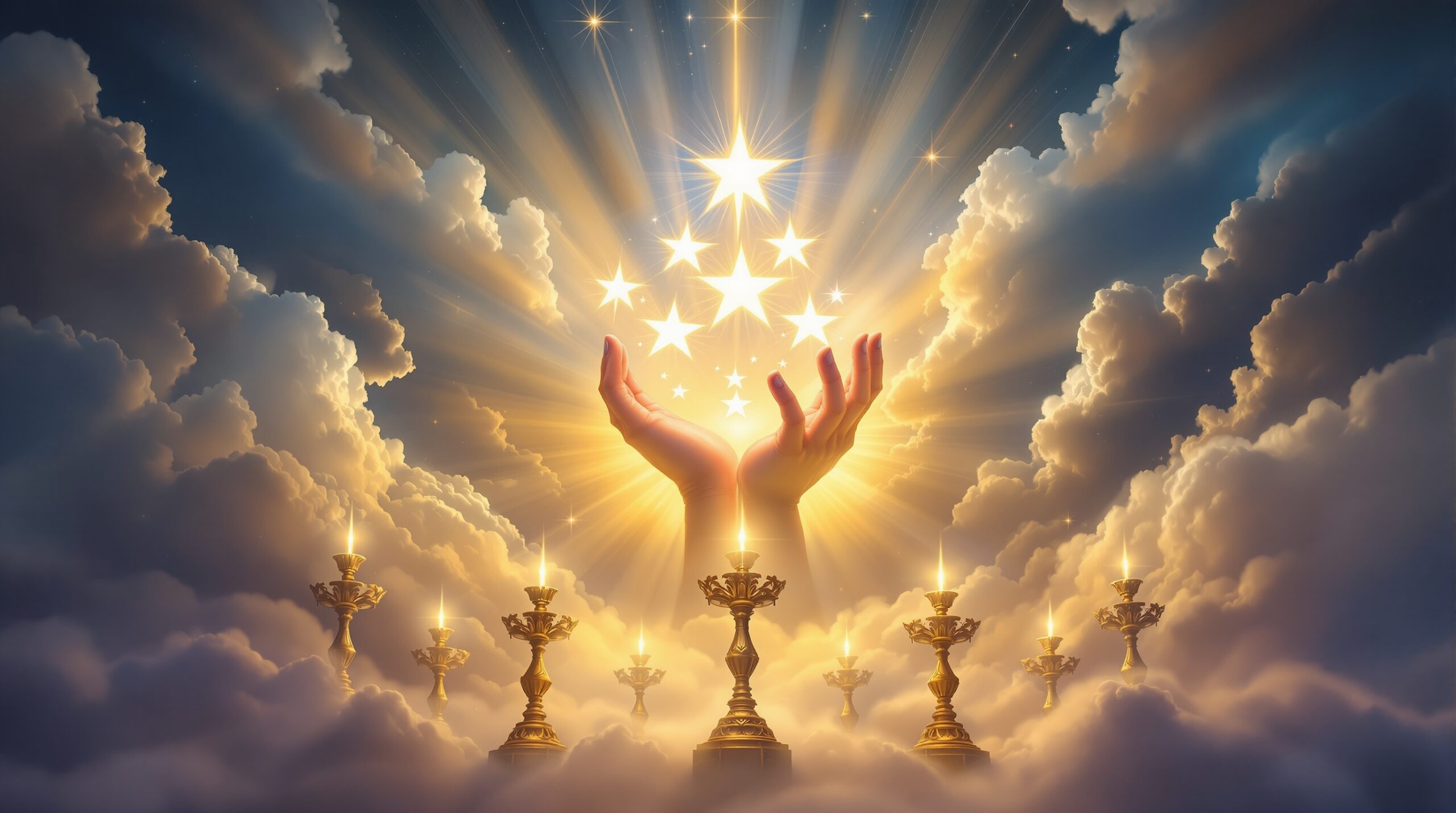
The seven stars in Revelation are not merely symbolic decorations in Christ’s vision. They specifically represent the messengers or leaders of the seven churches, held under His direct authority and protective care. Understanding their identity helps us grasp how Christ relates to church leadership throughout history.
Quick Answer: The seven stars in Revelation are the angels (or messengers) of the seven churches in Asia Minor, as Christ explicitly states in Revelation 1:20. Held in Christ’s right hand, they represent church leadership under His sovereign authority and protective care.
Definition: The seven stars in Revelation represent the messengers or leaders of the seven churches, held in Christ’s right hand as a demonstration of His sovereign oversight and protective authority over church leadership.
Key Scripture: “The mystery of the seven stars which you saw in My right hand, and the seven golden lampstands: The seven stars are the angels of the seven churches” (NKJV Revelation 1:20)
Context: This interpretation comes directly from Christ Himself, eliminating speculation about the stars’ identity.
Key Takeaways
- Christ's explicit identification: The seven stars represent the angels (messengers) of the seven churches addressed in Revelation 2-3
- Position of authority: Held in Christ's right hand, symbolizing His sovereign control and protective relationship with church leadership
- Direct accountability: Church leaders answer to Christ alone, not human hierarchies or cultural pressures
- Old Testament foundation: Stars symbolize righteous teachers and leaders who guide God's people (Daniel 12:3)
- Ongoing relevance: This vision affirms Christ's intimate involvement with every local congregation throughout history
What Does the Bible Say About the Seven Stars in Revelation?
Christ's explicit interpretation in Revelation 1:20 identifies the seven stars as "the angels of the seven churches." The Greek word angeloi means "messengers" and can refer to either heavenly beings or human representatives. This direct explanation from Jesus eliminates speculation about the stars' basic identity while introducing the question of whether these messengers are angelic guardians or human leaders.Revelation 1:16 describes Christ holding these stars “in His right hand”—the biblical position of power, honor, and protection. Scholars such as G.K. Beale and Grant Osborne note that this imagery establishes Christ’s sovereign control over church leadership, whether human or angelic. The right hand consistently represents authority throughout Scripture, as seen in Psalm 110:1 where the Messiah sits at God’s right hand.
The stars appear within the opening vision where Christ stands among seven golden lampstands (the seven churches). Each of the seven letters in Revelation 2-3 is addressed “to the angel of the church in…” demonstrating their role as recipients of Christ’s messages. The seven stars in Revelation represent church leadership held under Christ’s sovereign authority—He alone determines their position, guards their calling, and holds them accountable for their stewardship.
Most scholars interpret these angels as human church leaders (pastors or overseers) based on the practical, pastoral content of the letters requiring human recipients capable of repentance and action. Robert Mounce and Craig Keener argue that the alternative view sees them as guardian angels assigned to each congregation, though this interpretation faces challenges explaining why heavenly beings would need exhortations to repent.
The Old Testament Background
Daniel 12:3 connects stars with "those who are wise" and "those who turn many to righteousness," establishing the conceptual link between stars and spiritual leaders. Job 38:7 uses "morning stars" to represent divine beings worshiping God. This dual symbolism explains why interpreters debate whether Revelation's angels are heavenly or human.Understanding the Vision's Context and Significance
John receives this vision while exiled on Patmos "for the word of God and for the testimony of Jesus" (NKJV Revelation 1:9). The vision follows a classic theophany pattern, echoing Old Testament divine appearances like Daniel 7:9-14 and Ezekiel 1:26-28. Christ's appearance includes white hair, eyes like flame, feet like brass, and a face shining like the sun—imagery establishing His divine identity and supreme authority.The seven churches existed in Roman Asia (modern western Turkey) during a period of increasing persecution under Domitian (approximately A.D. 95). These congregations faced pressure to participate in emperor worship, compromise with pagan culture, and accommodate false teaching for economic survival. David Aune observes in his commentary that the practical content of these letters suggests they addressed real pastoral situations requiring human leadership response.
The image of Christ holding the stars directly countered Roman imperial iconography—emperors were depicted on coins holding symbols of power in their right hands. For the original audience, seeing Christ hold their leaders in His hand provided significant assurance: their true King maintained authority despite Roman supremacy. The number seven represents completeness in biblical symbolism—these seven actual churches also represent the complete church across all times and places.
Christ positions Himself among the churches while holding their leaders in His hand, demonstrating both His intimate presence with His people and His transcendent authority over their oversight. This dual positioning shows that Jesus remains accessible to His congregations while maintaining sovereign control over their spiritual direction.
Why the Seven Stars Matter for Christians Today
This vision establishes that church leaders derive their authority from Christ alone, not human appointment, cultural approval, or institutional hierarchy. For pastors and church leaders, the stars' position in Christ's hand provides both comfort and accountability—no earthly power can remove what Christ guards, yet leaders answer directly to Him for their faithfulness. This reality offers courage when facing opposition while demanding integrity in ministry.For congregations, members should recognize that faithful leaders represent Christ’s voice, making their teaching worthy of careful attention rather than casual dismissal. The letters to the seven churches evaluate leadership based on doctrinal faithfulness, moral purity, and spiritual vitality—not numerical growth, cultural influence, or organizational success. Ben Witherington III emphasizes that these standards remain constant across all church ages.
Christ’s warnings to churches like Ephesus (lost first love), Sardis (spiritual death), and Laodicea (lukewarm compromise) demonstrate that He will remove lampstands and their angels when they abandon their calling. The repeated phrase “He who has an ear, let him hear what the Spirit says to the churches” calls individual believers to personal response, not merely corporate acknowledgment.
This vision assures believers that Christ has not abandoned His church despite apparent weakness or persecution—He walks among the lampstands and knows each situation intimately. The seven stars in Revelation reveal that Christ maintains direct oversight of His church through leaders who serve under His hand, providing courage for faithful ministry and accountability that prevents both leadership tyranny and congregational rebellion.
For readers wanting to trace how this authority structure develops throughout Revelation’s narrative, Revelation Explained: Verse by Verse examines each occurrence in its immediate context.
Why This Vision Matters
The seven stars matter because they expose the illusion of human autonomy in church leadership. No pastor, elder, or spiritual authority operates independently of Christ's oversight. This vision reminds believers that faithful leadership flows from divine calling, not personal ambition or institutional politics. Present circumstances may challenge church leaders, but Christ's authority over them remains absolute.Conclusion
The seven stars in Revelation represent the messengers or leaders of the seven churches, held in Christ's right hand as a demonstration of His sovereign authority and protective care. This powerful image assured first-century believers facing persecution that their true King had not abandoned them, and it continues to encourage Christians today. Church leaders serve under Christ's direct authority, deriving their calling from His hand rather than human systems.Congregations can trust that Christ maintains intimate involvement with their spiritual welfare, knowing their works and holding their leaders accountable. Whether the angels are heavenly guardians or human pastors, the theological truth remains identical: Christ alone holds ultimate authority over His church. For a deeper verse-by-verse exploration of Revelation’s symbols and their meaning, see Revelation Explained: Verse by Verse by Richard French.
Sources
- Revelation 1:9-20 (the inaugural vision)
- Revelation 2:1-3:22 (the seven letters)
- Daniel 12:3 (stars as righteous teachers)
- Daniel 7:9-14 (Son of Man theophany)
- Zechariah 4:1-14 (lampstand vision)
- Judges 5:20 (stars fighting for God's people)
- Job 38:7 (morning stars as divine beings)
- Exodus 25:31-40 (tabernacle lampstand)
- Beale, G.K. The Book of Revelation: A Commentary on the Greek Text. New International Greek Testament Commentary. Eerdmans, 1999.
- Osborne, Grant R. Revelation: Baker Exegetical Commentary on the New Testament. Baker Academic, 2002.
- Mounce, Robert H. The Book of Revelation. New International Commentary on the New Testament. Eerdmans, 1997.
- Keener, Craig S. Revelation: The NIV Application Commentary. Zondervan, 2000.
- Johnson, Dennis E. Triumph of the Lamb: A Commentary on Revelation. P&R Publishing, 2001.
- Theological Dictionary of the New Testament (TDNT), "angelos" entry
- Louw-Nida Greek-English Lexicon of the New Testament
- Ancient Jewish apocalyptic literature (1 Enoch, Jubilees) for comparative angel imagery