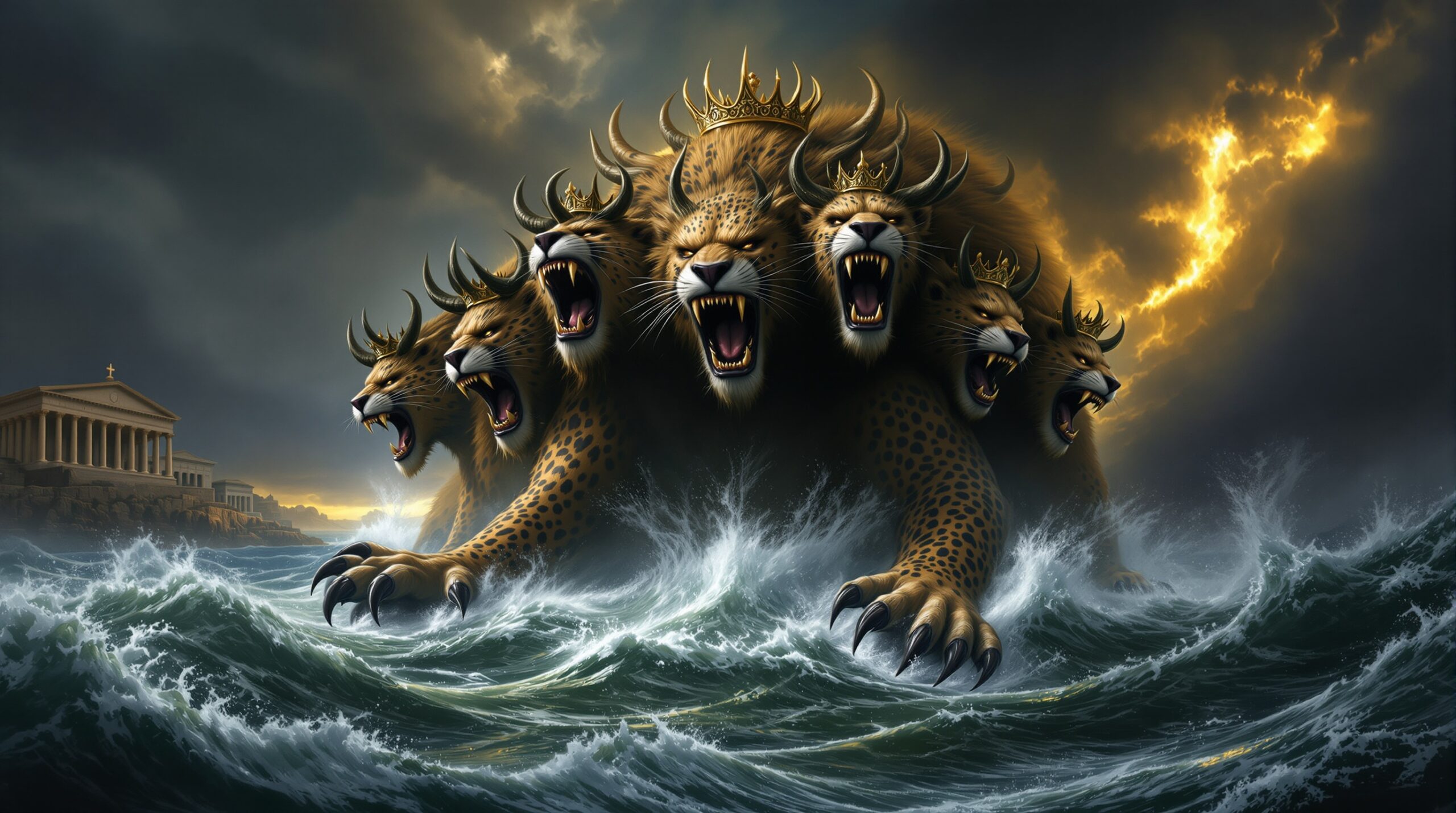
The beast of Revelation stands as one of Scripture’s most striking symbols of opposition to God. In Revelation 13, John describes a terrifying creature rising from the sea—a beast with seven heads, ten horns, and blasphemous names—that demands worship and controls all economic activity. For nearly 2,000 years, Christians have wrestled with this image, particularly as believers have faced persecution from governments demanding absolute allegiance. This article examines what Scripture reveals about the beast of Revelation, its connection to Old Testament prophecy, and what this symbol means for Christians facing pressure to compromise their faith.
Quick Answer: The beast of Revelation symbolizes political-religious power that demands worship belonging only to God and persecutes His people. Drawing from Daniel’s visions, the beast represents Satan’s earthly kingdom—manifested in Rome for John’s original audience, recurring throughout history in oppressive regimes, and culminating in a final Antichrist before Christ’s return.
Key Scripture: “Then I saw a beast rising up out of the sea, having seven heads and ten horns, and on his horns ten crowns, and on his heads a blasphemous name” (NKJV Revelation 13:1)
Context: This creature embodies all anti-God empires throughout history, empowered by Satan to wage war against the saints.
- The beast from the sea represents political power making blasphemous divine claims and persecuting believers
- Daniel's four-beast vision provides the Old Testament foundation for understanding Revelation's composite creature
- The second beast (false prophet) enforces worship of the first beast through religious deception
- The mark of the beast controls economic participation, forcing allegiance to systems opposing God
- Christ's victory over the beast is certain, providing hope for suffering Christians
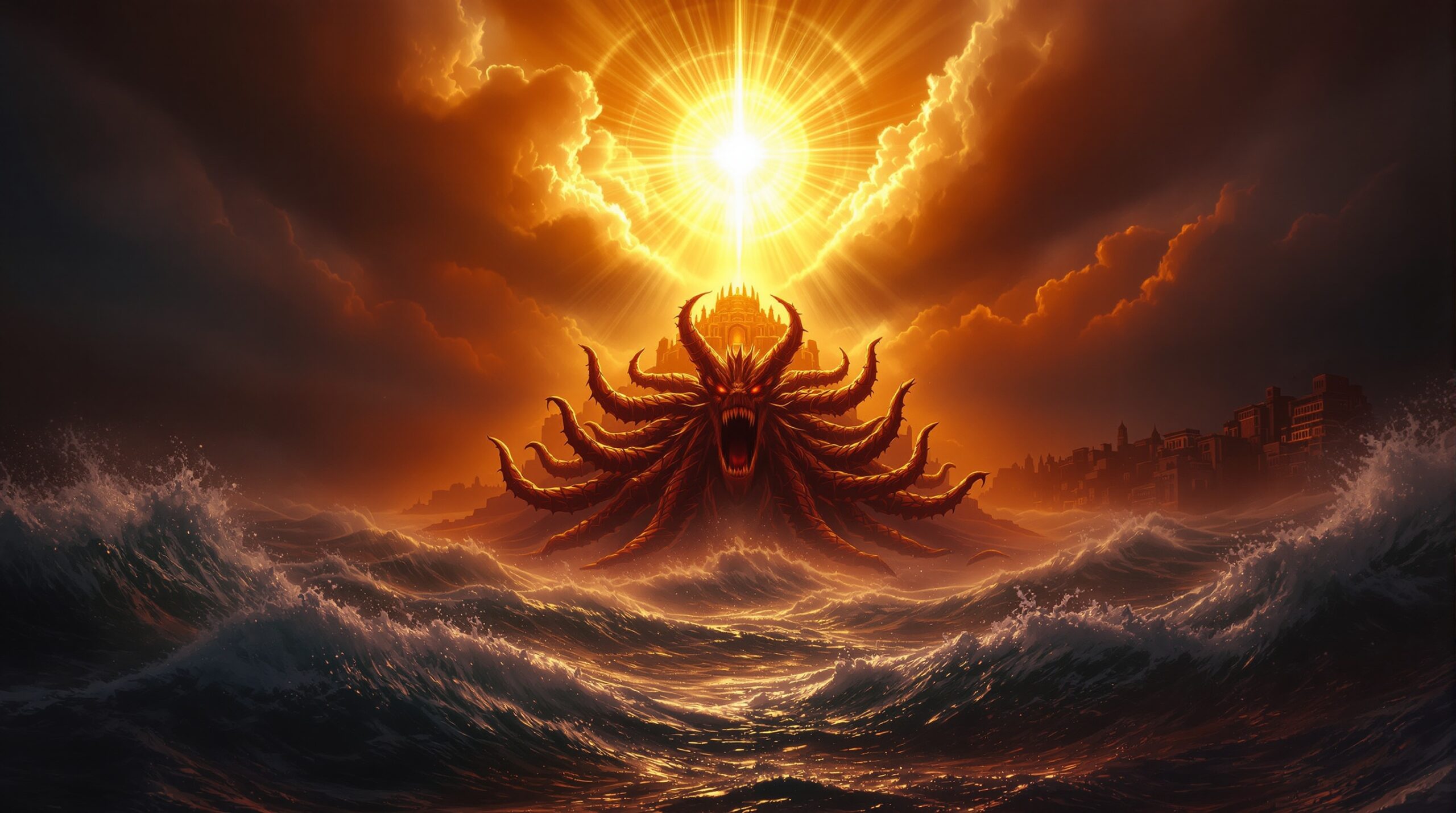
The Beast of Revelation from the Sea in Revelation 13
John's vision presents a creature with seven heads, ten horns, ten crowns, and blasphemous names covering its body. The Greek word thērion means "wild beast" or "dangerous animal," emphasizing its threatening, untamed nature. This is no domesticated creature. It represents raw, predatory power.The dragon gives this beast “his power, his throne, and great authority” (NKJV Revelation 13:2). Satan operates through the beast as his earthly representative, creating an unholy trinity: the dragon (Satan), the beast (political power), and the false prophet (religious deception). This counterfeit mirrors the true Trinity, with each member glorifying and empowering the others.
The beast’s central offense appears in its demand for worship. “All who dwell on the earth will worship him, whose names have not been written in the Book of Life of the Lamb slain from the foundation of the world” (NKJV Revelation 13:8). The Greek word proskyneō means to prostrate oneself in worship, an act reserved exclusively for God. This divides humanity into two groups: those who capitulate and those sealed in the Lamb’s book.
Notice the beast’s limited authority: 42 months (NKJV Revelation 13:5). Divine sovereignty restricts the beast’s persecution. God sets boundaries even on evil’s apparent triumph. The beast of Revelation operates as Satan’s earthly representative, wielding delegated authority that mimics Christ’s relationship to the Father, creating a counterfeit trinity that demands the worship belonging only to God.
Connection to Daniel's Vision
Daniel 7 presents four beasts representing successive kingdoms: a lion (Babylon), a bear (Medo-Persia), a leopard (Greece), and a terrifying fourth beast (Rome) with ten horns. John's vision deliberately combines all four Danielic beasts. He describes his creature as leopard-like, with bear's feet and a lion's mouth (NKJV Revelation 13:2). This suggests the beast of Revelation culminates all anti-God empires throughout history rather than representing a single kingdom.The ten horns appear in both Daniel 7:7, 24 and Revelation 13:1, 17:12, connecting to kings or kingdoms under the beast’s authority. Daniel’s “time, times, and half a time” (three and a half years) equals Revelation’s “forty-two months.” Both prophets describe blasphemous claims and persecution of saints for divinely limited periods.
For a detailed examination of how these Old Testament connections develop throughout Revelation’s narrative, see the chapter-by-chapter analysis in Revelation Explained: Verse by Verse.
The Second Beast and the Mark
A second beast rises from the earth with two horns like a lamb but speaks like a dragon (NKJV Revelation 13:11). This creature functions as the false prophet, performing signs that deceive earth's inhabitants and cause people to worship the first beast. Just as the Holy Spirit glorifies Christ, this false prophet directs worship to the beast, completing the unholy trinity.The false prophet creates an image of the beast that speaks and causes those refusing worship to be killed (NKJV Revelation 13:15). This scenario would have resonated with John’s original audience, who knew stories of Nebuchadnezzar’s golden image and the fiery furnace from Daniel’s prophecy.
The mark (Greek charagma meaning “stamp” or “impress”) appears on the right hand or forehead (NKJV Revelation 13:16). “No one may buy or sell except one who has the mark or the name of the beast, or the number of his name” (NKJV Revelation 13:17). This parodies God’s seal on believers’ foreheads, forcing visible identification with the beast’s system.
For John’s churches in Asia Minor, this imagery reflected their present reality. Roman emperor worship permeated civic life. Trade guilds required members to attend feasts honoring pagan deities and Caesar. Christians refusing such participation faced economic exclusion, an early form of the mark preventing buying and selling.
The number 666 appears as “the number of a man” (NKJV Revelation 13:18). Using Hebrew gematria (where letters have numerical values), “Nero Caesar” (Nrwn Qsr) totals 666. Symbolically, six falls short of seven, the number of completeness. Triple sixes represent perpetual human failure despite divine pretensions.
The mark of the beast represents systematic pressure to participate in anti-God systems through economic and social control, forcing a choice between material security through conformity and costly faithfulness to Christ.
Understanding the Beast's Identity
John's original audience would have recognized unmistakable connections to the Roman Empire and Caesar worship. Emperor Domitian demanded to be addressed as "Dominus et Deus" (Lord and God), a direct challenge to the Christian confession "Jesus is Lord." The imperial cult dominated Asia Minor through temples, priests, and festivals honoring Caesar throughout the seven churches' cities.Persecution was not theoretical. John wrote from exile on Patmos “for the word of God and for the testimony of Jesus Christ” (NKJV Revelation 1:9). Antipas had been martyred in Pergamum, where “Satan’s throne” dwelt (NKJV Revelation 2:13), likely referring to the prominent emperor worship there.
Yet the beast imagery transcends Rome. Throughout church history, political-religious powers have demanded worship and persecuted saints. Many Reformation scholars identified the beast with aspects of the medieval papacy. Others see the beast as a recurring pattern appearing whenever governments claim absolute authority over conscience.
Many interpreters see the beast of Revelation fulfilled in a future Antichrist before Christ’s return. Second Thessalonians describes “the man of lawlessness” who “sits as God in the temple of God, showing himself that he is God” (NKJV 2 Thessalonians 2:4). This aligns with the beast’s blasphemous self-worship and global authority described in Revelation’s prophecy.
Despite interpretive differences, scholars agree on fundamentals: the beast represents political power opposing God, demands exclusive worship, persecutes believers, wields Satan’s authority, and faces certain defeat. Revelation 19:20 describes the beast and false prophet cast alive into the lake of fire. Their destruction is assured.
Whether identifying Rome, powers throughout church history, or a future Antichrist, the beast consistently represents political authority making blasphemous divine claims and systematically persecuting those who refuse to compromise their allegiance to Christ.
Why the Beast Matters for Christians Today
Understanding the beast of Revelation equips believers to discern when powers demand the allegiance belonging only to God. The question isn't primarily about decoding future events but recognizing present pressures. Every generation faces "beast-like" systems requiring compromise for economic participation or governments claiming absolute authority over conscience.Modern applications appear when employers demand ethical violations, when professional advancement requires abandoning biblical convictions, or when social acceptance demands celebrating what contradicts Scripture. The mark’s significance relates not to technology but to enforced participation in systems opposing God.
Exclusive worship of God and the Lamb constitutes primary resistance to the beast’s claims. Weekly gathered worship where Christians confess “Jesus is Lord” embodies faithful resistance. Living daily under Christ’s lordship in workplace, family, and civic life demonstrates that no earthly power merits our allegiance.
Avoid common misapplications: not every troubling political leader is the Antichrist; technology advances aren’t inherently the mark; beast imagery shouldn’t become partisan rhetoric. Instead, develop discernment through Scripture and dependence on the Spirit.
Revelation 13:10 concludes the first beast description with, “Here is the patience and the faith of the saints.” Understanding the beast strengthens endurance rather than enabling escape from pressure. The beast’s authority remains limited to 42 months. Persecution fits God’s prophetic plan and will end.
The beast passages call believers to recognize where they face pressure to bear visible identification with anti-God systems and to choose costly loyalty to Christ, trusting that present suffering is temporary and God’s justice will prevail.
Conclusion
The beast of Revelation represents political-religious power throughout history that demands worship belonging only to God, persecutes His people, and controls economic life. For John's audience, this meant Rome and Caesar worship, but the pattern recurs in oppressive regimes of every age. The beast's connection to Daniel's visions, its relationship to the false prophet, and the mark's economic control reveal a consistent pattern: Satan's kingdom systematically pressures believers to compromise.Yet the beast’s defeat is certain. Christ’s victory is assured. Understanding this symbol equips Christians not for fearful speculation but for faithful witness. When powers demand what belongs only to God, believers must recognize the choice, count the cost, and remain loyal to the Lamb.
For a deeper verse-by-verse exploration of Revelation’s symbols and structure, see Revelation Explained: Verse by Verse by Richard French.