The white horse appears twice in Revelation—once in chapter 6 as the first seal judgment, and again in chapter 19 bearing the victorious Christ—but scholars have debated the first rider's identity for centuries. Understanding this symbol matters because it shapes how we read Revelation's message about God's sovereignty over history and the ultimate victory of Christ. The white horse in Revelation is not merely symbolic of victory in general. It specifically represents divine conquest operating under God's sovereign control, whether as judgment or final triumph. This article examines what Scripture reveals about the white horse in Revelation, the context surrounding these visions, and why this imagery matters for Christians today.
Quick Answer: The white horse in Revelation appears twice with different meanings. In Revelation 6:2, the rider represents conquest or judgment released by Christ's opening of the first seal, with scholars debating whether this is Christ Himself, Antichrist, or military conquest. In Revelation 19:11, the rider is clearly Jesus Christ returning as conquering King. Definition: The white horse in Revelation symbolizes divine conquest and victory, appearing first as judgment authorized by the Lamb and later bearing Christ Himself in final triumph over all earthly powers. Key Scripture: "Now I saw heaven opened, and behold, a white horse. And He who sat on him was called Faithful and True, and in righteousness He judges and makes war" (NKJV Revelation 19:11) Context: The Lamb who opens the seals controls both visions, revealing God's sovereignty over all historical forces.
These white horse visions function as both warning and comfort. They warn that all earthly powers operate under divine authority and face certain judgment, while they comfort believers that God controls history's unfolding toward His purposes. The sections that follow will examine the first rider's contested identity, Christ's clear return in chapter 19, and what these visions mean for believers navigating uncertain times today.
Key Takeaways
Two white horses: Revelation 6:2 introduces judgment; Revelation 19:11 reveals Christ's victorious return
Divine sovereignty: The Lamb opens each seal, showing God controls even judgment and conquest
Different crowns: The first rider receives a stephanos (victor's wreath); Christ wears diadēmata (royal crowns)
Scholarly debate: Interpreters identify the first rider as Christ, Antichrist, or conquest itself
Pastoral purpose: These visions encouraged persecuted believers that God governs history toward certain victory
The White Horse in Revelation 6:2
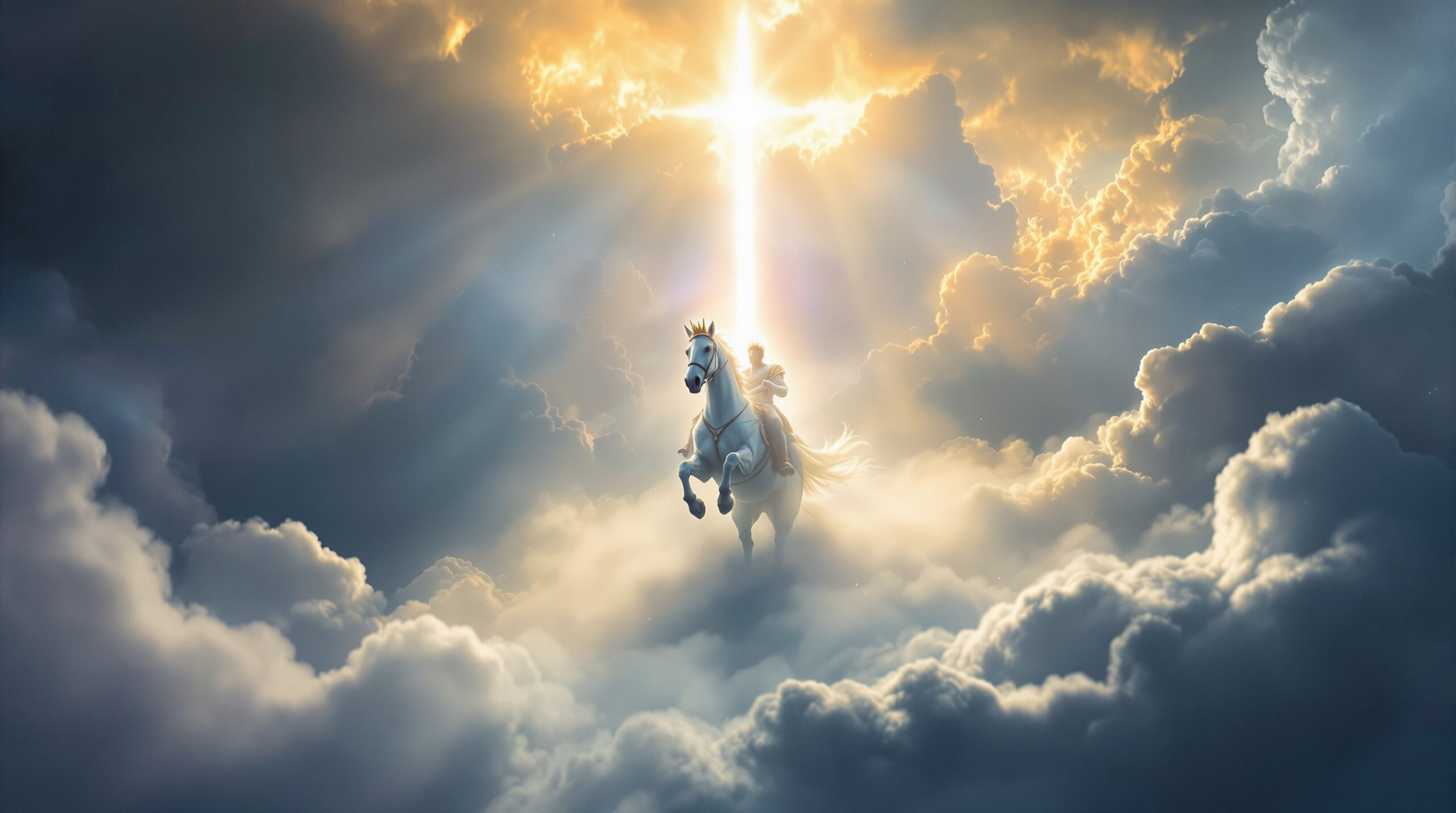
"And I looked, and behold, a white horse. He who sat on it had a bow; and a crown was given to him, and he went out conquering and to conquer" (NKJV Revelation 6:1-2). This passage introduces the first of four horsemen released when the Lamb opens the seal judgments. Context tells us this rider operates under divine authorization—Christ Himself breaks the seal that releases this figure. The rider carries a bow and receives a stephanos, meaning "victor's crown" or "wreath." The passive voice "was given" indicates delegated authority from an external source. White color throughout Revelation typically symbolizes victory, purity, and divine glory, appearing consistently with Christ and His followers in passages like Revelation 1:14, 3:4-5, 7:9, and 19:8. The white horse in Revelation 6:2 appears as the first of four horsemen released when Christ opens the seal judgments, representing conquest that operates under divine authorization. Three main interpretations exist among scholars. Some identify the rider as Christ going forth in gospel conquest, emphasizing the white color and conquering language consistent with Christ elsewhere in Revelation. Others, like Grant Osborne, argue the first rider is best understood as depicting the Antichrist, who will come promising peace but bringing conquest and deception. A third view, represented by G.K. Beale, sees the rider as representing military conquest itself: "The first horseman represents the preliminary stage of the final battle and the persecution of the church."
The Four Horsemen as a Unit
The white horse cannot be understood in isolation—it begins a sequence of four riders bringing comprehensive judgment.
Red horse: Takes peace from earth, bringing warfare (6:3-4)
Black horse: Economic upheaval and famine (6:5-6)
Pale horse: Death itself, given authority over a fourth of the earth (6:7-8)
Christ's Return on the White Horse in Revelation 19
"Now I saw heaven opened, and behold, a white horse. And He who sat on him was called Faithful and True, and in righteousness He judges and makes war. His eyes were like a flame of fire, and on His head were many crowns" (NKJV Revelation 19:11-12). This passage provides clear identification—the rider is explicitly named "Faithful and True" and "The Word of God," unmistakably Jesus Christ returning in final victory. Distinctions from the first rider are deliberate and significant. Christ wears diadēmata (royal crowns) rather than the single victor's wreath. His weapon is a sharp sword proceeding from His mouth—His spoken word—not a bow. He leads heavenly armies also mounted on white horses and clothed in fine linen. In Revelation 19:11, the white horse clearly bears Jesus Christ returning as conquering King, distinguished from the first rider by explicit identification, royal crowns, and the sword of His word. Robert Mounce notes the intentional contrast: "The clearly identified Christ on the white horse in 19:11 is deliberate and instructive." This vision fulfills promises made to overcomers throughout Revelation—Christ who conquered through the cross now conquers in final judgment. His blood-dipped robe recalls both His sacrifice and coming judgment. All earthly powers, symbolized by the beast and false prophet, are defeated by Christ's word alone. For readers wanting to trace how this victory imagery develops across Revelation's narrative, Revelation Explained: Verse by Verse examines each occurrence in its immediate context.
Old Testament Background
Understanding Zechariah's vision illuminates Revelation's white horse imagery.
Zechariah 1:8-11; 6:1-8: Four colored horses patrol the earth as divine agents executing God's purposes
Divine sovereignty: The horses represent God's eyes ranging throughout the earth
Judgment framework: Not chaos unleashed, but God's active governance of history
Why the White Horse Matters for Christians Today
The white horse passages reveal God's sovereignty over all historical forces. Whether the first rider represents Christ, Antichrist, or conquest itself, the text tells us the Lamb opens each seal. No military power, political system, or conquering force operates outside divine control and purposes. This truth provides comfort when world events seem chaotic or threatening—God has not lost control of history, and His purposes move toward certain victory. Original audiences faced intense pressure to compromise their faith for economic security and social acceptance under Roman persecution. These visions revealed that apparent powers were temporary and under divine judgment. Christians today facing pressure to compromise biblical truth for cultural acceptance, economic advantage, or political favor can find similar encouragement. Faithful witness matters more than immediate comfort, and God vindicates His people even when vindication isn't immediate. These passages also warn against placing ultimate hope in earthly powers or military might. All earthly kingdoms and conquering forces ultimately fall under divine judgment. Christians should avoid both fearing earthly powers too much and trusting them too much. Only Christ's kingdom endures. Certainty of Christ's return on the white horse guarantees vindication and justice for believers enduring difficulty while containing sobering warning for those outside Christ about coming judgment. The white horse ultimately points us to worship the One who rides in final victory, strengthening us to remain faithful until He comes. Common misapplications include using these passages to predict specific timelines, reading current political situations as clear fulfillments, or allowing fear to dominate response. The overall message to believers is hope and encouragement in God's sovereign purposes.
Why This Vision Matters
The white horse in Revelation reveals that God governs all historical forces—conquest, judgment, and ultimate victory—toward His purposes. For persecuted believers in John's day and Christians facing pressure today, this vision provides assurance: earthly powers operate only by divine permission and face certain judgment, while Christ's victorious return guarantees justice and restoration for His faithful people.
Continue Through the Seals
The white horse is only the first of four. As the Lamb keeps breaking the seals, the red horse of war rides out to take peace from the earth, the black horse of famine follows with its scales of scarcity, and the pale horse of death comes last, the only rider named. Seen side by side in the full four-horsemen sequence, the pattern is unmistakable — conquest gives way to conflict, conflict to hunger, hunger to death — and not one of them rides beyond the authority of the Lamb who opened the seal.
Conclusion
The white horse in Revelation carries profound meaning across both appearances. In chapter 6, it introduces divine judgments upon the earth, reminding us that even conquest and suffering operate under God's sovereign control. In chapter 19, it bears Christ Himself returning in final victory, fulfilling every promise made to His faithful people. Whether facing persecution like John's original audience or contemporary pressures to compromise faith, Christians can take courage: the Lamb who was slain controls history's unfolding, and His victory is certain. For deeper verse-by-verse exploration of Revelation's symbols and their meaning, see Revelation Explained: Verse by Verse by Richard French.
Sources
Revelation 6:1-8 (the four horsemen and seal judgments)
Revelation 19:11-21 (Christ's return on the white horse)
Revelation 4-5 (the throne room scene and the worthy Lamb)
Zechariah 1:8-11; 6:1-8 (four horses as divine agents)
Leviticus 26; Deuteronomy 28 (covenant curses)
Beale, G.K. The Book of Revelation: A Commentary on the Greek Text (New International Greek Testament Commentary). Eerdmans, 1999.
Osborne, Grant R. Revelation (Baker Exegetical Commentary on the New Testament). Baker Academic, 2002.
Mounce, Robert H. The Book of Revelation (New International Commentary on the New Testament). Eerdmans, 1997.
Keener, Craig S. Revelation (NIV Application Commentary). Zondervan, 2000.
Johnson, Dennis E. Triumph of the Lamb: A Commentary on Revelation. P&R Publishing, 2001.