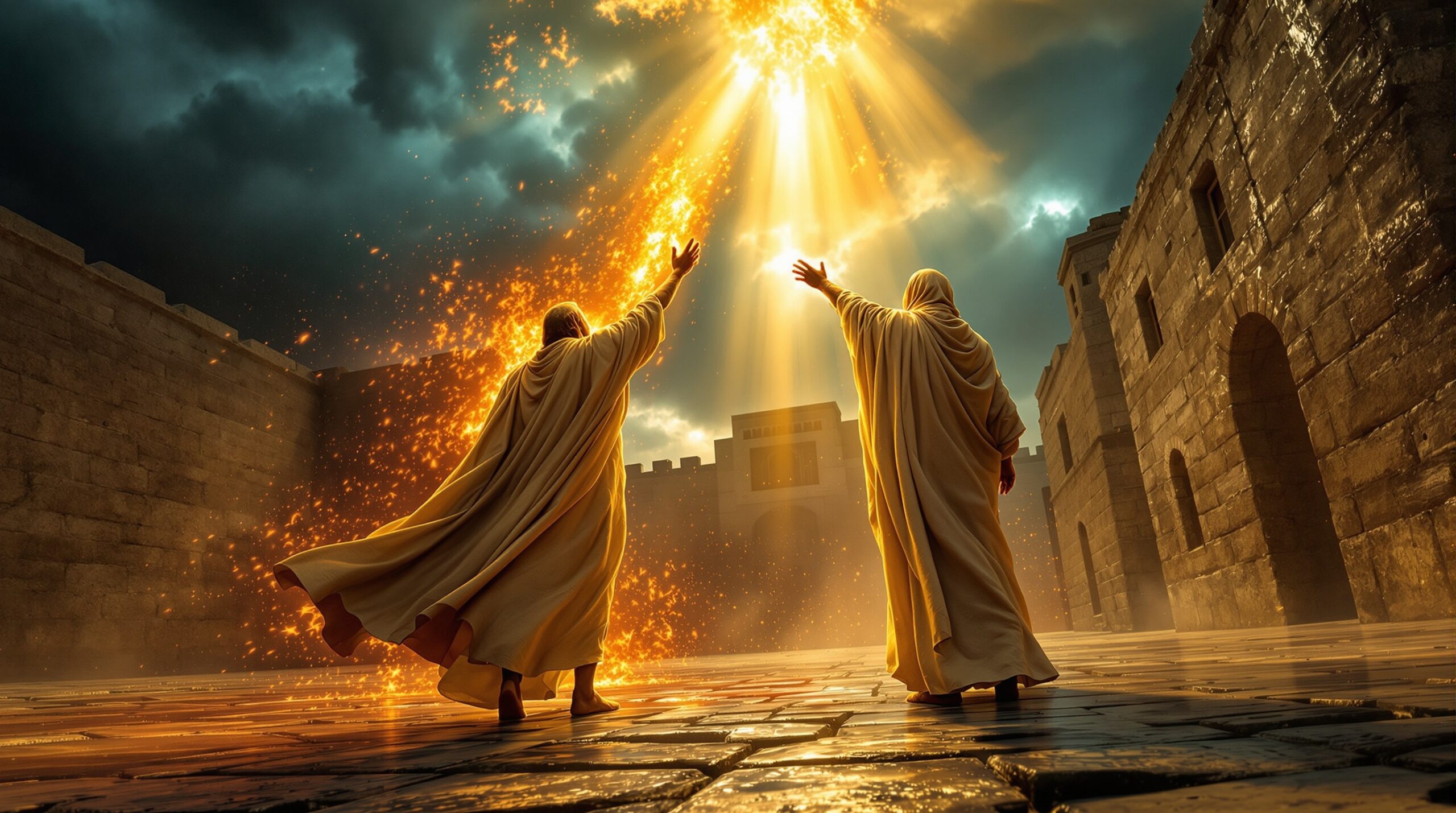
In Revelation 11, two mysterious figures appear during history’s darkest hour. They prophesy for 1,260 days, perform miracles like Moses and Elijah, face death at the beast’s hand, and rise again while the world watches. These two witnesses in Revelation have sparked centuries of debate about their identity. Yet their purpose remains clear: they demonstrate God’s faithful testimony when opposition reaches its peak. This article examines what Scripture reveals about their ministry, message, possible identities, death and resurrection, and what they mean for believers today.
Quick Answer: The two witnesses of Revelation 11:3-13 are prophetic figures empowered by God to testify for 1,260 days during intense tribulation. They perform miracles like Moses and Elijah before being martyred and resurrected, representing God’s unfailing witness to a rebellious world.
Key Scripture: “And I will give power to my two witnesses, and they will prophesy one thousand two hundred and sixty days, clothed in sackcloth” (NKJV Revelation 11:3)
Context: Their ministry demonstrates that God maintains faithful testimony even when the world violently opposes truth.
- Divine commission: God appoints the two witnesses in Revelation for a specific 1,260-day prophetic ministry during tribulation
- Miraculous authority: Their powers mirror Moses (plagues, water to blood) and Elijah (drought), authenticating their divine message
- Protected testimony: No enemy can harm them until their God-appointed work is complete
- Martyrdom and resurrection: The beast kills them after their testimony finishes, but God vindicates them through resurrection after three-and-a-half days
- Prophetic significance: They represent God's indestructible testimony that triumphs over all opposition
The Ministry and Message of the Two Witnesses in Revelation
The two witnesses receive direct divine commissioning when God declares "I will give power to my two witnesses" (NKJV Revelation 11:3). This phrase establishes that God initiates and empowers their prophetic work. Their ministry spans 1,260 days (equivalent to 42 months or three-and-a-half years). This specific timeframe echoes Daniel's "time, times, and half a time" of persecution. This limited period demonstrates God's sovereign control over tribulation's duration.Clothed in sackcloth, these witnesses embody their message of repentance and judgment. Sackcloth symbolized mourning over sin in Hebrew culture. It marks them as counter-cultural prophets who lament rebellion rather than celebrate it. Their miraculous authority authenticates their divine message. Revelation 11:5-6 describes fire proceeding from their mouths to consume enemies, power to shut heaven from rain (like Elijah in 1 Kings 17:1), authority to turn water to blood, and ability to strike earth with plagues (like Moses in Exodus 7-12).
The Greek word exousia in verse 6 means “delegated authority” or “jurisdiction.” This shows these aren’t personal powers but divine authorization. God supernaturally protects them during their ministry: “If anyone wants to harm them, he must be killed in this manner” (NKJV Revelation 11:5). This protection remains absolute until their appointed time arrives.
The two witnesses in Revelation prophesy for precisely 1,260 days with miraculous authority reminiscent of Moses and Elijah. This demonstrates that God protects His messengers until their testimony is complete, regardless of human opposition. Their ministry coincides with the entire period when gentiles trample Jerusalem, mentioned in Revelation 11:1-2. This shows that God maintains faithful witness throughout the darkest tribulation.
The Legal Significance of "Two" Witnesses
Deuteronomy 19:15 requires two or three witnesses to establish truth legally in Israel's judicial system. Zechariah 4:14 depicts "two anointed ones" standing before the Lord, representing complete divine testimony. The number "two" signifies valid testimony that cannot be dismissed under Hebrew law. Whether these are literal individuals or symbolic representation, their dual witness establishes legally binding truth that the world must confront.Possible Identities: Moses and Elijah, Enoch and Elijah, or Symbolic?
The Moses and Elijah view points to their specific miracles (drought and plagues) which directly mirror these prophets' ministries. Both appeared with Christ at the Transfiguration in Matthew 17:3. Malachi 4:5-6 promises Elijah's return before "the great and dreadful day of the LORD." This makes them strong candidates as literal returning prophets.The Enoch and Elijah view emphasizes that both were translated to heaven without experiencing death. Genesis 5:24 records Enoch’s translation, and 2 Kings 2:11 describes Elijah’s ascension. Since Hebrews 9:27 states it’s appointed for people to die once, some interpreters suggest these two must return to fulfill that appointment before experiencing resurrection.
The symbolic view understands the two witnesses in Revelation as representing the church’s ongoing prophetic testimony throughout history. Revelation 11:4 identifies them as “two olive trees and two lampstands,” echoing Zechariah 4 where these symbolized Joshua the high priest and Zerubbabel the governor (offices rather than specific individuals). Since lampstands in Revelation 1:20 represent churches, these witnesses may symbolize the faithful church maintaining testimony across all ages.
Scholar G.K. Beale argues “the two witnesses represent the witnessing church. The figurative nature of the temple-measuring and the symbolic nature of virtually all of Revelation 11 favor a symbolic rather than literal identification.” This reflects broad scholarly recognition that apocalyptic literature demands careful attention to symbolic meanings.
Whether the two witnesses are literal individuals like Moses and Elijah or symbolic of the church’s prophetic testimony, their function remains clear: representing God’s legally valid, indestructible witness to truth. All interpretive approaches agree the passage emphasizes faithful witness despite opposition, divine protection until work is complete, and certain vindication.
Death, Resurrection, and Vindication of the Two Witnesses
The timing of death reveals God's sovereignty: "When they finish their testimony, the beast that ascends out of the bottomless pit will make war against them, overcome them, and kill them" (NKJV Revelation 11:7). Martyrdom comes only after God's appointed work is complete. The beast represents brutal anti-God power (likely Rome to original readers, the future Antichrist to futurist interpreters).Their bodies lie unburied for three-and-a-half days in “the great city…where also our Lord was crucified” (NKJV Revelation 11:8). Refusing burial expressed ultimate contempt in ancient culture. The global witness proves remarkable: “peoples, tribes, tongues, and nations will see their dead bodies” (NKJV Revelation 11:9). This prediction of worldwide simultaneous viewing seemed impossible in John’s day but describes routine reality in our global media age.
Earth-dwellers “rejoice over them, make merry, and send gifts to one another, because these two prophets tormented those who dwell on the earth” (NKJV Revelation 11:10). This celebration reveals how deeply the world system despises prophetic truth that exposes sin and calls for repentance.
Then resurrection transforms mockery into terror: “After the three-and-a-half days the breath of life from God entered them, and they stood on their feet, and great fear fell on those who saw them” (NKJV Revelation 11:11). This echoes Genesis 2:7 and Ezekiel 37’s valley of dry bones. A voice from heaven commands “Come up here,” and they ascend in a cloud while their enemies watch. Complete vindication before those who celebrated their death.
The two witnesses’ resurrection after three-and-a-half days vindicates God’s prophets before their enemies, transforms the world’s mockery into fear, and demonstrates God’s power over death itself. An earthquake destroys one-tenth of the city, kills 7,000 people, and produces fear among survivors who give glory to God (NKJV Revelation 11:13).
For readers wanting to trace how this resurrection imagery connects to other passages in Revelation’s narrative, Revelation Explained: Verse by Verse examines each occurrence in its immediate context and broader scriptural framework.
Why the Two Witnesses in Revelation Matter for Christians Today
The two witnesses call believers to maintain faithful testimony despite opposition. Like these prophets clothed in sackcloth, Christians are called to counter-cultural proclamation that the world may reject. Prophetic truth rarely wins popularity contests. The world system celebrates when such testimony is silenced, revealing how deeply it despises conviction of sin.Believers can trust divine timing and protection. No persecution, illness, or accident can take us before our appointed time. This doesn’t mean immunity from suffering (the witnesses were indeed killed) but sovereignty over its timing and meaning. We need not fear prematurely; unfaithfulness should concern us more than death. God sustains His people through whatever He calls them to endure.
Apparent defeat serves greater purposes in God’s plan. The witnesses’ death looked like complete triumph for their enemies. Bodies lay unburied, celebration was universal, silence seemed permanent. Yet this “defeat” set up even greater vindication that shocked enemies and glorified God. When faithful witness leads to loss (job security, reputation, relationships, even life), remember God’s pattern. What appears as defeat may be His setup for greater testimony. The cross looked like defeat on Friday until Sunday revealed its true meaning.
Believers should avoid excessive speculation about the witnesses’ identity or detailed end-times calculations. Such speculation distracts from clear application: maintain faithful testimony regardless of cost. What remains crystal clear (faithful testimony matters, God protects until work is done, vindication is certain) demands response rather than debate.
The Greek word martys means both “witness” and “martyr,” concepts inseparable for early Christians. Faithful testimony may cost us reputation, relationships, security, or life. Living as witnesses means speaking truth about Christ when silence would be easier, maintaining biblical convictions when compromise would be profitable, and trusting God’s timing rather than seeking comfortable self-preservation.
Conclusion
The two witnesses in Revelation 11 stand as powerful examples of faithful prophetic ministry during tribulation. Whether understood as literal future individuals or symbolic of the church's ongoing testimony, their message remains consistent: God maintains indestructible witness to truth regardless of opposition. Their 1,260-day ministry, miraculous authority, martyrdom, and resurrection all demonstrate God's sovereignty over His witnesses and their certain vindication.For believers facing pressure to compromise or remain silent, these witnesses model prophetic boldness rooted in confidence that God controls timing and ensures vindication. Their story reminds us that apparent defeat often precedes greater triumph, and that faithful witness is never in vain. The same power that raised Christ and raised these witnesses will raise all who stand for His truth.
For a deeper verse-by-verse exploration of Revelation’s prophetic visions and their application to Christian life, see Revelation Explained: Verse by Verse by Richard French.