When the third seal breaks in Revelation 6, a black horse emerges carrying a rider with scales—an image that would have sent chills through first-century believers who understood what rationed bread meant for survival. This isn’t abstract symbolism but a vision of economic collapse so severe that a day’s wages buys only enough food for one person, with nothing left for family or shelter. The black horse in Revelation reveals divine judgment on economic injustice and God’s sovereignty over material systems.
Quick Answer: The black horse in Revelation 6:5-6 represents the third seal judgment, bringing severe economic hardship and famine conditions where basic food becomes luxury-priced while oil and wine are preserved, symbolizing selective divine judgment on unjust economic systems.
Key Scripture: “So I looked, and behold, a black horse, and he who sat on it had a pair of scales in his hand. And I heard a voice in the midst of the four living creatures saying, ‘A quart of wheat for a denarius, and three quarts of barley for a denarius; and do not harm the oil and wine’” (NKJV Revelation 6:5-6)
Context: This vision follows conquest and war, showing how military conflict leads to economic collapse.
Key Takeaways
- The third seal judgment unleashes economic crisis through catastrophic inflation and scarcity of essential food supplies
- Scales symbolize rationing during famine, echoing Old Testament covenant curses where bread is measured by weight
- A denarius for a quart means a full day's wages buys barely enough grain for one person's daily survival
- Oil and wine preserved suggests selective judgment where luxuries remain while the poor suffer disproportionately
- Christ opens the seal, establishing that even economic disasters remain under divine sovereignty and purpose
What the Bible Says About the Black Horse in Revelation
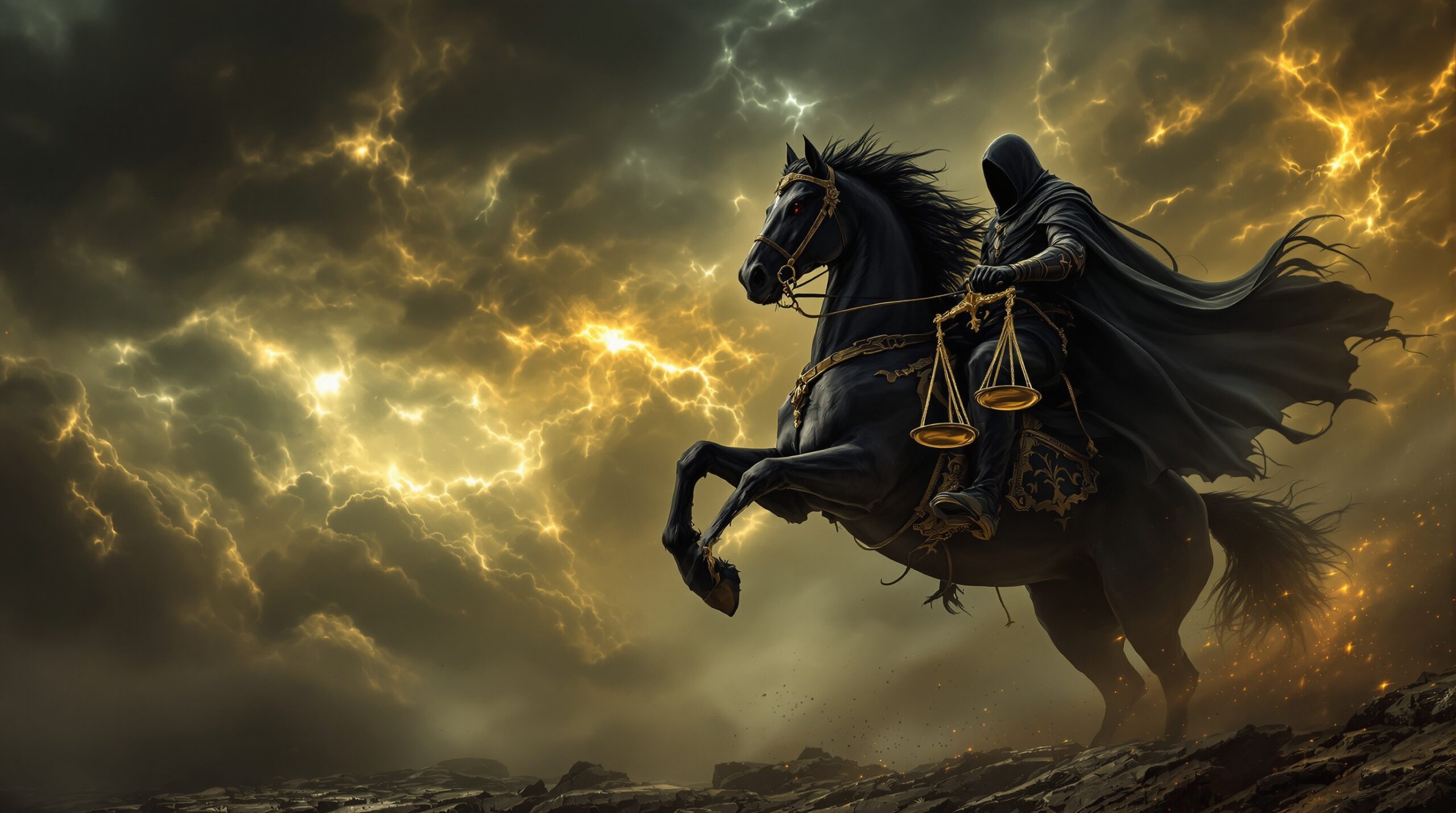
The black horse appears when Christ opens the third seal: "When He opened the third seal, I heard the third living creature say, 'Come and see.' So I looked, and behold, a black horse, and he who sat on it had a pair of scales in his hand" (NKJV Revelation 6:5). The Greek word melas (black, dark) traditionally symbolizes mourning and famine throughout Scripture. Scales (zygon in Greek, meaning balance) indicate measured rationing—bread sold by weight rather than volume, signaling severe shortage.An economic proclamation reveals precise inflation rates: “A quart of wheat for a denarius, and three quarts of barley for a denarius” (NKJV Revelation 6:6). The black horse in Revelation represents economic judgment where catastrophic inflation makes basic survival impossible for ordinary workers, as a full day’s wages purchases only one day’s food for one person. A denarius represented a laborer’s daily wage, forcing the worker to choose: spend everything on quality grain for himself alone, or stretch inferior barley to feed his family while everyone remains hungry.
Yet the command “do not harm the oil and wine” introduces divine restraint—this is selective rather than absolute devastation. Sequence matters: the black horse follows the white horse (conquest) and red horse (war), showing how military conflict produces economic collapse. Each living creature around God’s throne commands a horse forward, emphasizing that these are purposeful acts of divine sovereignty rather than random catastrophes.

The Scales of Scarcity: Famine in Biblical Context
Old Testament background provides essential interpretive framework for the scales imagery. Leviticus 26:26 warns covenant-breakers: "When I have cut off your supply of bread, ten women shall bake your bread in one oven, and they shall bring back your bread by weight, and you shall eat and not be satisfied" (NKJV). The Hebrew word mishqal (weighing) connects directly to Revelation's scales—both describe crisis conditions where food becomes so precious it must be carefully portioned.Ezekiel 4:16-17 records the prophet eating bread by weight as a prophetic sign of Jerusalem’s coming siege and famine. In normal economic times, grain was sold by volume in the marketplace; only during severe shortage was it measured meticulously by weight. Zechariah 6:1-8 establishes precedent for colored horses as divine agents: “Four chariots were coming from between two mountains… with the second chariot black horses” (NKJV Zechariah 6:2).
Scales held by the black horse rider symbolize the careful rationing necessary during famine, echoing covenant curses where bread is sold by weight rather than volume, signaling divine judgment on economic injustice. First-century believers lived in an economy where grain distribution was political power—Roman emperors maintained control through the annona, the grain subsidies that fed urban populations. Preservation of oil and wine while grain becomes unaffordable would have struck the original audience as bitterly ironic—luxuries of the wealthy remain untouched while the poor starve.
Economic Realities in Roman Asia Minor
Seven churches of Revelation existed in cities experiencing dramatic economic inequality. Wealthy landowners controlled grain supplies; hoarding during shortages was common. Asia Minor produced wine and olive oil as luxury exports—products protected even during grain shortages because they generated elite wealth. Many early Christians came from lower economic classes already living with insecurity, making this vision immediately relevant to their fears.
Why the Black Horse Matters for Christians Today
The black horse in Revelation challenges where believers place ultimate trust—in material security or in God's faithful provision. This passage exposes the fragility of earthly economic systems that seem stable but can collapse rapidly under divine judgment. Jesus taught, "Do not worry about your life, what you will eat or what you will drink" (NKJV Matthew 6:25), and the third seal reinforces this call to trust God rather than material abundance.This vision reveals God’s sovereignty even over economic crises that appear beyond human control—Christ opens the seal, the living creatures announce it, showing these events proceed from God’s throne. For believers facing financial anxiety, job loss, inflation, or poverty, this text offers comfort: God sees economic suffering and includes such injustice in His coming judgment of evil. Disparity between starving poor and protected luxuries calls Christians to refuse participation in economic exploitation.
The black horse warns against the idolatry of economic security while comforting believers that even financial crises remain under Christ’s sovereign authority and serve His redemptive purposes. Revelation repeatedly critiques economic systems (Babylon’s wealth in chapters 17-18) and warns about greed (Laodicea’s self-sufficiency in 3:17). For readers wanting to trace how this imagery develops across Revelation’s narrative, Revelation Explained: Verse by Verse examines each occurrence in its immediate context.
Selective nature of this judgment—oil and wine preserved—might represent God’s mercy in allowing earthly security systems to fail so people recognize their need for Him. Common misapplications to avoid: using this passage to predict specific dates (violating Jesus’ teaching about unknown times), justifying economic injustice as inevitable, or becoming paralyzed by fear rather than living faithfully. Understanding what the four horsemen represent helps place the black horse within the broader sequence of seal judgments.
Different Views on When This Occurs
Preterists see the black horse fulfilled in first-century famines, particularly the severe conditions during Rome's siege of Jerusalem in AD 70, when Josephus records people paying enormous prices for tiny amounts of food. Futurists interpret this as part of a future seven-year tribulation period, with worldwide economic collapse occurring after the rapture, possibly involving the Antichrist's manipulation of global food supplies.Historicists view the four horsemen as successive church history periods, with the black horse representing medieval famines or economic disruption following the Reformation. Idealists see the black horse as a timeless symbol of economic oppression and inequality that characterizes the present evil age throughout church history.
All views agree the imagery depicts economic crisis, severe inflation, and scarcity of essential food, drawing on Old Testament covenant curse language. All recognize the disparity between suffering poor and protected luxuries as divine critique of unjust systems. Differences stem primarily from one’s broader approach to Revelation’s timing and audience—whether primarily addressing first-century context, unfolding history, future events, or transcendent principles applicable in every age. Those interested in how the seal judgments relate to other prophetic sequences can explore the seven trumpets in Revelation.
Conclusion
The black horse in Revelation reveals that economic security is fragile, material systems will ultimately fail, but God's sovereignty extends even over financial crises and famine conditions. When Christ opens the third seal, He demonstrates His authority over the very systems in which we're tempted to place our trust instead of Him. For first-century believers facing economic pressure under Rome and for Christians today navigating financial anxiety, this vision offers both warning and comfort: earthly abundance is temporary, but God's faithful provision never fails.Scales of scarcity remind us that God weighs all things, sees economic injustice, and will establish perfect justice when He returns. Consider how this passage challenges your own relationship with material security—where do you place ultimate trust when economic stability feels uncertain? For a deeper verse-by-verse exploration of this passage and all of Revelation’s seal judgments, see Revelation Explained: Verse by Verse by Richard French.
Sources
- The Book of Revelation (NICNT) by Robert Mounce - Scholarly exegesis and Greek terminology analysis
- Revelation (Baker Exegetical Commentary) by Grant Osborne - Historical-cultural background on Roman economy
- The Book of Revelation: A Commentary on the Greek Text by G.K. Beale - Old Testament allusions and covenant curse connections
- Blue Letter Bible - Greek lexicon references for melas and zygon