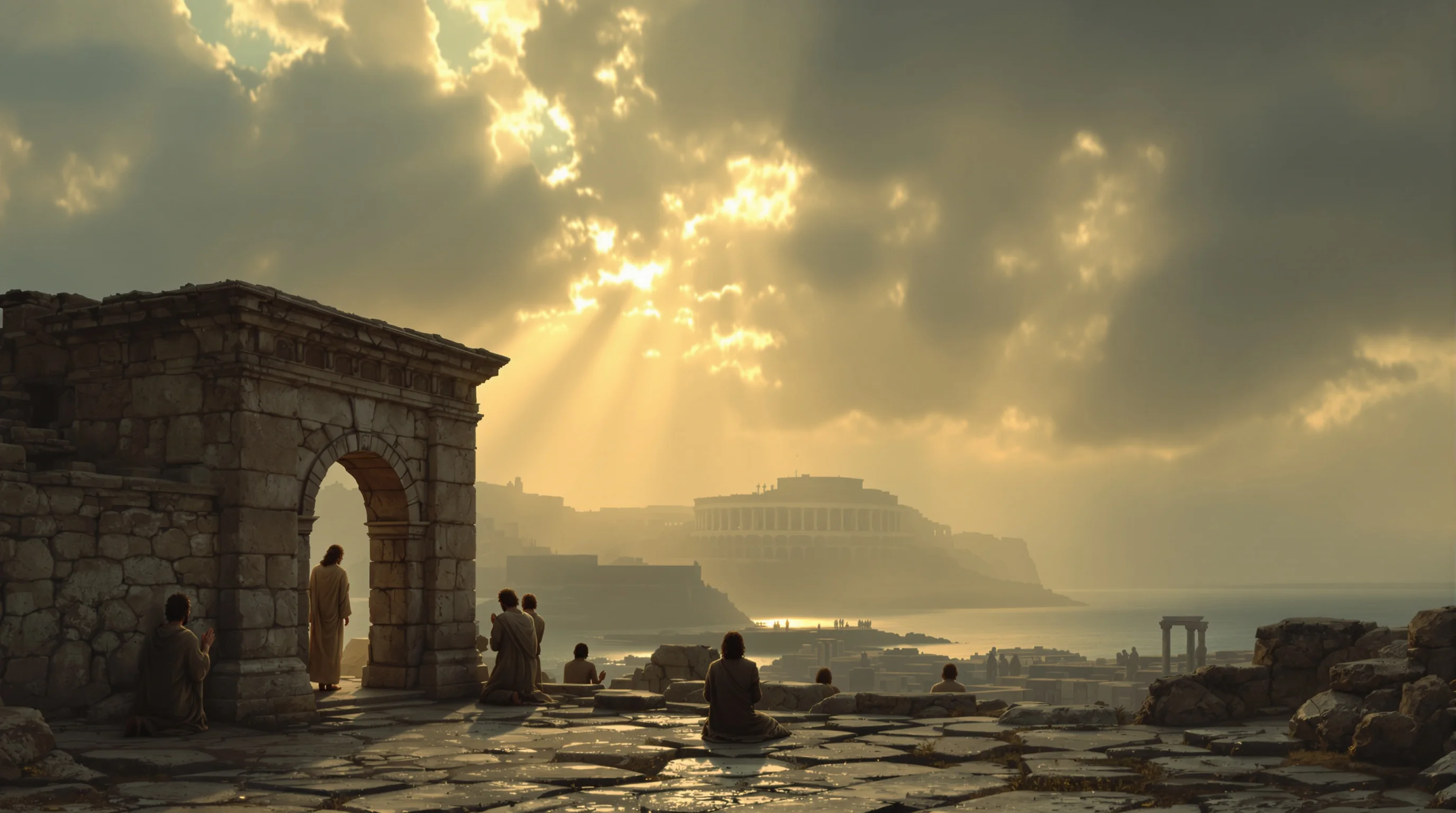
Maybe you have wondered why faithful people sometimes suffer the most. Christ rebukes five of the seven churches in Revelation 2 and 3. He finds something to correct in Ephesus, Pergamum, Thyatira, Sardis, and Laodicea. When he turns to the church in Smyrna, a poor, slandered congregation about to face prison, he offers no correction at all (WEB Revelation 2:8-11).
The church in Smyrna represents a congregation Christ commends without rebuke and promises life beyond death. His opening title comes straight from John's first vision: "The first and the last, who was dead, and has come to life says these things" (WEB Revelation 2:8). The Lord speaking to this church has already passed through death himself, and he is about to tell them that some may follow him there.
This article walks through Smyrna's setting, what it means that the church was "poor yet rich," the ten days of tribulation, the crown of life, the second death, and the later witness of Polycarp, a bishop remembered for living out this letter's call.
Quick Answer: Facing poverty, slander, and imprisonment, its believers heard Christ call them rich, limit their trial to ten days, and promise the crown of life to those faithful unto death.
Definition: The church in Smyrna in Revelation represents a congregation enduring real poverty and persecution whom Christ declares spiritually rich and promises to reward for faithfulness even to the point of death.
Key Scripture: "Be faithful to death, and I will give you the crown of life." (WEB Revelation 2:10)
Context: Smyrna and Philadelphia (WEB Revelation 3:7-13) are the only two of the seven churches that receive commendation with no rebuke.
Key Evidence: Christ's letter to Smyrna contains no rebuke (WEB Revelation 2:8-11), and the second-century Martyrdom of Polycarp records the faithfulness of Smyrna's bishop to the point of death.
This letter works as both comfort and preparation. Christ names the church's suffering directly, so the believers know he sees it. He then sets a boundary on how long the trial will last, which means their pain has a limit. Finally, he ties the reward to his own resurrection life, so the church can face even death with hope. The sections ahead examine the city's pressures, the meaning of true riches, the ten-day trial, and the crown and second death that frame the believer's hope.
Key Takeaways
- Faithful church: Smyrna receives praise and no correction from Christ, a distinction it shares only with Philadelphia.
- Poor yet rich: The Greek word ptōcheia describes destitution, and Christ calls these believers rich in his sight.
- Ten days: The trial has a fixed boundary. Many see an echo of Daniel's ten-day test in Daniel 1:12-14.
- Crown of life: The stephanos is a victor's wreath given for endurance.
- Second death: Overcomers are safe from the lake of fire (WEB Revelation 20:14).
Who Was the Church in Smyrna? The City and Its Pressures
The church in Smyrna met in a prosperous harbor city on the Aegean coast of Asia Minor, the modern city of İzmir. Civic identity and allegiance to Rome were tightly bound together in the city.
That loyalty created real pressure for Christians. Believers who refused to take part in acts honoring the emperor risked exclusion from trade guilds and the loss of their livelihoods, which helps explain the poverty Christ names in verse 9. Once Christians were seen as a separate group, they could be reported as disloyal.
Into this setting, Christ introduces himself with words drawn from Isaiah: "the first and the last" (WEB Revelation 2:8; compare WEB Isaiah 44:6). The church in Smyrna faced economic, social, and legal pressure in a city proud of its loyalty to Rome. Christ met that pressure by revealing himself as sovereign over life and death.
Affliction, Poverty, and True Riches
Christ tells the church, "I know your works, oppression, and your poverty (but you are rich)" (WEB Revelation 2:9). The word translated "oppression" (thlipsis) describes pressure or affliction. "Poverty" (ptōcheia) describes beggar-level destitution, likely the result of economic exclusion rather than simple hardship.
Christ's evaluation reverses the world's math. The church in Laodicea later claims to be rich and self-sufficient, yet Christ calls it poor, blind, and naked (WEB Revelation 3:17). Smyrna receives the opposite verdict: materially poor, yet rich where it matters most.
Notice the phrase "I know." Perhaps you have felt that no one understood what you were carrying. Christ tells this struggling congregation that he sees their suffering specifically, and he shares in it personally. He calls the church in Smyrna rich because its faithfulness counts as wealth in God's kingdom.
Who Was the Synagogue of Satan?
Christ names "the blasphemy of those who say they are Jews, and they are not, but are a synagogue of Satan" (WEB Revelation 2:9). This is one of the harder phrases in the letter, and faithful readers have wrestled with it for centuries.
- Specific conflict: The phrase describes a first-century group whose slander, likely reported to Roman authorities, endangered believers.
- Covenantal language: Compare Romans 2:28-29. This verse should never be used against Jewish people today; it addresses a specific local conflict.
For a fuller look at this difficult phrase, see What Is the Synagogue of Satan in Revelation?
Ten Days of Tribulation and the Crown of Life for the Church in Smyrna
Christ tells the church in Smyrna, "Don't be afraid of the things which you are about to suffer. Behold, the devil is about to throw some of you into prison, that you may be tested; and you will have oppression for ten days" (WEB Revelation 2:10). The command "don't be afraid" echoes Isaiah 41:10 and 43:1-2, where the LORD promises his presence through danger.
Imprisonment in this period usually meant holding before trial or execution rather than a fixed sentence. Even so, the trial has an end point built into the promise itself.
The vision serves a clear purpose: Christ prepares his people for suffering before it arrives. It functions as both warning and comfort, since he names the coming trial and also caps its length. The implication is that no persecution moves outside his sovereign limits, and death itself cannot cancel his promise.
Christ follows the warning with a reward: "Be faithful to death, and I will give you the crown of life" (WEB Revelation 2:10). The word for "crown" (stephanos) is the athlete's victory wreath, not a royal crown. James uses the same image: "the crown of life which the Lord promised to those who love him" (WEB James 1:12). The crown of life in Revelation 2:10 is the victor's reward Christ promises to believers who stay faithful until death. Readers wanting a closer look at this promise can explore What Is the Crown of Life in Revelation?
Interpreting the Ten Days
Interpreters read "ten days" in several ways, though all agree the text sets a fixed limit on the trial. There is no shame in admitting the number is hard to pin down.
- Brief, bounded test: Many connect the phrase to Daniel 1:12-14, where a ten-day test leads to vindication.
- Preterist and idealist readings: These views take the phrase as a short literal period or a symbol of limited trial.
Polycarp of Smyrna: Faithfulness Remembered
Polycarp, bishop of Smyrna in the second century, illustrates the church's later faithfulness. His death came generations after John wrote Revelation and should not be read as a direct fulfillment of the text.
The Overcomer and the Second Death
Christ closes the letter with a promise: "He who overcomes won't be harmed by the second death" (WEB Revelation 2:11). Revelation defines this term plainly: "This is the second death, the lake of fire" (WEB Revelation 20:14). For more on this phrase, see What Is the Second Death in Revelation?
The word "overcomes" (nikaō) means to conquer or prevail. John closes each of the seven letters with this word, as in the promises to Ephesus (WEB Revelation 2:7) and Laodicea (WEB Revelation 3:21).
It's worth naming a few misapplications to avoid. The "ten days" should never become material for date-setting. Suffering is no proof of God's displeasure, and this letter shows the opposite is often true. The text also offers no encouragement to seek martyrdom; the Martyrdom of Polycarp (chapter 4) faults Quintus, who volunteered for death and then gave way.
Some futurists, following the notes of C. I. Scofield, read the seven churches as a prophetic profile of the whole church age, while others treat them as historical congregations with ongoing application. The text itself does not settle which reading is correct, and readers can hold either view in good conscience. Christ promises that the second death will never harm those who overcome, even if they lose their earthly lives.
For readers who want to trace this letter's connections across the rest of Revelation's seven messages, Revelation Explained: Verse by Verse by Richard French examines each church's letter in its immediate context.
Why This Vision Matters
Smyrna shows that suffering can belong to faithful discipleship rather than signal God's absence. Christ knows his people's hardship, sets limits on their trial, and rewards their endurance with life rather than ruin. The risen Lord "who was dead, and has come to life" (WEB Revelation 2:8) guarantees that death will never have the final word for those who belong to him.
Conclusion
The church in Smyrna was poor, slandered, and threatened with prison, yet Christ called it rich and faithful. That reversal still speaks to you if you are carrying pressure, loss, or quiet fear today. You can hold to the same command Christ gave Smyrna, "Be faithful to death" (WEB Revelation 2:10), trusting that he sees your circumstances and has already set limits on what you will face. Take heart: the one who died and came to life walks with you. For a deeper verse-by-verse exploration of Revelation's symbols and structure, see Revelation Explained: Verse by Verse.