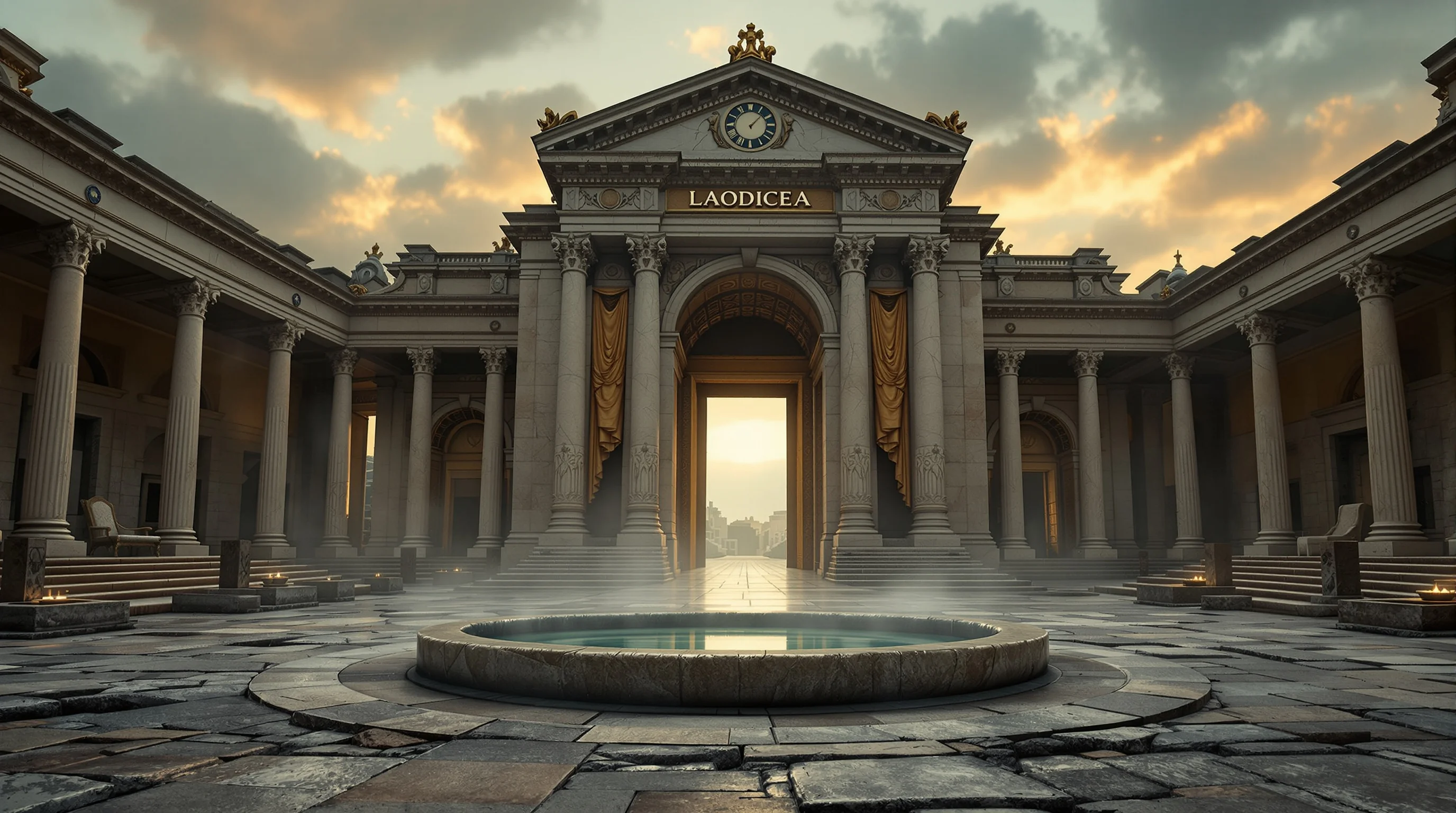
The church of Laodicea receives the only letter among the seven in Revelation 2-3 that contains no word of praise. Yet it also receives the highest promise of all: a seat with Christ on His throne (WEB Revelation 3:21). That civic self-reliance explains much about the church's spiritual condition.
The church of Laodicea represents a prosperous congregation whose self-reliance hid its need for Christ. This article looks at the city behind the seven churches' final letter: its banking, textiles, eye salve, and water supply. Then we read Revelation 3:14-22 verse by verse and ask what it means for readers today. Maybe your faith has gone quiet without your noticing. If so, this passage is worth sitting with.
Quick Answer: The church of Laodicea is the seventh congregation addressed in Revelation 3:14-22. It was a prosperous church in a banking and textile city in Asia Minor. Christ rebukes its lukewarm works and its self-satisfied claim of needing nothing, then offers true riches, white garments, eye salve, and restored fellowship to everyone who opens the door.
Definition: The church of Laodicea in Revelation represents a prosperous congregation whose material wealth produced spiritual self-deception and blindness to its own poverty before Christ.
Key Scripture: "Because you say, 'I am rich, and have gotten riches, and have need of nothing;' and don't know that you are the wretched one, miserable, poor, blind, and naked" (WEB Revelation 3:17).
Key Evidence: Christ's three gifts in Revelation 3:18, gold, white garments, and eye salve, match the city's banking, its prized black wool, and its medicine. The city's decision to rebuild after an earthquake without imperial aid shows the self-reliance the letter confronts.
Context: The first hearers would have recognized each image, gold, clothing, eye salve, as a pointed reference to their own city's pride.
This letter functions as both diagnosis and remedy. Christ names the condition plainly because a church that believes it lacks nothing cannot receive anything. He then offers exactly what the church lacks: tested faith, covering for shame, and restored sight. The implication is hopeful, since the same Lord who exposes the blindness also supplies the cure.
Key Takeaways
- Only letter without praise: Laodicea alone among the seven churches receives no commendation from Christ.
- Lukewarm works: The charge concerns the church's deeds. Hot and cold water each served a purpose, while tepid water was useless.
- Local imagery: Gold, white garments, and eye salve answer the city's pride in banking, textiles, and medicine.
- Loving rebuke: "As many as I love, I reprove and chasten" (WEB Revelation 3:19).
- Open door: Christ knocks and offers table fellowship to anyone who hears His voice.
What Was the City Behind the Church of Laodicea?
The church of Laodicea stood in one of the wealthiest cities of Asia Minor, a financial center on a major trade route. After a destructive earthquake, the city declined imperial aid and paid for its own recovery. That self-funded rebuilding says something about the city's character, and likely about the church's as well.
Laodicea also prized its glossy black wool, which makes Christ's offer of white garments land with particular force. The congregation likely began during Paul's ministry centered in Ephesus.
Unlike several of the other seven churches, this one faces no persecution in the letter.
Laodicea's wealth, wool, and medicine supplied the very images Christ used to expose the church's spiritual poverty.
The Water Supply and the Lukewarm Image
Laodicea had no local water source of its own.

- Reading the image: Both hot and cold are desirable in the text. The point is usefulness, tied directly to the phrase "I know your works."
The Letter Verse by Verse: Revelation 3:14-19
Christ introduces Himself with a title found nowhere else in the seven letters: "The Amen, the Faithful and True Witness, the Beginning of God's creation" (WEB Revelation 3:14). "The Amen" echoes Isaiah 65:16, where God is called the God of truth. "Beginning" translates a Greek word pointing to Christ as source and ruler of creation, consistent with Colossians 1:15-18.
The famous charge follows in verses 15-16: "I know your works, that you are neither cold nor hot. I wish you were cold or hot. So, because you are lukewarm, and neither hot nor cold, I will vomit you out of my mouth" (WEB Revelation 3:15-16). In context, it describes useless water, and by extension, useless works.
Verse 17 sets the church's own words against Christ's assessment. The congregation makes a three-part boast: rich, wealthy, needing nothing. Christ answers with a five-part diagnosis: wretched, miserable, poor, blind, and naked. The pattern recalls Ephraim's self-congratulation in Hosea 12:8, where prosperity breeds blindness to real need.
Behind the sharp words lies a motive: "As many as I love, I reprove and chasten. Be zealous therefore, and repent" (WEB Revelation 3:19). This echoes Proverbs 3:12, where fatherly discipline flows from love, not rejection. "Be zealous" directly answers the charge of lukewarmness.
Fatherly love drives the rebuke in Revelation 3:19, calling a complacent church to zeal and repentance.
Gold, White Garments, and Eye Salve
Christ answers each civic boast with a gift: "I counsel you to buy from me gold refined by fire" (WEB Revelation 3:18).
- Gold: Refined, tested faith (compare Zechariah 13:9 and Malachi 3:2-3), in place of the city's banking wealth.
- White garments: Covering for shame (compare Isaiah 61:10), in place of the city's prized black wool.
- Eye salve: Restored spiritual sight. The command to "buy" echoes Isaiah 55:1, an offer received as a gift rather than earned.
For readers wanting to trace how this imagery develops across Revelation's wider narrative, Revelation Explained: Verse by Verse examines each occurrence in its immediate context.
The Open Door and the Shared Throne (Revelation 3:20-22)
One of Scripture's most familiar invitations appears in verse 20: "Behold, I stand at the door and knock. If anyone hears my voice and opens the door, then I will come in to him, and will dine with him, and he with me" (WEB Revelation 3:20). Christ speaks these words to a church, not to outsiders. The image of Him standing outside the door of a congregation that claimed to lack nothing carries its own quiet irony.
The Greek word for "dine" refers to the main evening meal, a leisurely occasion built around close fellowship, not a quick snack. The scene recalls the knocking beloved in Song of Solomon 5:2, a picture of covenant intimacy rather than mere politeness.
Then comes the letter's highest promise: the one who overcomes will sit with Christ on His throne, just as Christ overcame and sat down with His Father on His throne. No other church among the seven receives a greater promise, and it goes to the one Christ rebukes most sharply. Verse 22 closes with the familiar call to hear, addressed to all the assemblies, not Laodicea alone.
It is worth noting that Revelation 4:1 opens right after this letter with a door standing open in heaven, followed by the throne-room vision of chapters 4-5. Readers hold differing views on how this transition relates to the timing of the rapture, and this article takes no position on that question. The literary connection between the open door of 3:20 and the open door of 4:1 is worth noticing either way.
The church of Laodicea receives the harshest rebuke and the highest promise in Revelation's seven letters.
How Interpreters Read the Seven Letters
Readers approach Laodicea through several lenses. All of them agree that the church was self-deceived and that repentance is commanded.
- Preterist and idealist: A real first-century church, and also a timeless warning to any self-reliant congregation.
- Historicist and futurist: Historicists often treat the letters as successive church eras, with Laodicea as the final one. Some dispensational futurists adopt a similar "church ages" framework, though many futurists decline to follow it, since the text gives no explicit chronological markers.
What the Church of Laodicea Asks of Readers Now
Three commands close the church of Laodicea's letter, and they still apply: buy from Christ what only He can give, be zealous, and repent by opening the door. None of these is complicated, but each requires honesty about where our confidence actually rests.
Comfort and affluence can dull spiritual sight just as easily as persecution can sharpen it. Wealth itself was never the issue in this letter; misplaced trust in it was. Measuring ourselves by Christ's assessment, rather than our own comfortable self-estimate, is the starting point for the repentance He asks for.
You might find yourself asking whether you are the lukewarm one. That question is okay to hold, and faithful readers have wrestled with it for centuries. Here is the comfort hidden inside the rebuke: the church that received no praise is still the church Christ loves (WEB Revelation 3:19). The remedy He offers, gold, garments, eye salve, is freely given, not purchased through effort.
A few misreadings are worth avoiding. Lukewarmness describes useless, self-satisfied works, not a quiet personality or a less demonstrative temperament. Verse 20 reads first as an appeal to believers already inside the church, though a gospel invitation remains a valid secondary application. Nothing in the text supports labeling any modern denomination or movement "Laodicean"; that speculation goes beyond what Scripture says.
The church of Laodicea warns every generation that self-sufficiency blinds believers to their need for Christ.
Why This Vision Matters
Spiritual danger often arrives through prosperity rather than persecution, which is part of what makes it so easy to miss. Christ's honest diagnosis in this letter leads toward healing, not despair, and His knock shows that the invitation remains open. The promise of a shared throne connects to Revelation's larger hope: the Lamb who overcame invites His people to reign with Him.
Conclusion
The church of Laodicea was rich in goods and poor before Christ, confident in its resources and blind to its actual condition. In response, Christ offers refined gold, white garments, eye salve, and His own presence at the table. If this letter stings a little, you are in good company, and there is no shame in that. Let it draw you toward the door rather than away from it, because Christ still knocks, and His rebuke comes from love. For a deeper verse-by-verse exploration of Revelation's symbols and structure, see Revelation Explained: Verse by Verse by Richard French.