
To the church in Philadelphia, Christ promised something the city itself could not offer: a home where "he who overcomes" will "go out from there no more" (WEB Revelation 3:12).
Maybe you have wondered whether a small, quiet faith counts for much. The church of Philadelphia in Revelation is one of only two of the seven churches, along with Smyrna, that receive no rebuke from Christ. The church of Philadelphia is not a picture of strength or influence. It specifically represents a small, marginalized congregation that Christ commends for loyalty rather than size.
This article walks through the key of David, the open door, the conflict with opponents, the city's setting, the debated "hour of testing," and the promise given to the one who overcomes.
Quick Answer: The church of Philadelphia in Revelation is the sixth of the seven churches addressed in Revelation 2-3, a congregation with "a little power" that kept Christ's word and did not deny His name. Christ, who holds the key of David, sets before it an open door no one can shut and promises protection and a permanent place in God's temple.
Definition: The church of Philadelphia in Revelation represents a faithful, weak, and marginalized first-century congregation that Christ commends without correction and promises to keep through coming testing.
Key Scripture: "I know your works (behold, I have set before you an open door, which no one can shut), that you have a little power, and kept my word, and didn't deny my name." (WEB Revelation 3:8)
Context: The letter first encouraged a real congregation in Asia Minor facing exclusion and social pressure near the end of the first century.
This letter functions as both diagnosis and promise. It names the church's weakness honestly, then shows how Christ's authority, not the church's strength, secures its future. The sections below trace how that authority unfolds, from the key Christ holds, to the door He opens, to the permanent place He guarantees.
Key Takeaways
- No rebuke: Philadelphia and Smyrna are the only two of the seven churches that Christ commends without correction (WEB Revelation 2-3).
- Key of David: Christ claims the authority over access pictured in Isaiah 22:22, as noted by Beale (NIGTC) and Osborne (BECNT).
- Open door: Christ opened the door, and it stays open. It likely includes gospel opportunity and access to His kingdom, compare (WEB 1 Corinthians 16:9).
- Hour of testing: Faithful interpreters read Revelation 3:10 in several ways. This article presents each view without choosing one.
- Pillar promise: The overcomer receives permanence and three names marking belonging (WEB Revelation 3:12).
What Does the Bible Say About the Church of Philadelphia in Revelation?
The church of Philadelphia in Revelation sits sixth of seven, after Sardis, which has a name for being alive yet is dead (WEB Revelation 3:1), and before lukewarm Laodicea (WEB Revelation 3:15-17). Placed between those two troubled churches, Philadelphia stands out as an example of faithfulness under pressure rather than complacency or compromise.
Christ introduces Himself in striking terms: "To the angel of the assembly in Philadelphia write: He who is holy, he who is true, he who has the key of David, he who opens and no one can shut, and who shuts and no one opens, says these things:" (WEB Revelation 3:7). It's worth noting that this description is distinctive to this letter.
The commendation follows: the church had "a little power," kept Christ's word, and did not deny His name (WEB Revelation 3:8). The praise rests on obedience and loyalty. Small size carries no special virtue of its own; it describes the church's circumstances honestly.
The letter's purpose is encouragement. It works by shifting attention from the church's weakness to Christ's authority. The implication is that the church's future rests on the One who holds the key, not on its own strength.
Even this commended church hears a call to keep going: "I am coming quickly! Hold firmly that which you have, so that no one takes your crown" (WEB Revelation 3:11). The word "quickly" stresses certainty rather than a timetable.
The church of Philadelphia in Revelation is commended for keeping Christ's word and refusing to deny His name while having only a little power.
The Key of David and Christ's Authority
The key image comes from Isaiah 22:15-25, where Eliakim replaces the unfaithful steward Shebna as keeper of the royal household.
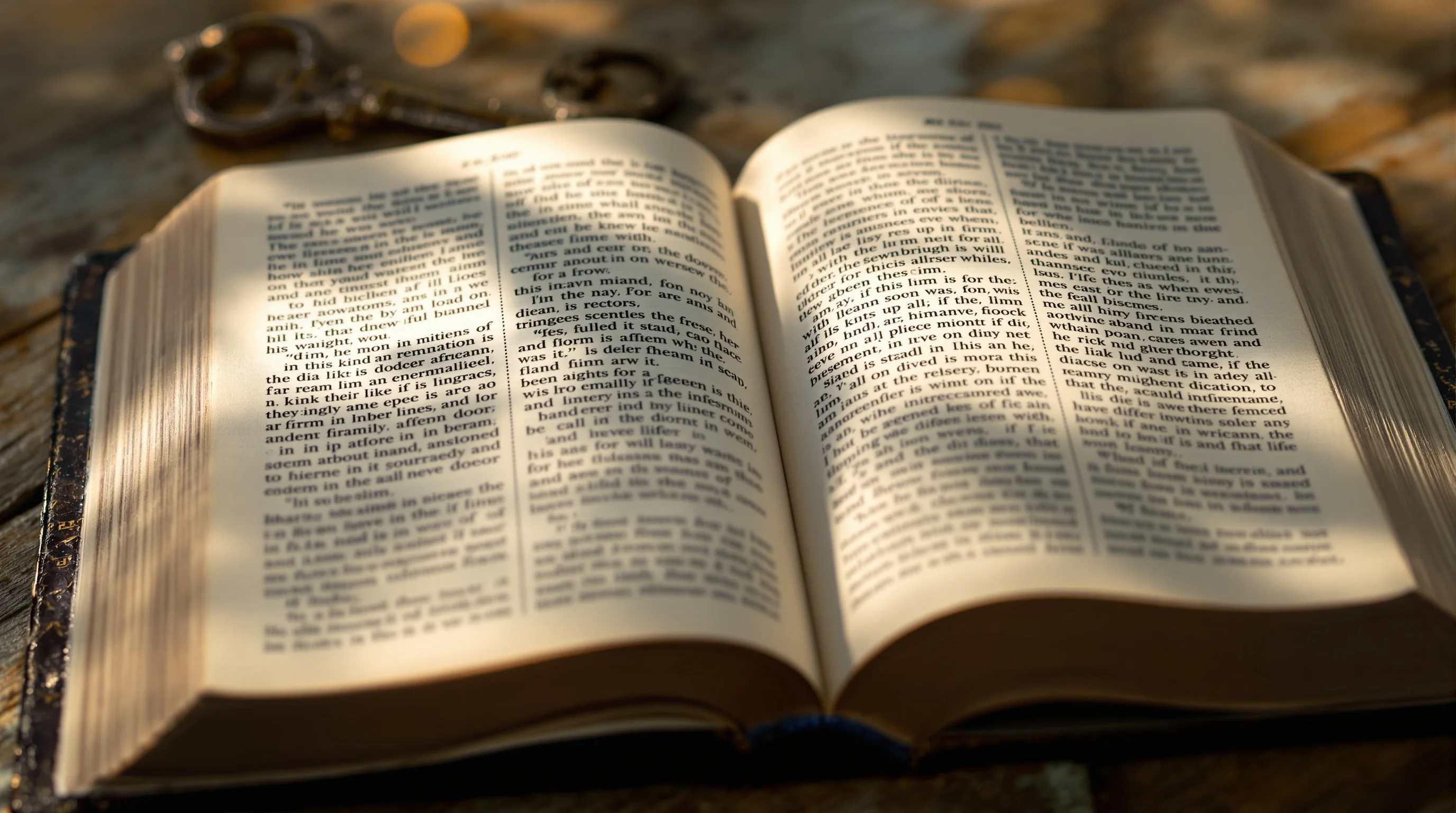
- Isaiah 22:22 (WEB): "I will lay the key of David's house on his shoulder. He will open, and no one will shut. He will shut, and no one will open."
- Connections: Jesus is called the "Root of David" (WEB Revelation 5:5) and holds "the keys of Death and of Hades" (WEB Revelation 1:18). For a fuller look at this image, see What Is the Key of David in Revelation 3?
The Open Door and Vindication Before Opponents
The door is His gift to a weak church, not something the church earned or opened itself.
Elsewhere in the New Testament, an open door often describes gospel opportunity: "for a great and effective door has opened to me, and there are many adversaries" (WEB 1 Corinthians 16:9). The image may also include access to Christ's kingdom itself. The text leaves room for both meanings, and they fit together naturally.
Verse 9 adds a striking promise: opponents will "Behold, I make some of the synagogue of Satan, of those who say they are Jews, and they are not, but lie—behold, I will make them to come and worship before your feet, and to know that I have loved you." (WEB Revelation 3:9). This reverses an Old Testament hope of nations bowing to Israel.
You might be tempted to equate this "open door" with career success or ministry growth. The text ties it specifically to Christ's authority, the gospel, and access to His kingdom. The open door in Revelation 3:8 is a door Christ Himself opened, and no human power can close it.
Who Were the Synagogue of Satan?
The phrase in Revelation 3:9 points to specific local opponents in a specific first-century conflict, not to a general group.
- The dispute: It concerned who truly belongs to God's people. John, and Jesus Himself, were Jewish.
- Caution: For more, see What Is the Synagogue of Satan in Revelation?
The Church of Philadelphia in Revelation: City Setting and the Overcomer's Promise
The church of Philadelphia in Revelation existed in a city that the letter's imagery may reflect.
The promise lands with weight: "He who overcomes, I will make him a pillar in the temple of my God, and he will go out from there no more" (WEB Revelation 3:12). For people who knew what it meant to flee shaking buildings, a permanent dwelling meant something real.
Three names follow this promise: God's name, the name of the New Jerusalem, and Christ's new name. Together they mark identity, ownership, and security, and they point ahead to God dwelling fully with His people (WEB Revelation 21-22). Isaiah 62:2 provides background for the idea of a "new name."
The conflict with local opponents suggests these believers may have lost the social standing that synagogue membership once provided, leaving them exposed to civic religious pressure. This is a likely reading drawn from the text rather than a certainty.
Different Views on the Hour of Testing in Revelation 3:10
Verse 10 reads: "Because you kept my command to endure, I also will keep you from the hour of testing, which is to come on the whole world, to test those who dwell on the earth" (WEB Revelation 3:10). Few verses in this letter generate more discussion, and faithful readers have wrestled with it for centuries. It's okay to find it challenging, and okay to hold your own view with humility.
- Preterist: The verse refers to empire-wide pressures or persecution facing Christians in first-century Asia Minor.
- Futurist (pretribulation): The verse promises removal of believers before a future global tribulation.
- Futurist (posttribulation): The verse promises protection through that tribulation rather than removal from it.
- Idealist: The hour represents recurring seasons of testing across history, not one specific event.
- Historicist: The seven churches picture successive eras of church history, with Philadelphia often linked to a missionary period. The text itself gives no explicit era scheme, and proposed timelines vary widely among historicist interpreters.
Christians who hold different views on rapture timing all read Revelation 3:10 as a promise of Christ's protection for His faithful people. For more on how these views shape the seven letters, see Revelation Explained: Verse by Verse.
How Interpreters Read "Keep You From"
Much of the debate centers on the Greek phrase tērēsō ek, meaning "I will keep you from" or "out of."
- Comparison text: John 17:15 (WEB) uses the same verb and preposition: "I pray not that you would take them from the world, but that you would keep them from the evil one."
- Scope questions: Readers weigh what "hour" and "whole world" cover in this verse. For a fuller discussion, see What Is the Hour of Trial in Revelation 3:10?
Why This Vision Matters
Christ knows small, unnoticed faithfulness, and weakness does not disqualify anyone from His approval. Believers who feel shut out or pressured to compromise can trust the One who holds the key of David. Revelation's hope appears here in miniature: a door that stays open, protection from God, and a permanent home in the New Jerusalem. Present pressure is real, but Christ's promise is firmer.
Conclusion
The church of Philadelphia in Revelation shows that a congregation with little power can stand approved before Christ by keeping His word and holding to His name. If your faith feels small or your circumstances feel unsteady, this letter was written with people like you in mind. Christ's authority is in the key, His welcome in the door, His vindication in verse 9, His protection in verse 10, and His belonging in the pillar and the names.
You are invited to hold firmly to what you have (WEB Revelation 3:11). The One who opens and no one shuts keeps His promises to the weary, and that promise still stands for you today.