When Revelation 20:11 describes the earth and heaven fleeing from the presence of the one seated on the throne, the image stops readers cold. The entire created order cannot endure before this final, absolute judgment. It is one of Scripture's most arresting pictures, and it raises a question that every thinking person eventually asks: what happens when history ends and all the dead stand before God?
The Great White Throne Judgment, described in Revelation 20:11, 15, is Scripture's answer. Maybe you've approached this passage with a mixture of awe and unease, uncertain whether it should comfort you or alarm you. That tension is honest, and it's worth sitting with. This article walks through what the text actually says, where this vision fits in Revelation's larger story, and why it matters for Christians living right now.
Quick Answer: The Great White Throne Judgment is the final divine judgment described in Revelation 20:11, 15, in which all the dead are raised, their deeds examined from written records, and their eternal destinies determined by whether their names appear in the Book of Life.
Definition: The Great White Throne Judgment in Revelation represents the universal final reckoning presided over by Christ, where every human being stands before God's perfect authority, works are examined as evidentiary record, and the Book of Life determines eternal destiny.
Key Scripture: "And anyone not found written in the Book of Life was cast into the lake of fire." (NKJV Revelation 20:15)
Context: This judgment follows the millennial reign and the defeat of Satan, closing the old order before the new creation begins in Revelation 21.
This vision serves as the hinge between two ages. It closes the long story of human history under the weight of sin and opens the door to the new creation. For believers, understanding the Great White Throne Judgment means grasping both the seriousness of God's justice and the security of belonging to Christ. The Great White Throne Judgment is not a scene designed to terrify those in Christ; it is designed to clarify what God's justice looks like when it is fully and finally exercised. The sections below examine what the text says verse by verse, how its Old Testament roots shaped the original audience's understanding, and what it means for Christians handling questions of accountability and hope today.
Key Takeaways
- Universal scope: The phrase "small and great" in Revelation 20:12 is a merism encompassing all of humanity regardless of earthly status, wealth, or influence.
- Two sets of records: The plural "books" of deeds and the singular Book of Life work together: works serve as evidentiary record, not as the basis for salvation. As Grant Osborne observes, the determining issue is whether one's name appears in the Lamb's book.
- Total resurrection: The threefold mention of sea, Death, and Hades in Revelation 20:13 confirms that no circumstance of death places anyone beyond God's reach for judgment.
- Death itself is destroyed: Death and Hades are cast into the lake of fire (NKJV Revelation 20:14), fulfilling 1 Corinthians 15:26, which calls death the last enemy to be destroyed.
- Christ presides: John 5:22 identifies the Son as the appointed judge, meaning the Great White Throne is presided over by the one who bore the penalty of judgment on behalf of those whose names are written in the Book of Life.
Key Evidence:
- Revelation 20:11, 15 provides the primary textual basis for the judgment's scope and outcome.
- Daniel 7:9, 10 establishes the Old Testament courtroom template John consciously develops (G.K. Beale, NIGTC).
- John 5:22 identifies Christ as the appointed judge, using the Greek dedoken to indicate a permanent, deliberate commission.
- Exodus 32:32, 33; Psalm 69:28; and Daniel 12:1 together show that divine record-keeping is a covenant theme running across both Testaments.
- Revelation 3:5 explicitly promises that Christ will not blot the overcomer's name from the Book of Life, grounding assurance in the judge's own word.
What the Bible Says About the Great White Throne Judgment
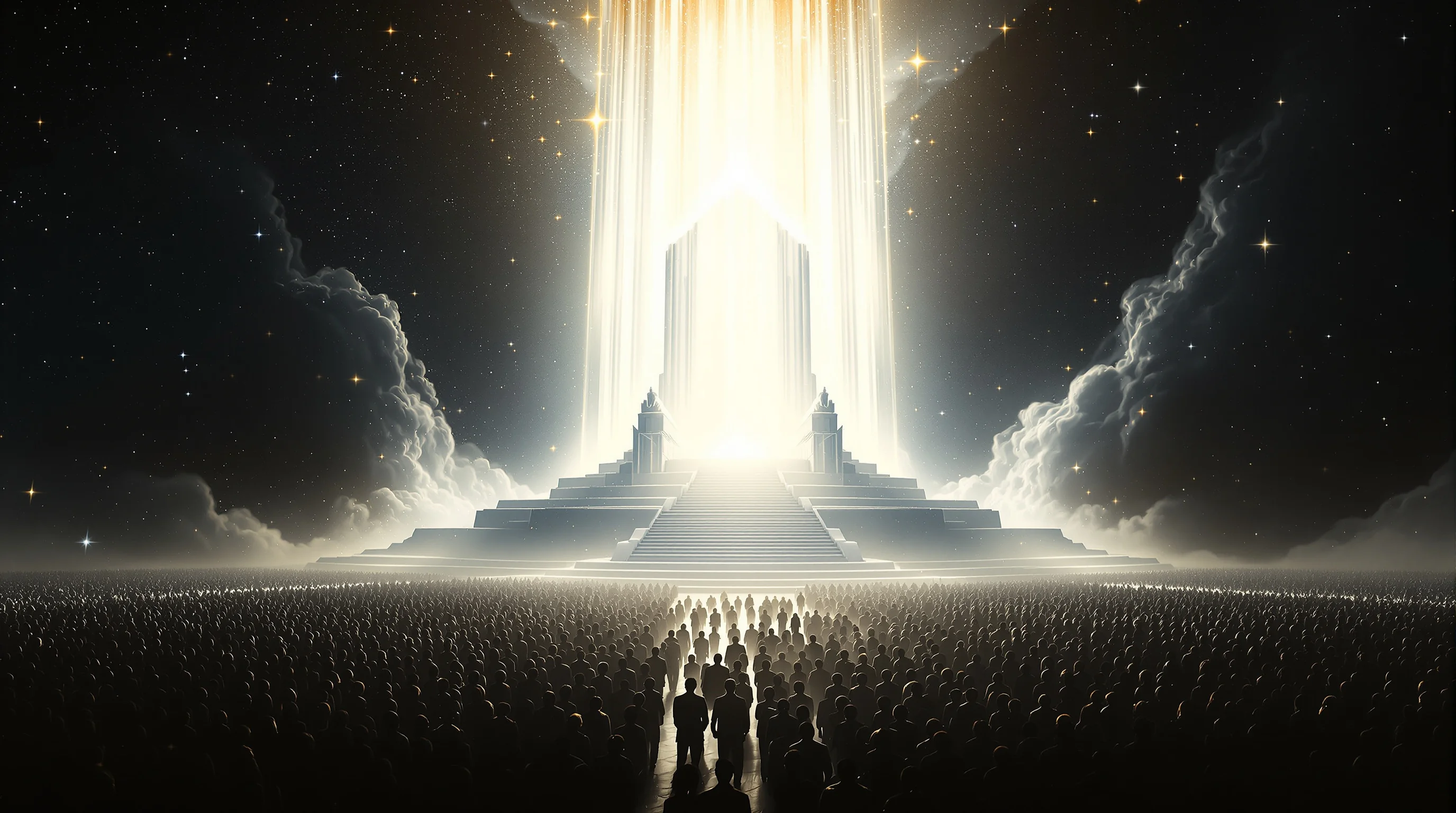
The passage opens with a throne that commands the entire scene. "Then I saw a great white throne and Him who sat on it, from whose face the earth and the heaven fled away. And there was found no place for them." (NKJV Revelation 20:11) In Revelation's symbolic vocabulary, white consistently marks holiness and righteous authority. The same color appears on the rider of Revelation 19:11 and on the Ancient of Days in Daniel's vision. The fleeing of earth and heaven signals something more than dramatic backdrop: the present created order cannot stand before this absolute sovereignty. This is not a courtroom of equals.
Verses 12 and 13 describe what follows. "And I saw the dead, small and great, standing before God, and books were opened. And another book was opened, which is the Book of Life. And the dead were judged according to their works, by the things which were written in the books." (NKJV Revelation 20:12) Robert Mounce writes that the books record human deeds while the Book of Life registers those who belong to God. The two sets of records work together. Grant Osborne observes that works function as evidence of one's relationship with God, not as the ground of salvation itself. The Great White Throne Judgment is the moment when every human record is opened, every name is checked, and no earthly status shields anyone from God's complete and final reckoning.
The threefold mention of sea, Death, and Hades in verse 13 carries real weight. In the ancient world, drowning at sea meant a body was unrecoverable, thought to be beyond reach. John's vision shatters that assumption. Then comes verse 14: "Then Death and Hades were cast into the lake of fire. This is the second death." (NKJV Revelation 20:14) Physical death, which has reigned since Adam, is itself brought to an end. The second death in Revelation refers to permanent separation from God, the ultimate consequence of remaining outside of Christ.
Christ as the Judge at the Throne
Revelation 20:11 identifies the one seated on the throne without naming him directly, but John's Gospel clarifies who presides over this scene.

- Appointed authority: "For the Father judges no one, but has committed all judgment to the Son." (NKJV John 5:22) The Greek word dedoken means "has entrusted," indicating a deliberate, permanent appointment.
- Christological center: G.K. Beale notes that the Son of Man who approached the Ancient of Days in Daniel 7 is now understood as the one seated on the throne, having been exalted after his resurrection.
Understanding the Great White Throne Judgment in Its Biblical Context
Where a passage sits in Revelation matters as much as what it says. Revelation 20:11, 15 is placed between the final defeat of Satan (20:1, 10) and the vision of the New Jerusalem (21:1, 22:5). This placement is architecturally deliberate. John structures these final chapters as a movement from judgment to renewal, from the destruction of everything that opposes God to the establishment of everything that fulfills his purpose. The Great White Throne Judgment is the closing act of the old order, not an isolated scene.
The Old Testament roots run deep here. Daniel 7:9, 10 depicts the Ancient of Days taking his seat on a throne of fire with books opened before him. Readers steeped in the Hebrew Scriptures would have recognized John's scene immediately. G.K. Beale notes that this is a conscious development of Daniel's courtroom vision, with the defining difference that the Son of Man who approached the Ancient of Days is now the one seated on the throne. The first resurrection described earlier in Revelation 20 sets the stage for this final accounting.
The Book of Life also carries deep Old Testament roots. In Exodus 32:32, 33, Moses asks God to blot his name from God's book if Israel cannot be forgiven. Psalm 69:28 speaks of names written among the living. Daniel 12:1 promises that everyone found written in the book will be delivered. Taken together, these references reveal that divine record-keeping is a covenant theme, not a legal technicality. The Book of Life in Revelation is the New Testament fulfillment of God's long-standing practice of knowing and keeping his own.
For the original audience, all of this carried immediate force. Craig Keener observes that first-century Christians living under Roman imperial pressure watched governors and emperors render verdicts over their lives. John's vision counters that picture directly: the throne before which every Caesar must one day stand is not in Rome. The Great White Throne Judgment answers every earthly court that has ever condemned the innocent: God's reckoning is complete, perfectly just, and cannot be appealed or avoided.
Comfort and Warning for Persecuted Believers
For the original audience, this passage carried both vindicating comfort and sober warning in equal measure.
- Comfort: The martyrs of Revelation 6:9, 11 cry out for justice; the Great White Throne Judgment is God's answer to that cry. Every cost paid for faithfulness to Christ is written in the record.
- Warning: Those who accommodated Roman imperial demands to preserve social standing faced a court whose verdict carries infinitely greater weight than any imperial tribunal ever could.
Why the Great White Throne Judgment Matters for Christians Today
The Great White Throne Judgment is designed to produce clarity, not fear, in those who are in Christ. Works are examined as evidence of genuine faith, not as currency for earning God's favor. As Grant Osborne notes, this distinction resolves the apparent tension between grace and accountability: the works are the visible record of what grace has actually produced, not a competing basis for salvation.
For those whose names are written in the Book of Life, the Great White Throne Judgment is a declaration that the one who judges them is the one who saved them. Revelation 3:5 makes this explicit: "He who overcomes shall be clothed in white garments, and I will not blot out his name from the Book of Life." (NKJV Revelation 3:5) The judge at the Great White Throne bore the penalty of judgment before he presided over it. That sequence is the anchor of Christian hope.
This vision also speaks directly to the problem of unanswered injustice. For Christians who watch evil go unpunished, Revelation 20:11, 15 is stabilizing. Craig Keener's observation about Roman imperial courts applies equally to any era: when earthly verdicts fail, the books of Revelation 20 remain open and complete. Present-day faithfulness, honest living, and costly obedience are not invisible. They are written.
It's worth being clear about two misapplications. This passage gives no human being the authority to identify who is or is not in the Book of Life. And works-based judgment here does not mean salvation by works. Faithful readers have wrestled with the relationship between grace and judgment in this passage for centuries, and there is no shame in approaching it with honest questions. For readers wanting to trace how the lake of fire imagery develops across Revelation's narrative, Revelation Explained: Verse by Verse examines each occurrence in its immediate context.
Why This Vision Matters
The Great White Throne Judgment gives every believer a firm ground for confidence: history moves toward a verdict, God's authority over every earthly power is absolute, his records are complete, and his verdicts are just. For Christians handling a world that often appears indifferent to righteousness, this vision anchors faith in the certainty of divine accountability. What appears unanswered now will be answered then, fully and finally. The vision warns that no human action escapes God's record, functions as a guarantee of ultimate justice, and confirms that present faithfulness carries eternal weight. God's sovereignty over the final verdict is the ground on which believers stand when earthly courts fail and earthly powers seem unchecked.
Conclusion
The Great White Throne Judgment is Scripture's most complete picture of final divine accountability: universal in scope, precise in its records, and decisive in its verdicts. The Book of Life is the determining factor, and the judge is the risen Christ who bore the penalty he now administers. If this passage has felt heavy or unsettling to you, that response is honest. The weight of this vision is real. But for those who belong to Christ, that weight is the weight of certainty, not dread. The one who presides over the Great White Throne is the same one who secured your name in the Book of Life before you ever stood before him. Your present faithfulness, your honest questions, your costly obedience in ordinary days, none of it is invisible to the one who keeps the record. For a deeper verse-by-verse exploration of Revelation 20 and the events surrounding this judgment, see Revelation Explained: Verse by Verse by Richard French.
Sources
- Revelation 20:11 - 15 (NKJV) - Core passage
- Revelation 3:5; 13:8; 17:8; 21:27 (NKJV) - Book of Life cross-references within Revelation
- Daniel 7:9 - 10; 12:1 (NKJV) - Old Testament judicial throne imagery
- Exodus 32:32 - 33 (NKJV) - Origin of the divine register concept
- John 5:22, 27 (NKJV) - Christ as appointed judge
- 1 Corinthians 15:26 (NKJV) - Death as the last enemy destroyed
- Psalm 69:28 (NKJV) - The book of the living
- Robert H. Mounce, The Book of Revelation (New International Commentary on the New Testament), Eerdmans, Revised Edition 1997
- Grant R. Osborne, Revelation (Baker Exegetical Commentary on the New Testament), Baker Academic, 2002
- G.K. Beale, The Book of Revelation (New International Greek Testament Commentary), Eerdmans, 1999
- Craig S. Keener, Revelation (The NIV Application Commentary), Zondervan, 2000
- David E. Aune, Revelation 17 - 22 (Word Biblical Commentary, Vol. 52C), Thomas Nelson, 1998