What the Bible Says About the Locusts in Revelation
Natural locusts have no king. Proverbs 30:27 makes that plain: "The locusts have no king, yet they all advance in ranks" (NKJV Proverbs 30:27). Yet the locusts in Revelation 9 answer to a ruler named Destroyer. That single detail signals we are not reading about insects.
Revelation 9 is among the most visually arresting passages in Scripture, and it generates genuine confusion even among serious Bible readers. G.K. Beale, writing in his NIGTC commentary on Revelation, notes that the composite imagery of this chapter has occupied interpreters across every major tradition for centuries. If you've found yourself uncertain about what these creatures represent or why this vision exists at all, that uncertainty is completely understandable. These images were designed to arrest attention, not provide easy answers at first glance.
The locusts in Revelation are demonic beings, not literal insects. They appear from the Abyss under divine permission, target only the unsealed, and operate within strict limits God sets. Robert Mounce, in The Book of Revelation (NICNT), identifies the directed nature of the judgment as the clearest marker that these are supernatural agents rather than natural creatures. This article examines what the text actually says about these creatures, where they come from, and what their judgment means for believers today.
Quick Answer: The locusts in Revelation 9 are demonic beings released from the Abyss under divine permission. They are symbolic, not literal insects, drawn from Joel's locust-army imagery. Their torment targets only the unsealed, lasts five months, and operates within boundaries God sets, confirming His sovereignty over every destructive force.
Definition: The locusts in Revelation 9 symbolize a demonic army released from the Abyss under God's sovereign permission, commissioned to torment the unsealed for a bounded period as part of the fifth trumpet judgment.
Key Scripture: "They were commanded not to harm the grass of the earth, or any green thing, or any tree, but only those men who do not have the seal of God on their foreheads." (NKJV Revelation 9:4)
Context: This vision belongs to the fifth trumpet judgment, the first of three escalating woes designed to call the world to repentance before God's final consummation.
Revelation 9 gives believers a reason for trust. This vision serves a specific purpose in Revelation's structure: the fifth trumpet opens a qualitative shift in the judgment sequence, moving from cosmic disruption to direct demonic assault. It functions as a warning, not a final verdict, with the torment bounded in scope and duration to press the world toward repentance. The sections below examine what the text says about these creatures, how their imagery connects to the Old Testament, and what this vision means for believers handling a world that can feel spiritually chaotic.
Key Takeaways
- Demonic origin: The locusts appear from the Abyss, a prison for fallen supernatural beings, confirming they are demonic rather than natural creatures.
- Divine boundaries: God limits the torment to five months and withholds the power to kill, demonstrating His sovereignty over every destructive force.
- Sealed believers are protected: The locusts bypass vegetation entirely and target only the unsealed, connecting directly to the sealing of God's people in Revelation 7:1-8.
- Joel's army fulfilled: John draws the composite description (horses, crowns, lion's teeth) almost directly from Joel 2:4-5, identifying this as an intensified Day of the Lord event.
- A call to repentance: The fifth trumpet belongs to a sequence of warning judgments. Revelation 9:20-21 reveals the intended response is repentance, not merely fear.
Key Evidence
- Abyssos as demonic prison: The Greek term abyssos denotes an underworld prison for evil beings, confirmed by Revelation 20:1-3, where Satan himself is bound there.
- Homoioma construction: Revelation 9:7-8 uses the Greek homoioma ("likeness" or "resemblance") throughout the creature description, signaling visionary symbolism rather than literal identification.
- Joel 2:4-5 parallel: G.K. Beale (NIGTC) identifies Joel 1-2 as the primary source for the locust description, writing that "the bizarre appearance of the locusts shows that they are not ordinary locusts but demons... The description is developed from Joel 1-2, where locusts are also portrayed as a demonic army."
- Proverbs 30:27 contrast: Natural locusts have no king (Proverbs 30:27). The Revelation locusts answer to Abaddon/Apollyon, a named demonic ruler, marking them as belonging to a different order entirely.
- Vegetation exemption: The locusts ignore all plant life (NKJV Revelation 9:4), reversing the Exodus eighth plague pattern and reinforcing their supernatural rather than natural identity.
- Five-month limit: The bounded duration of torment (NKJV Revelation 9:5) demonstrates divine sovereignty: no destructive force operates outside God's permission or beyond the limits He sets.
What the Text Says About the Locusts in Revelation
The locusts in Revelation 9 are demonic beings whose composite description, ruling king, and origin in the Abyss mark them as supernatural agents of judgment, not natural insects. The passage opens with a fallen star receiving the central point to the bottomless pit. The Greek term abyssos denotes an underworld prison for evil beings, a detail confirmed by Revelation 20:1-3, where Satan himself is bound there. God grants the central point. That matters. The text presents this as permission, not a loss of control.
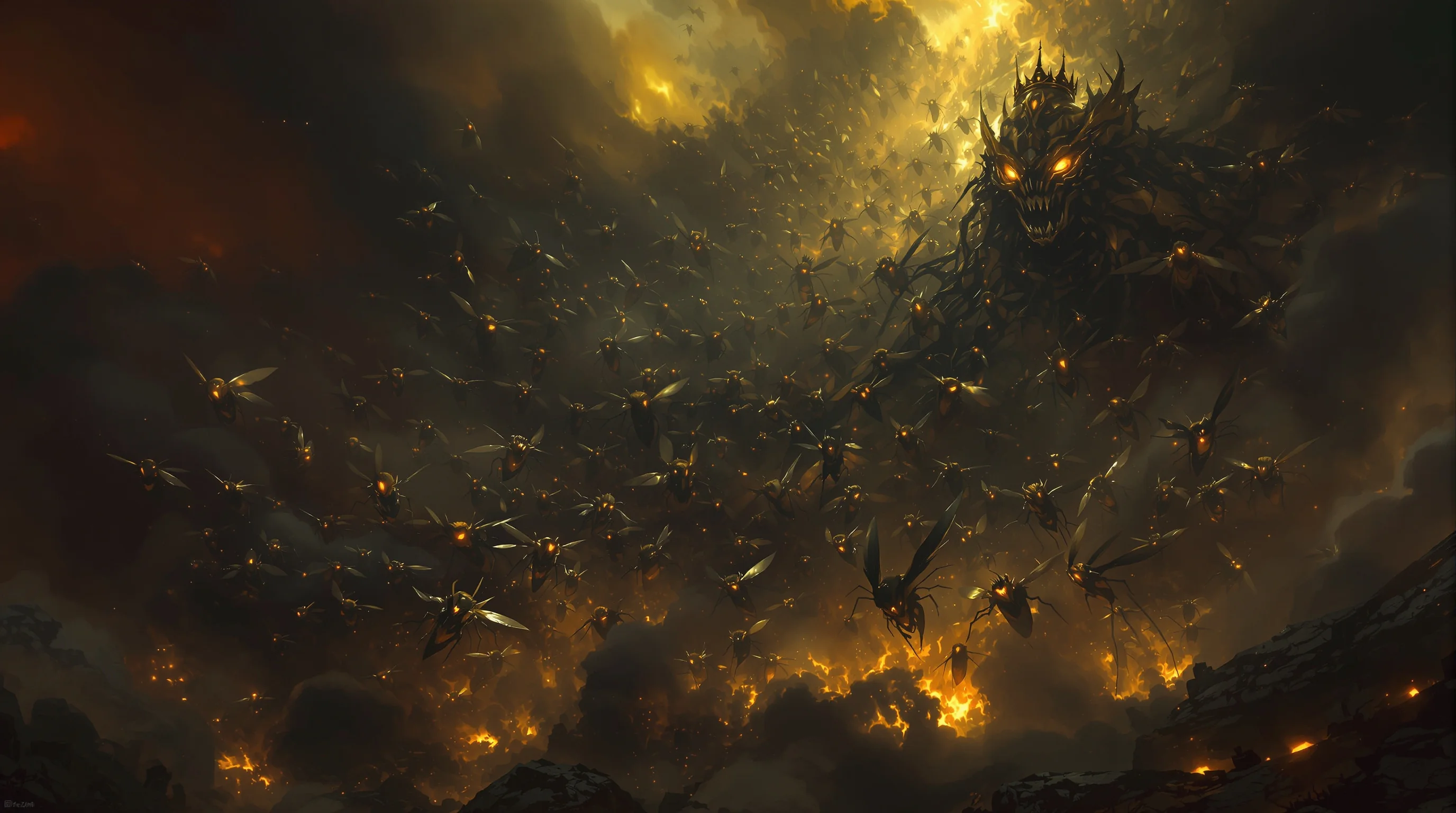
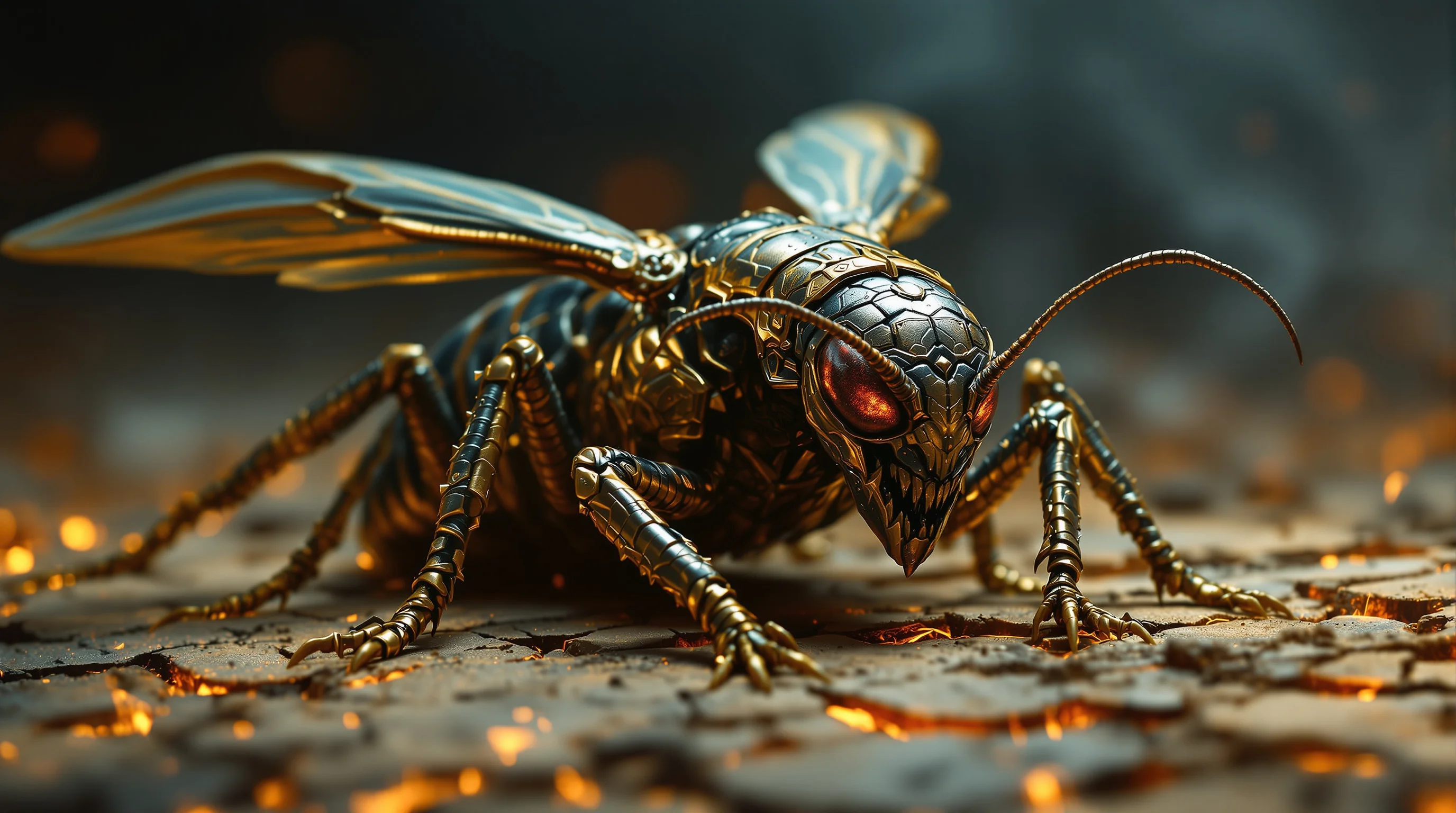
What appears from the pit defies easy categorization. Revelation 9:7-8 uses the Greek homoioma, meaning "likeness" or "resemblance," throughout the description: "The shape of the locusts was like horses prepared for battle. On their heads were crowns of something like gold, and their faces were like the faces of men. They had hair like women's hair, and their teeth were like lions' teeth" (NKJV Revelation 9:7-8). John is describing appearances, not identities. The repeated "like" signals visionary symbolism. Robert Mounce observes that the directed nature of the judgment confirms these are no ordinary creatures; the locust plague is a judgment aimed precisely at the enemies of God, not an indiscriminate catastrophe.
The king seals the case. Revelation 9:11 names the ruling angel Abaddon in Hebrew and Apollyon in Greek, both meaning "Destroyer." Grant Osborne notes this is a direct demonic assault, controlled but released by God's sovereign decree. Natural locusts have no king. These do. That contrast, drawn straight from Proverbs 30:27, is John's literary signal that these creatures belong to a different order entirely.
The Seal That Protects Believers
Revelation 9:4 draws a sharp line between the sealed and the unsealed.
- Scope of protection: The locusts skip all vegetation and harm only those without God's seal, reversing the pattern of the Exodus locust plague, which devastated crops.
- Greek term: Sphragis ("seal") denotes ownership and protection, connecting directly to the 144,000 sealed in Revelation 7:1-8.
- Implication: Covenant relationship with God is the one boundary demonic torment cannot cross.
Understanding the Locusts in Revelation Through Context
To read Revelation 9 well, we need to see where it sits in the larger structure. The seven trumpet judgments follow the opening of the seventh seal, and Revelation 8:13 marks a decisive shift: an eagle announces three woes distinct from the first four trumpets. The fifth trumpet, the locusts, is the first woe. This escalating structure is deliberate. These are warning judgments, severe but partial, designed to prompt repentance before the final consummation rather than to destroy outright.
The Old Testament background here is essential. G.K. Beale identifies Joel 1-2 as the primary source for the locust description, writing that "the bizarre appearance of the locusts shows that they are not ordinary locusts but demons... The description is developed from Joel 1-2, where locusts are also portrayed as a demonic army." Joel 2:4-5 reads: "Their appearance is like the appearance of horses; and like swift steeds, so they run... like a mighty people set in battle array" (NKJV Joel 2:4-5). John's language in Revelation 9:7-9 mirrors this almost exactly, signaling that the fifth trumpet recapitulates and intensifies Joel's Day of the Lord imagery. For readers steeped in Hebrew Scripture, the connection would have been immediate.
The contrast with Exodus is equally telling. The eighth plague devastated Egypt's vegetation as divine judgment. Revelation's locusts ignore vegetation entirely (NKJV Revelation 9:4), which distinguishes them from both natural locusts and the Exodus plague. Their supernatural identity is reinforced, not by what they do, but by what they refuse to do. For a verse-by-verse examination of how these Old Testament threads run through Revelation's trumpet sequence, Revelation Explained: Verse by Verse by Richard French traces each connection in its immediate context.
Maybe you've wondered whether passages like this one were meant for a specific audience in the first century, or whether they carry meaning for believers now. First-century readers living under pressure from the imperial cult would have heard something pastoral in this vision. Suffering was bounded, purposeful, and moving toward a divine conclusion. Grant Osborne's observation stands: God's sovereign decree frames the entire assault from beginning to end.
Four Interpretive Views in Brief
Scholars have read the locusts in Revelation through four main interpretive lenses.
- Preterist view: Events fulfilled in the Jewish-Roman War (66-70 AD), though the demonic king resists purely historical identification.
- Historicist view: Often connected to the rise of Islam in the seventh century, based on the composite warrior imagery.
- Futurist view: A literal demonic army released during a future Great Tribulation period.
- Idealist view: A timeless symbol of demonic torment targeting the unsealed throughout the church age.
Why the Locusts in Revelation Matter for Christians Today
The five-month limit on torment (NKJV Revelation 9:5) demonstrates that demonic power is real but leashed. God holds the central point to the Abyss. No destructive force operates outside His permission or beyond the boundaries He sets. For believers in every era, Revelation 9 delivers this assurance: demonic power is real, bounded, and unable to reach those who bear God's seal.
Protection here is covenantal, not incidental. The locusts cannot touch the sealed. Robert Mounce notes that the judgment is directed, not indiscriminate, which means the unsealed condition is the vulnerability, not geography or circumstance. Belonging to God carries genuine, active protection. That is a theological claim with real pastoral weight, and it connects directly to Abaddon's role as the locust king whose authority ends precisely where God's seal begins.
The most common misreading of this passage identifies the locusts with modern military technology or specific political movements. What the passage actually emphasizes is divine sovereignty, the protection of the sealed, and the call to repentance found in Revelation 9:20-21. The trumpet judgments are warning judgments, not final ones. God's purpose through them is repentance, and that purpose shapes how we read every detail of the vision.
Why This Vision Matters
Revelation 9 exists to produce trust. The locusts in Revelation remind us that the worst spiritual forces in creation operate within limits God holds. Believers sealed by Him are protected. The world is called to repentance. The God who governs demons governs history, and that truth is as steady today as it was for the seven churches of Asia Minor.
Conclusion
The locusts in Revelation 9 are demonic beings, not insects. They appear from the Abyss under divine permission, torment only the unsealed for a bounded period, and answer to a king named Destroyer. Every detail of the vision, from the composite appearance to the five-month limit to the protective seal, confirms God's sovereignty over evil. Nothing here is random. Nothing operates beyond His knowledge or outside His boundaries.
Revelation 9 is an invitation to remain sealed, stay in covenant, and trust the God who holds every central point. Your security before Him is declared, not incidental, and no demonic force has the authority to revoke it. For a deeper verse-by-verse exploration of this passage and the full trumpet sequence, see Revelation Explained: Verse by Verse by Richard French.
Sources
- Revelation 9:1-12 (NKJV) - primary text
- Revelation 7:1-8 (NKJV) - sealing of God's people
- Revelation 8:13 (NKJV) - three woes announcement
- Revelation 20:1-3 (NKJV) - the Abyss as demonic prison
- Joel 1:6; 2:4-5 (NKJV) - Old Testament locust army imagery
- Exodus 10:1-20 (NKJV) - the eighth plague of Egypt
- Proverbs 30:27 (NKJV) - locusts have no king
- Job 26:6; Proverbs 15:11 (NKJV) - Abaddon in Hebrew wisdom literature
- G.K. Beale, The Book of Revelation: A Commentary on the Greek Text (NIGTC; Eerdmans/Paternoster, 1999)
- Robert H. Mounce, The Book of Revelation, Revised Edition (NICNT; Eerdmans, 1997)
- Grant R. Osborne, Revelation (BECNT; Baker Academic, 2002)
- David E. Aune, Revelation 6-16 (WBC Vol. 52B; Word, 1998)
- Gordon D. Fee and Douglas Stuart, How to Read the Bible for All Its Worth (Zondervan, 2003) - for interpretive method and genre considerations