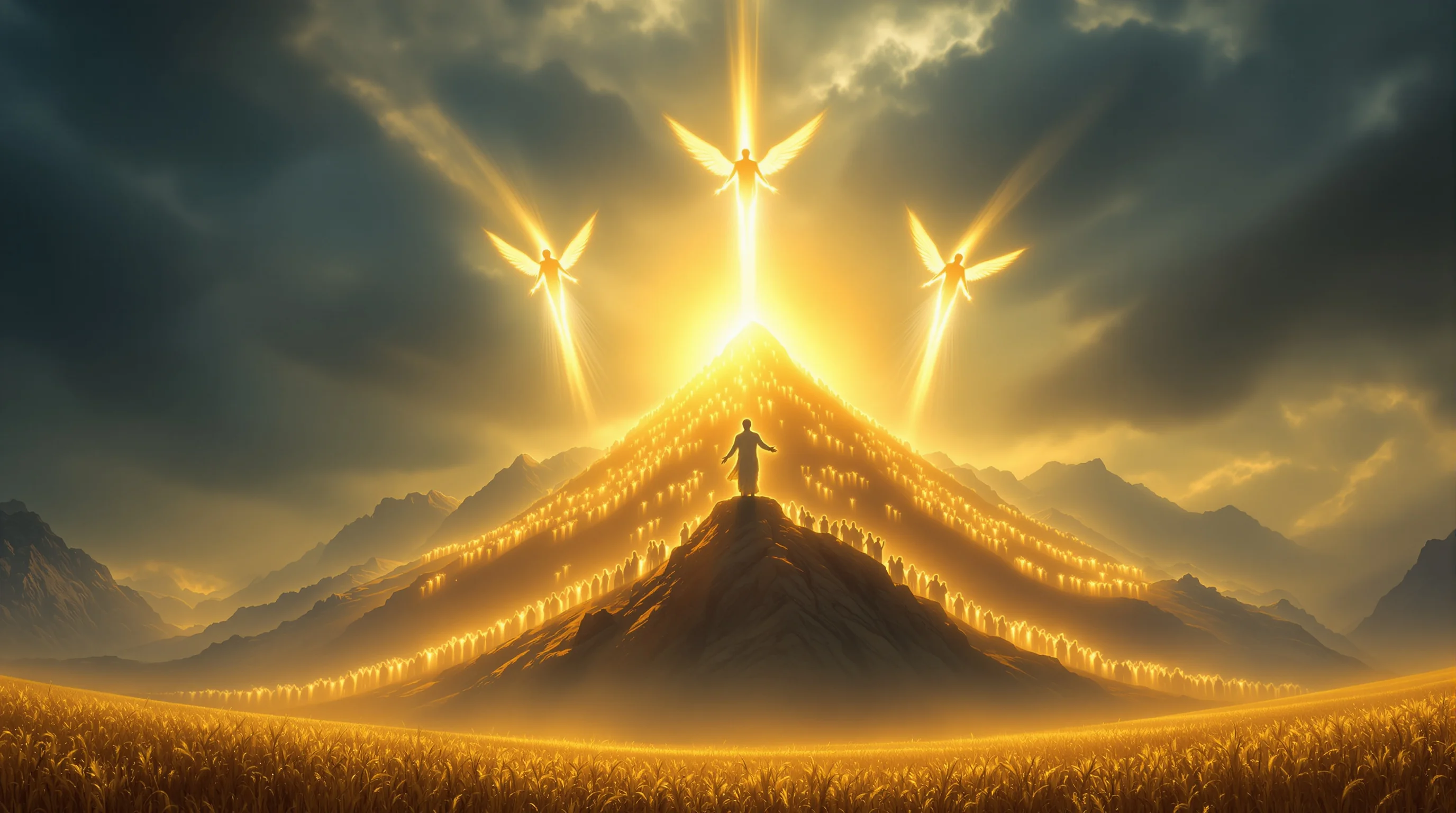
Revelation chapter 14 opens with a direct answer to the chapter before it. The beast of chapter 13 ends by forcing everyone to take his mark, "He causes all, the small and the great, the rich and the poor, and the free and the slave, to be given marks on their right hands or on their foreheads;" (WEB Revelation 13:16). Then the Lamb appears on Mount Zion, and His people bear a different mark: His Father's name written on their foreheads (WEB Revelation 14:1). Two marks point to two owners and two destinies.
Here, revelation chapter 14 reveals who wins once the beast has been given authority to make war on the saints, and the first readers of this letter needed that answer before facing the bowl judgments that follow in chapters 15 and 16.
Maybe you've wondered who holds the final word when the pressure to compromise keeps growing. Let's look at what this vision contains: the Lamb and the 144,000, three angels proclaiming judgment and grace, a blessing on the faithful dead, and a double harvest that closes the chapter. Taken together, these scenes tell us who is really in control.
Quick Answer: Revelation chapter 14 is a vision of the Lamb's certain victory. It shows Jesus standing on Mount Zion with the 144,000, three angels proclaiming the everlasting gospel, Babylon's fall, and a warning against beast worship, a blessing on the faithful dead, and a double harvest of grain and grapes that pictures final accountability.
Definition: The Lamb in Revelation 14 represents Jesus Christ standing in triumph over the beast and the dragon, gathering His redeemed people and bringing history toward a just and certain end.
Key Scripture: "I saw, and behold, the Lamb standing on Mount Zion, and with him a number, one hundred forty-four thousand, having his name, and the name of his Father, written on their foreheads." (WEB Revelation 14:1)
Key Evidence: The Father's name on the 144,000 answers the beast's mark (WEB Revelation 14:1; 13:16-17), the three angels proclaim the everlasting gospel and Babylon's fall (WEB Revelation 14:6-8), and the faithful dead rest from their labors (WEB Revelation 14:13).
Context: The chapter previews final outcomes rather than following a strict timeline, which fits Revelation's habit of showing the same reality from several angles.
This vision steadies believers caught between the beast's claims and the Lamb's. It works by contrasting two marks, two allegiances, and two destinies, and it shows that the Lamb's side ends in rest while the beast's side ends in judgment. The implication is that present pressure is real but never final. The sections below walk through the Lamb and the 144,000, the three angels, the promise to the faithful dead, the two harvests, and what this means for readers today.
Key Takeaways
- Two marks: The Father's name on the 144,000 answers the beast's mark from Revelation 13:16-17 (WEB Revelation 14:1).
- Firstfruits: The 144,000 are called firstfruits, the first portion of a harvest offered to God (WEB Revelation 14:4).
- Three angels: The angels announce the everlasting gospel, Babylon's fall, and a warning against beast worship (WEB Revelation 14:6-11).
- Rest for the faithful: Those who die in the Lord rest, and their works follow them (WEB Revelation 14:13).
- Two harvests: The grain harvest and the winepress draw on Daniel 7:13, Joel 3:13, and Isaiah 63:1-6.
What Happens in Revelation Chapter 14? The Lamb and the 144,000 on Mount Zion
Revelation chapter 14 begins with the Lamb standing on Mount Zion, the place of God's chosen King in Psalm 2:6 and the refuge of His people in Joel 2:32. John writes: "I saw, and behold, the Lamb standing on Mount Zion, and with him a number, one hundred forty-four thousand, having his name, and the name of his Father, written on their foreheads" (WEB Revelation 14:1).
The sealed forehead recalls Ezekiel 9, where those marked are spared judgment, and it echoes Exodus 28:36-38, where the high priest wore "Holy to the Lord" across his forehead. The Father's name on the foreheads of the 144,000 answers the beast's mark from the two beasts of Revelation 13, showing that the Lamb's people belong to Him alone.
John's repeated vision formula holds the chapter together (WEB Revelation 14:1, 14:6, 14:14). It moves from the redeemed, to the message, to the response, to the outcome.
Why the 144,000 Are Called Firstfruits
Revelation 14:4-5 describes the 144,000 in language borrowed from the sacrificial system. For the fuller debate over their identity, see Who Are the 144,000 in Revelation?
- Firstfruits: The Greek term means the first portion offered to God, and "blameless" is a sacrificial word.
- "Virgins": This likely pictures loyalty, since the prophets describe idolatry as adultery (Hosea 2; Ezekiel 16).
- Debate: Some interpreters read the 144,000 as literal Israel, others as a symbol for the whole church.
The Three Angels' Messages and the Call to Endurance
The first angel calls the whole earth to worship its Maker: "I saw an angel flying in mid heaven, having an eternal Good News to proclaim to those who dwell on the earth, to every nation, tribe, language, and people. He said with a loud voice, Fear the Lord, and give him glory, for the hour of his judgment has come. Worship him who made the heaven, the earth, the sea, and the springs of waters!" (WEB Revelation 14:6-7). This fourfold phrase echoes Daniel 3 and 7 and recurs in Revelation 5:9 and 7:9. Its message is a summons to fear God and worship the Creator, offered to every nation before the harvest begins.
Next comes a second angel, who announces, "Babylon the great has fallen, which has made all the nations to drink of the wine of the wrath of her sexual immorality" (WEB Revelation 14:8). Babylon appears here for the first time in Revelation, before chapters 17 and 18 describe her in full. The wording draws on Isaiah 21:9 and Jeremiah 51:7-8.
A third angel warns that worshiping the beast brings God's wrath, using fire and brimstone imagery that recalls Sodom (WEB Genesis 19:24). At the pastoral center of the chapter comes the call: "Here is the patience of the saints: here are they that keep the commandments of God, and the faith of Jesus" (KJV Revelation 14:12). For a fuller look at these three proclamations, see our guide on the three angels' messages.
"Blessed Are the Dead Who Die in the Lord"
Verse 13 is one of the chapter's most tender promises. "I heard a voice from heaven saying, Write, ‘Blessed are the dead who die in the Lord from now on.’ Yes, says the Spirit, that they may rest from their labors, for their works follow with them." (WEB Revelation 14:13).
- Comfort: The faithful dead are at rest, and their works are not forgotten.
The Two Harvests: The Grain and the Winepress
Revelation chapter 14 closes with two harvest scenes. First, "I looked, and saw a white cloud, and on the cloud one sitting like a son of man, having on his head a golden crown, and in his hand a sharp sickle." (WEB Revelation 14:14), who reaps the earth. Second, "The angel thrust his sickle into the earth, and gathered the vintage of the earth and threw it into the great wine press of the wrath of God." (WEB Revelation 14:19).
Together they picture final accountability. For readers who want to trace how this imagery develops across Revelation's narrative, Revelation Explained: Verse by Verse examines each occurrence in its immediate context.
Both readings are worth holding loosely, since the text itself leaves room for either. What stays constant is that judgment in this scene belongs to God and Christ alone, never to believers.
Old Testament Roots of the Harvest Imagery
John weaves three prophetic traditions into a single scene, and his first readers would have recognized each one.
- Son of Man on a cloud: drawn from Daniel 7:13-14.
- The sickle: "Put in the sickle; for the harvest is ripe. Come, tread, for the wine press is full, the vats overflow, for their wickedness is great." (WEB Joel 3:13).
- The winepress: in Isaiah 63:1-6, the divine warrior's garments are stained by the winepress of judgment.
How to Read Revelation Chapter 14 Today: Context, Views and Application
Revelation chapter 14 was first written to seven churches in Roman Asia, likely late in the first century, a period many scholars connect to Domitian's reign. Cities like Ephesus, Smyrna, and Pergamum were centers of the imperial cult, and trade guilds often required sacrifices to patron deities and the emperor. Christians who refused risked their income and sometimes their safety, and Antipas had already died for his faith at Pergamum (WEB Revelation 2:13). Many first-century believers already used "Babylon" as a code name for Rome (WEB 1 Peter 5:13), and the chapters on the seven trumpet judgments had already set the stage for this moment of decision.
Four main interpretive approaches apply this chapter differently. Preterists read Babylon as first-century Rome. Historicists connect the angels to later movements in church history, often the Reformation's recovery of the gospel. Futurists read the chapter as events shortly before Christ's return, with the harvest pointing to the Second Coming. Idealists see the chapter portraying realities that recur in every age. Most interpreters agree, whatever their view, that the Lamb is Christ, that Babylon represents idolatrous power, and that God's judgment is certain and just.
For readers today, that means worshiping the Creator alone, enduring under pressure, and sharing the gospel with every people. It's worth avoiding a few common missteps: setting dates, naming modern figures as the beast, treating the 144,000 as an exclusive group, or using harvest imagery to justify harming enemies. Revelation 14 equips believers to stay faithful by showing that the Lamb reigns, His people are secure, and every Babylon will fall.
Why This Vision Matters
Worship always has an object, and Revelation 14 asks every reader whose name they bear. Believers who face pressure to compromise can take courage from the Lamb standing on Zion with His people already named and secure. Grieving believers also have a promise here. Those who die in the Lord rest, and their works follow them.
Conclusion
Revelation chapter 14 shows the Lamb standing victorious on Zion with His sealed people, three angels calling the world to worship God, a promise of rest for the faithful dead, and a double harvest that brings history to a just end. If these visions feel heavy, that response makes sense. Faithful readers have wrestled with these images for two thousand years, and the weight is part of what makes the comfort real.
The God who judged Babylon and Sodom still reigns today, and the pressures you face are temporary even when they feel permanent. When something tempts you to bow anywhere but to Christ, remember that the Lamb keeps those who bear His name, and that includes you. For a deeper verse-by-verse exploration of Revelation's symbols and structure, see Revelation Explained: Verse by Verse by Richard French.