When the apostle John witnessed a sealed scroll in God’s hand that no one in heaven or earth could open, he wept—until a slain Lamb stepped forward to claim it. This dramatic moment in Revelation 5 reveals the hinge point of human history.
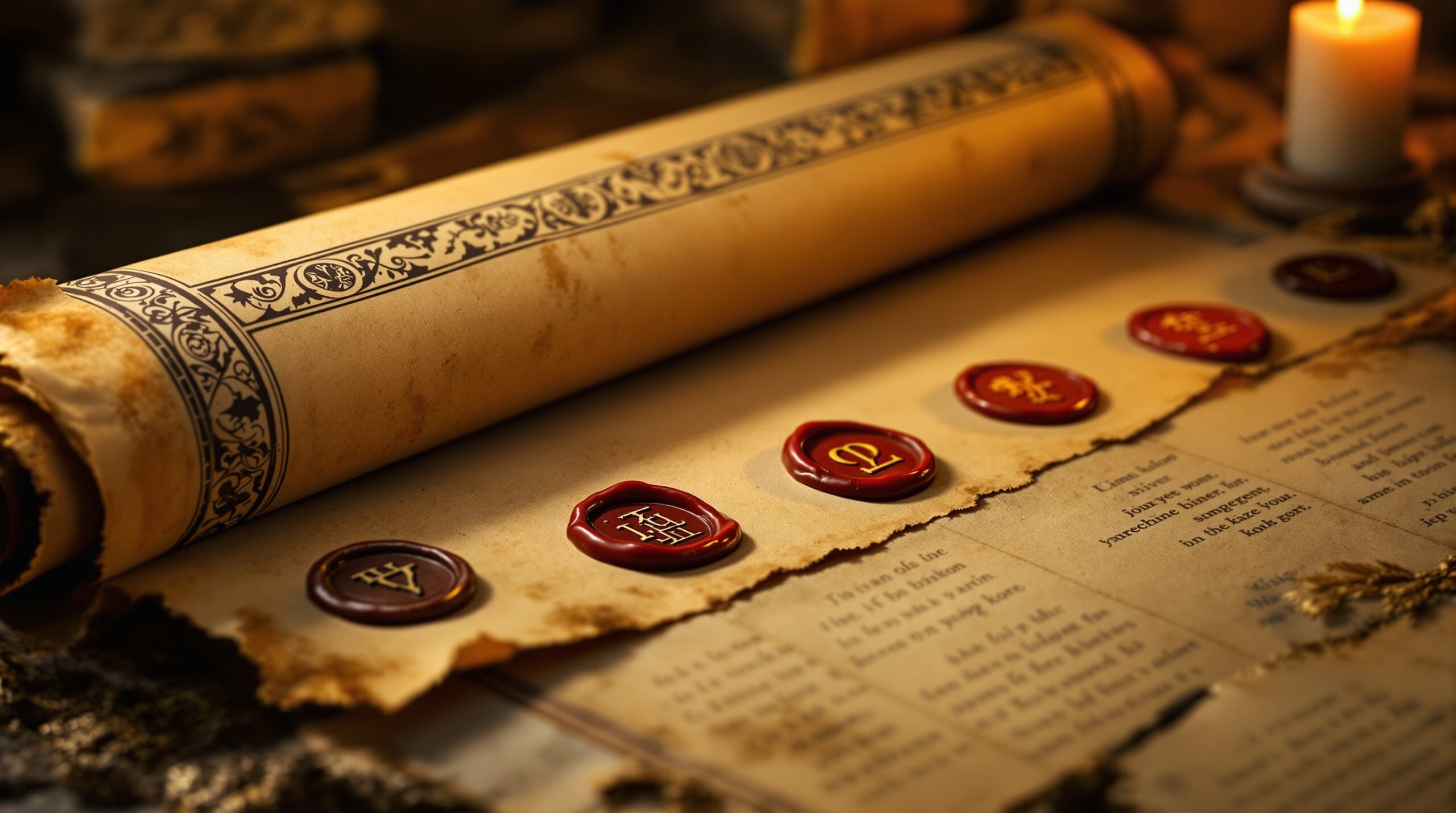
The scroll in Revelation 5 is not merely symbolic of hardship in general. It specifically represents God’s comprehensive plan for judging the world and redeeming creation, accessible only through Christ’s sacrificial victory. Context shows us a heavenly throne room where creation’s fate hangs in balance until the worthy One appears.
This passage addresses the crisis every believer faces: Does God control history when evil seems triumphant? Understanding what the scroll contains, who can open it, and why this vision matters for Christians today provides the answer.
Quick Answer: The scroll in Revelation 5 is God’s comprehensive plan for judging the world and redeeming creation, written inside and out and sealed with seven seals. Only Jesus Christ, the Lamb who was slain, possesses the authority to open it because His sacrificial death purchased humanity’s redemption and earned Him the right to execute divine judgment.
Definition: The scroll in Revelation 5 represents God’s complete redemptive and judicial plan for history’s conclusion, containing both the judgments and restoration that flow from Christ’s sacrificial victory.
Key Scripture: “You are worthy to take the scroll, and to open its seals; for You were slain, and have redeemed us to God by Your blood out of every tribe and tongue and people and nation” (NKJV Revelation 5:9)
Context: The scroll’s opening in Revelation 6 initiates the judgment sequences that culminate in new creation.
Key Takeaways
- The sealed scroll contains God's complete redemptive and judicial plan, written fully inside and out (Revelation 5:1)
- Christ's unique qualification stems from His death and resurrection—He conquered through sacrifice, not military power
- The scroll functions as both title deed to creation and legal indictment against rebellion
- Opening the seals releases judgments in Revelation 6-19, demonstrating that redemption and judgment flow from the same divine source
- The vision assures believers that history moves according to God's sovereign schedule, not human chaos or imperial power
What the Scroll in Revelation 5 Contains
The scroll in revelation 5 represents God's comprehensive plan for creation's future—both judgment and restoration. John describes it as "written inside and on the back, sealed with seven seals" (NKJV Revelation 5:1), indicating its contents are complete and secure. Greek term biblion refers to a scroll or book, while katesphragismenon means "sealed completely," emphasizing that no detail can be added or accessed without proper authority.Scholars such as G.K. Beale note that “the scroll represents God’s plan of judgment and salvation for the world, especially as it affects the saints. The scroll contains the entire contents of the remainder of the book.” This interpretation connects the scroll directly to Revelation 6-22, where its opening triggers successive judgments—seals, trumpets, and bowls—that ultimately lead to new creation.
Old Testament background illuminates the scroll’s meaning. Ezekiel received a scroll “written on the inside and on the outside, and written on it were lamentations and mourning and woe” (NKJV Ezekiel 2:10)—a document of judgment against rebellion. Daniel was told to “seal the book until the time of the end” (NKJV Daniel 12:4), establishing that divine plans remain hidden until God’s appointed moment. Grant Osborne explains the scroll functions as both inheritance document and legal indictment, describing it as a “title-deed” to earth—Christ’s redemptive work purchased creation, and breaking the seals depicts judgments that must occur before full possession.
Why No One Else Could Open It
John's grief in Revelation 5:4 reveals a cosmic crisis: "no one was found worthy to open and read the scroll." Greek axios means possessing sufficient moral weight and legal authority.- Created beings lack authority over God's redemptive plan
- Angels cannot execute judgment reserved for the God-man
- Only Christ bridges the gap as both Creator and Redeemer, possessing divine authority and human representation
The Lamb's Qualification to Open the Scroll
Christ's worthiness stems entirely from His sacrificial victory. An elder announces, "the Lion of the tribe of Judah, the Root of David, has prevailed to open the scroll" (NKJV Revelation 5:5). Greek enikēsen means "has conquered through victory"—but when John turns to see this conquering Lion, he beholds "a Lamb as though it had been slain" (5:6).This paradox reveals Revelation’s central truth: Christ conquers through sacrifice, not military force. Titles “Lion of Judah” (Genesis 49:9-10) and “Root of David” (Isaiah 11:1, 10) connect Him to Messianic prophecy, while the Lamb imagery evokes both Passover (Exodus 12) and Isaiah’s Suffering Servant (Isaiah 53:7).
Heavenly song explains His qualification: “You were slain, and have redeemed us to God by Your blood out of every tribe and tongue and people and nation” (NKJV Revelation 5:9). Greek ēgorasas means “purchased from the marketplace”—commercial language emphasizing that Christ bought humanity’s freedom through His death. According to Robert Mounce, “only the redemptive work of Christ qualifies him to execute the divine decree.”
Redemptive purchase grants Christ inheritance rights. Redeemed become “kings and priests” who “shall reign on the earth” (NKJV 5:10), echoing humanity’s original mandate in Eden and Israel’s calling in Exodus 19:6. Christ opens the scroll not as distant judge but as kinsman-redeemer claiming His purchased possession. For first-century Christians facing Roman persecution, this vision provided powerful counter-testimony: Caesar claimed ultimate authority, but only the slain Lamb holds history’s scroll.
Why This Vision Matters for Christians Today
The scroll in revelation 5 addresses the crisis every generation of believers faces: Does God control history when evil seems triumphant? John's tears (Revelation 5:4) reflect human despair when injustice prevails and God appears absent. The Lamb's appearance answers definitively—redemptive history proceeds on divine schedule, executed by the One truly worthy.This passage provides profound comfort to suffering believers. Original audience endured persecution, economic marginalization, and martyrdom under Roman imperial pressure. The scroll assured them their suffering wasn’t random but accounted for in God’s comprehensive plan. As Craig Keener notes, in a world where emperor-worship was required for marketplace participation, Christ’s “purchase” of people from every nation provided powerful alternative identity.
For modern Christians facing persecution, illness, injustice, or spiritual warfare, the same assurance applies: the Lamb holds the scroll. Nothing catches Him unprepared. History moves toward the restoration depicted in Revelation 21-22, not toward chaos. The vision also warns against complacency. The scroll contains judgments—divine responses to rebellion. Those outside Christ face not impersonal fate but the opened scroll’s contents.
Worship surrounding the scroll (5:8-14) models the proper response: recognizing Christ’s unique worthiness. Text calls readers not primarily to decode timelines but to worship the Lamb. When prophecy becomes intellectual puzzle-solving disconnected from adoration, we’ve misread it.
Avoiding Common Misapplications
Several misreadings distort the scroll's message and should be avoided:- Date-setting speculation treats the scroll as secret code for predicting contemporary events rather than emphasizing Christ's sovereignty
- Fear-based readings terrify Christians into anxiety instead of strengthening confidence in God's purposes
- Disconnecting judgment from redemption focuses on wrath while missing that both flow from the Lamb's sacrifice
Why This Vision Matters
The scroll in revelation 5 stands as Scripture's clearest statement that one Person—Jesus Christ—controls history's outcome through His redemptive sacrifice. For believers facing uncertain times, persecution, or personal suffering, this vision offers unshakable assurance: the Worthy One holds the scroll, and its contents lead not to destruction but to restoration. Our response should mirror heaven's—worship of the Lamb who alone deserves to open it.Conclusion
The scroll in revelation 5 represents God's complete plan for judging evil and restoring creation, accessible only through Christ's sacrificial victory. When John wept because no one could open it, the Lamb who was slain stepped forward—qualified by His redemptive death to execute divine purposes. This vision assures believers that history moves according to God's sovereign schedule toward new creation, not chaos. Our suffering has meaning, our prayers are heard, and the Worthy One controls the outcome.Sources
- Revelation 4:1-5:14 (immediate context)
- Revelation 6:1-8:1 (scroll's opening)
- Ezekiel 2:9-10 (written scroll imagery)
- Daniel 12:4, 9 (sealed scroll)
- Isaiah 29:11-12 (unreadable scroll)
- Genesis 49:9-10 (Lion of Judah)
- Isaiah 11:1, 10 (Root of David)
- Isaiah 53:7 (Lamb imagery)
- Exodus 19:6 (kingdom of priests)
- Beale, G.K. The Book of Revelation: A Commentary on the Greek Text. New International Greek Testament Commentary. Eerdmans, 1999.
- Osborne, Grant R. Revelation: Baker Exegetical Commentary on the New Testament. Baker Academic, 2002.
- Mounce, Robert H. The Book of Revelation: New International Commentary on the New Testament. Revised edition. Eerdmans, 1997.
- Keener, Craig S. Revelation: NIV Application Commentary. Zondervan, 2000.
- Johnson, Dennis E. Triumph of the Lamb: A Commentary on Revelation. P&R Publishing, 2001.