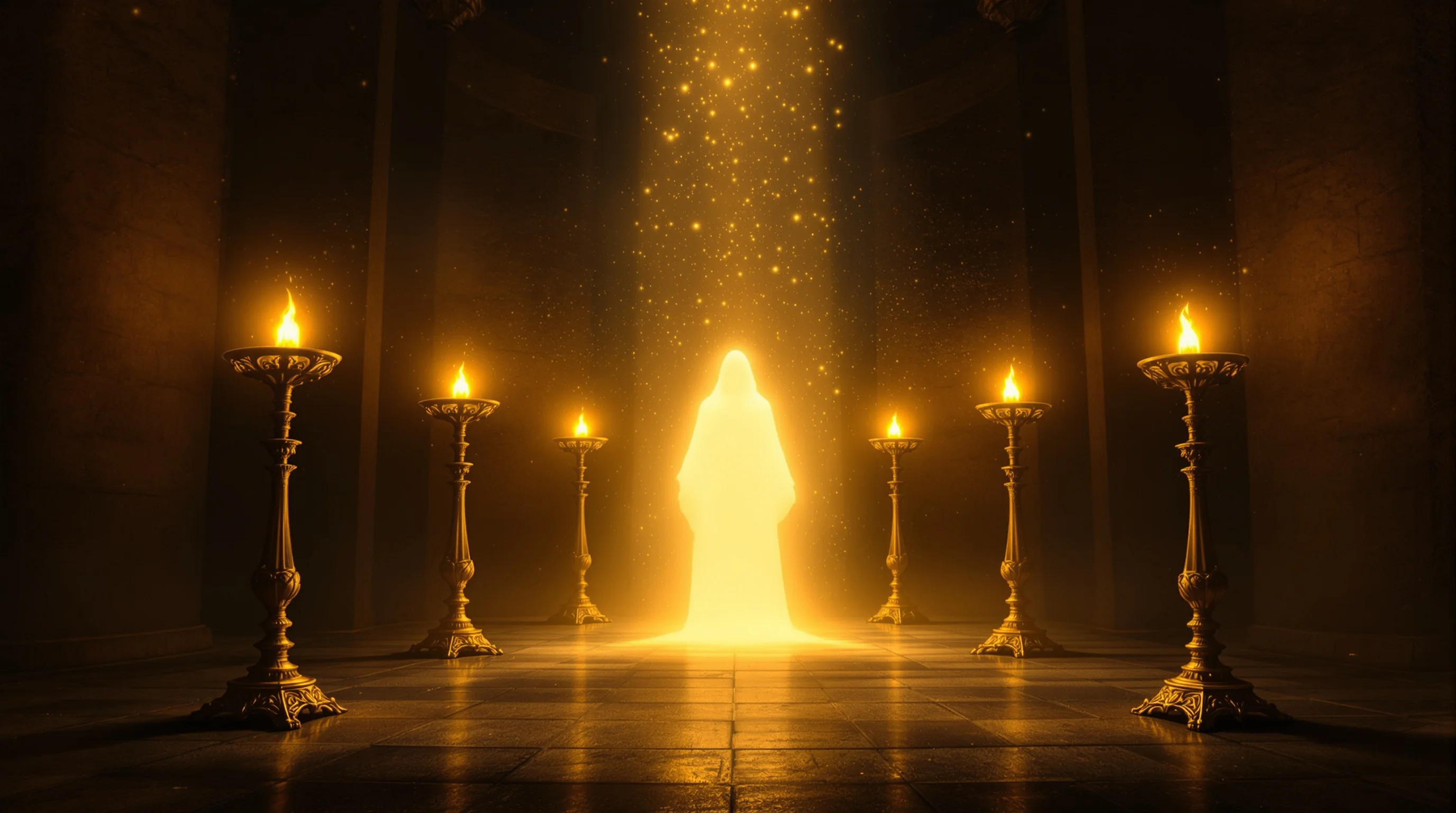
The first thing John sees when he turns toward the voice behind him on Patmos is startling: seven golden lampstands, with the risen Christ standing in the middle of them (WEB Revelation 1:12-13). If you find that image strange or even a little intimidating, you are in good company. It's okay to find Revelation's symbols challenging, since faithful readers have wrestled with them for centuries.
Here is the encouraging part. Revelation often explains its own symbols. John calls this one a "mystery," a previously hidden truth now being revealed, and then tells us plainly what it means (WEB Revelation 1:20). The seven golden lampstands represent something concrete: the actual churches Christ was addressing.
This article walks through what the seven golden lampstands are, where the image comes from in the tabernacle and in Zechariah 4, what the warning to Ephesus means, and how different interpretive approaches read the passage.
Quick Answer: The seven golden lampstands in Revelation are the seven churches of Asia Minor. Revelation 1:20 identifies them directly. Drawn from the tabernacle menorah and Zechariah 4, they portray the church as a light-bearing community. The risen Christ walks among his churches, tends them, and holds them accountable.
Definition: The seven golden lampstands in Revelation represent the seven churches of Asia Minor, pictured as light-bearing assemblies that Christ personally tends and oversees.
Key Scripture: "The mystery of the seven stars which you saw in my right hand, and the seven golden lamp stands is this: The seven stars are the angels of the seven assemblies. The seven lamp stands are seven assemblies." (WEB Revelation 1:20)
Key Evidence: Revelation 1:20 explicitly equates the lampstands with the seven assemblies, and Revelation 2:1 shows Christ walking among them. The tabernacle lampstand (WEB Exodus 25:31-40) and Zechariah's Spirit-fed lampstand (WEB Zechariah 4:2, 6) supply the background imagery.
Context: All major interpretive schools accept this identification; their disagreement concerns whether the seven churches also represent a timeline of church history or a pattern of churches in every age.
This vision functions as both introduction and foundation for chapters 2 and 3. It establishes that Christ is present among his people, watching, correcting, and sustaining their witness. Each of the letters that follow draws its opening description of Christ from this scene. The sections below examine the vision's Old Testament background, its meaning for the original audience, and what it offers believers today.
Key Takeaways
- Self-interpreted symbol: Revelation 1:20 states that the lampstands are seven assemblies, the churches of Asia Minor.
- Sanctuary imagery: The image draws on the golden lampstand of the tabernacle (WEB Exodus 25:31-40).
- Spirit-supplied light: Zechariah 4:6 teaches that God's people shine "by my Spirit" (WEB Zechariah 4:6).
- Christ's presence: Christ walks among the lampstands as an attentive overseer (WEB Revelation 2:1).
- Conditional warning: A church that does not repent can have its lampstand removed (WEB Revelation 2:5).
What Does the Bible Say About the Seven Golden Lampstands?
The seven golden lampstands appear in John's opening vision of the risen Christ. "I turned to see the voice that spoke with me. Having turned, I saw seven golden lamp stands. And among the lamp stands was one like a son of man, clothed with a robe reaching down to his feet, and with a golden sash around his chest." (WEB Revelation 1:12-13). The lampstands come first, before John even describes Christ's appearance. That ordering matters: the churches are the setting in which Christ is seen standing.
Revelation does not leave the image open to speculation. John calls it a "mystery" (Greek mystērion, something previously hidden now disclosed) and then explains it: "The mystery of the seven stars which you saw in my right hand, and the seven golden lamp stands is this: The seven stars are the angels of the seven assemblies. The seven lamp stands are seven assemblies." (WEB Revelation 1:20). The Greek word for assemblies is ekklesia, which simply means a called-out gathering.
The seven assemblies are named in the following chapters: Ephesus, Smyrna, Pergamum, Thyatira, Sardis, Philadelphia, and Laodicea. These were real congregations in the Roman province of Asia, and in context the number seven also suggests completeness. The seven golden lampstands in Revelation are the seven churches of Asia Minor, a meaning Revelation 1:20 states directly. Notice, too, that the lampstand (Greek luchnia, a stand that holds a lamp) carries the light and does not generate it.

The Seven Stars and Christ Among the Lampstands
Revelation 1:20 pairs the lampstands with a second symbol, the seven stars held in Christ's right hand. Revelation 2:1 describes him this way: "To the angel of the assembly in Ephesus write: He who holds the seven stars in his right hand, he who walks among the seven golden lamp stands says these things:" (WEB Revelation 2:1). The Greek word for walks, peripateō, pictures ongoing, attentive movement rather than a single visit.
- Christ's posture: He holds the stars securely while walking among the lampstands with care.
- What it reveals: Oversight is personal, not distant.
For more on the companion symbol, see What Are the Seven Stars in Revelation?
The Tabernacle Lampstand and Zechariah's Vision
The lampstand image has deep roots. In Exodus 25:31-40, God instructed Moses to make a lampstand of pure gold with seven lamps for the holy place, and the priests tended it continually (WEB Exodus 27:20-21). This priestly setting fits what Revelation says about believers elsewhere, that they are "and he made us to be a Kingdom, priests to his God and Father, to him be the glory and the dominion forever and ever. Amen." (WEB Revelation 1:6).
Zechariah's vision adds a second layer. The prophet sees "a lamp stand all of gold, with its bowl on the top of it, and its seven lamps on it" (WEB Zechariah 4:2), fed continually by two olive trees. The interpretation given to Zechariah is central: "Then he answered and spoke to me, saying, This is the LORD’s word to Zerubbabel, saying, ‘Not by might, nor by power, but by my Spirit,’ says the LORD of Armies." (WEB Zechariah 4:6). Revelation picks up this Spirit theme in 4:5: "Out of the throne proceed lightnings, sounds, and thunders. There were seven lamps of fire burning before his throne, which are the seven Spirits of God." (WEB Revelation 4:5). Later, Revelation 11:4 borrows Zechariah's language again for the two witnesses, calling them "the two olive trees and the two lamp stands, standing before the Lord of the earth" (WEB Revelation 11:4), though interpreters still debate who those witnesses are.
The seven golden lampstands draw on the tabernacle menorah and Zechariah 4, portraying the church as God's sanctuary light, fueled by his Spirit.
How the Churches in Asia Heard the Image
For the original churches, civic feasts and trade guilds often involved sacrifices, creating real pressure to compromise. John himself was exiled (WEB Revelation 1:9), and Antipas was martyred at Pergamum (WEB Revelation 2:13).
- Social pressure: Economic and civic life was tied to pagan worship.
- What the image told them: These vulnerable assemblies were God's true light-bearers, whatever their size.
Why the Seven Golden Lampstands Matter for Christians Today
The seven golden lampstands remind believers that Christ remains present in the middle of his churches, including the small and struggling ones (WEB Revelation 2:1). That presence brings both comfort and warning. To Ephesus, a church known for sound doctrine and hard work, Christ says: "Remember therefore from where you have fallen, and repent and do the first works; or else I am coming to you swiftly, and will move your lamp stand out of its place, unless you repent." (WEB Revelation 2:5).
Maybe you've wondered whether a busy, doctrinally careful church is automatically a healthy one. Ephesus shows that it is not; the congregation had left its first love even while staying active (WEB Revelation 2:2-4). Christ measures a church by love and faithfulness, not activity alone. The warning aims at repentance (Greek metanoeō, to change one's mind), and its purpose is restoration.
Zechariah 4:6 still applies: a church's witness depends on the Spirit Christ supplies, not on its own resources, continuing Israel's calling to be "a light to the nations" (WEB Isaiah 42:6; 49:6). Two missteps are worth avoiding: boasting that one's own church is superior to others, and reading the letters only as predictions while ignoring their original audience.
Different Views on the Seven Churches and Their Lampstands
All four major interpretive approaches accept Revelation 1:20, the menorah and Zechariah background, and the theme of Christ's presence and accountability. They differ mainly on how far the seven churches extend beyond their first-century setting.
Preterist: The lampstands are the actual first-century churches, and the warning to Ephesus addressed a real congregation facing a real choice.
Historicist: The seven churches represent successive stages of church history, from Ephesus as the early church to Laodicea as the final stage, a view that shaped much Reformation-era interpretation. Critics note that proposed sequences vary widely and the text gives no clear timeline signal.
Futurist: Most futurists accept the churches as historical while seeing them as representative types present throughout the church age; some dispensationalists also read a prophetic sequence into the order. This article takes no position on rapture timing or related questions.
Idealist: The lampstands are a timeless symbol of the Spirit-empowered church in every age, with seven pointing to fullness or completeness.
Each letter closes with the same invitation: "He who has an ear, let him hear what the Spirit says to the assemblies" (WEB Revelation 2:7). That phrase suggests the letters were meant for more than their original recipients. For a fuller look at each congregation, see this guide to the seven churches in Revelation.
Questions Still Debated
Evangelical interpreters agree on the core meaning of the lampstands but continue discussing related questions.
- The angels: The "angels" of the churches may be heavenly beings, human messengers, or personifications of the congregations.
- Removal: Some read Revelation 2:5 as the loss of a church's witness and standing, while others connect it to wider theological questions about salvation.
- Chapter 11: Scholars debate how the seven lampstands of chapter 1 relate to the two lampstands of chapter 11.
For a broader approach to reading Revelation's images verse by verse, this guide to decoding Revelation's symbolism walks through the method step by step. Richard French's Revelation Explained: Verse by Verse traces how this imagery develops across the book, chapter by chapter, for readers who want to go deeper.
Why This Vision Matters
The lampstand vision shows that Christ knows each congregation's works and stays present with it, rather than observing from a distance. For believers in churches that feel small or overlooked, the vision offers calm assurance alongside a clear calling to faithful witness. It connects to Revelation's larger message of hope: the Lord who walks among the lampstands is the same Lord who reigns from the throne (WEB Revelation 4:5).
Conclusion
The seven golden lampstands are the seven churches of Asia Minor, presented as light-bearers in the tradition of the tabernacle menorah and Zechariah's Spirit-fed lampstand. Christ walks among his churches, sees their faithfulness, calls them to repentance where needed, and supplies the very light they carry. If this image once felt distant or strange, you may now see it as an invitation: let your church's light depend less on its own strength and more on the Spirit who tends it. Your small acts of faithfulness are seen by the One who walks among you. For a deeper verse-by-verse exploration of Revelation's symbols and structure, see Revelation Explained: Verse by Verse.