Most readers can describe the two witnesses, yet few can explain why John measures a temple right before they appear or why a trumpet blast follows their resurrection. The chapter often gets read in fragments, and the thread connecting these scenes goes missing. This Revelation 11 explained walkthrough treats the chapter as one continuous vision rather than three unrelated episodes, following the verse-by-verse approach commentator G.K. Beale takes in his NIGTC commentary.
Revelation 11 is the second great interlude in the trumpet sequence, pausing the judgments to show what happens to God's people during the final season of trouble. It only makes sense when read as one movement, from measuring rod to open heavenly temple. The chapter presents a single argument: God protects, His witnesses testify at real cost, and heaven announces the outcome before the story finishes unfolding.
Maybe you've wondered whether your own quiet faithfulness counts for anything when no one seems to notice, the way believers under Domitian's reign must have wondered as they faced social and economic pressure for refusing emperor worship. This chapter speaks directly to that question. The walkthrough below follows the text verse by verse, shows how its three scenes connect, and explains why the seventh trumpet announces a reality rather than triggering a new disaster.
Quick Answer: Revelation 11 is a single vision in three movements: God measures and protects His true worshipers, two witnesses prophesy, die, and rise, and the seventh trumpet announces that the kingdoms of this world have become the kingdom of Christ. Protection, costly witness, and vindication form one unbroken argument.
Definition: The temple vision in Revelation 11 represents the church's protected yet costly testimony during a divinely limited season of persecution, culminating in heaven's declaration that Christ's reign has arrived.
Key Scripture: "The kingdoms of this world have become the kingdoms of our Lord and of His Christ, and He shall reign forever and ever!" (NKJV Revelation 11:15)
Context: The chapter interrupts the trumpet judgments to show the church's role during the limited season of trampling before the end.
This vision exists to answer a question every persecuted believer eventually asks: does faithful testimony matter if it ends in apparent defeat? The measuring scene establishes that God knows and protects His own, the witnesses demonstrate that testimony carries real cost, and the seventh trumpet confirms that cost was never wasted. It's worth noting that this question has pressed on believers since the first century, and you are not the first to feel its weight. The sections below work through the chapter in order, then turn to what this pattern means for readers facing their own pressure to stay quiet.
Key Takeaways
- Measuring: the sanctuary measurement in Revelation 11:1 marks God's ownership and spiritual protection of true worshipers (Beale, NIGTC).
- Forty-two months: the trampling period is divinely limited, echoing Daniel 7:25.
- Two witnesses: Moses and Elijah imagery portrays empowered prophetic testimony clothed in sackcloth.
- Death and resurrection: apparent defeat followed by vindication mirrors Christ's own pattern.
- Seventh trumpet: heaven announces an accomplished reign rather than launching a fresh plague.
Key Evidence:
- Naos designates the inner sanctuary rather than the broader temple complex, so the measuring concerns worshipers, not architecture (Beale, NIGTC).
- The witnesses' powers parallel Elijah shutting heaven (1 Kings 17:1) and Moses turning water to blood (Exodus 7:17-20).
- The 1,260 days and forty-two months echo Daniel 7:25's "time, times, and half a time."
- Craig Koester identifies the witnesses as embodying the church's prophetic vocation, provoking hostility and in the end receiving vindication (Koester, Anchor Yale Bible).
- Craig Keener notes that readers under Roman imperial pressure heard this chapter as assurance that their marginal status was known and temporary (Keener, NIVAC).
Revelation 11 Explained Verse by Verse
Revelation 11 explained in order reads as one vision with three scenes and no breaks between them. Each builds directly on what came before, and losing that sequence is what makes the chapter feel disconnected.
John receives a measuring rod for the sanctuary, the altar, and the worshipers in verses 1-2, while the outer court is left to the nations, who tread the holy city underfoot for forty-two months. The Greek word naos names the inner sanctuary rather than the broader temple complex, so the measuring concerns worshipers, not architecture (Beale, NIGTC).
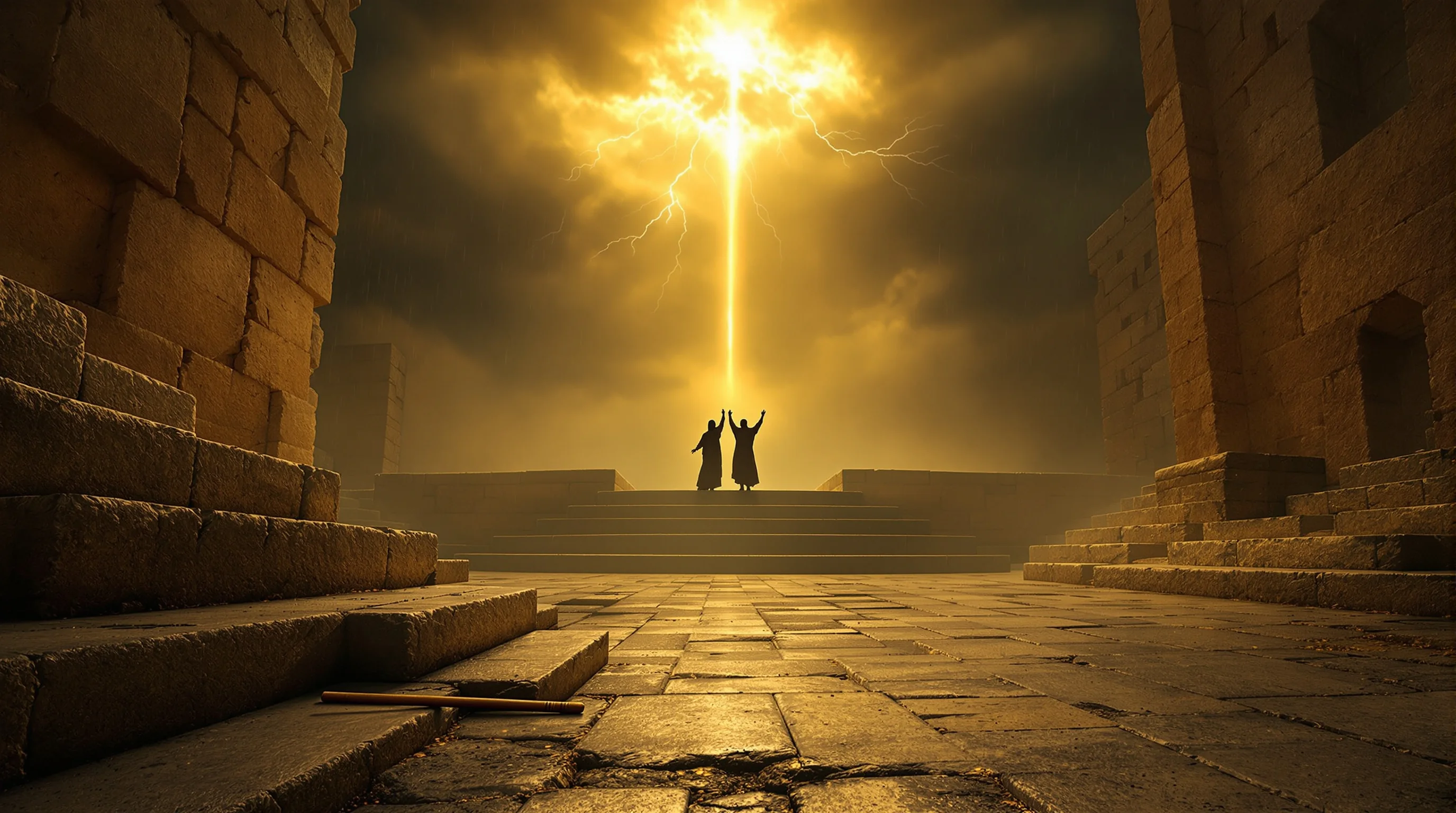
Two witnesses who prophesy 1,260 days in sackcloth appear in verses 3-6. They hold power to shut heaven like Elijah (NKJV 1 Kings 17:1) and turn water to blood like Moses (NKJV Exodus 7:17-20), and John identifies them as the two olive trees and lampstands from Zechariah 4.
The beast from the bottomless pit makes war on the witnesses in verses 7-10, kills them, and a watching world refuses them burial, celebrating over their bodies in "the great city" called Sodom and Egypt, "where also our Lord was crucified" (NKJV Revelation 11:8).
Verses 11-14 reverse the scene entirely. "The breath of life from God entered them, and they stood on their feet" (NKJV Revelation 11:11), echoing Ezekiel 37. An earthquake follows, survivors give glory to God, and the second woe passes. The chapter closes in verses 15-19: the seventh angel sounds, heaven worships, and the heavenly temple opens to reveal the ark of the covenant.
The Three Scenes as One Argument
Each scene answers the question the previous one raises.

- Measuring: establishes who belongs to God before danger arrives
- Witnesses: show what belonging costs during the limited season of trampling
- Trumpet and ark: declare the outcome that made the witness worth it, with covenant faithfulness visibly confirmed (Koester, Anchor Yale)
Readers wanting a fuller treatment of the witnesses themselves can turn to who the two witnesses represent for a dedicated look at their identity and purpose.
Understanding the Seventh Trumpet as an Announcement
The seventh trumpet in Revelation 11 explained correctly is a proclamation of completed sovereignty rather than a described disaster. That distinction changes how the whole chapter reads.
Each of the first six trumpets describes a judgment striking the earth, structurally speaking. The seventh breaks that pattern entirely. It produces loud voices in heaven and the worship of the twenty-four elders, with no plague narrated at all.
The Greek word basileia carries the sense of reign and royal power, and the verb tense presents the transfer of authority as already accomplished, a grammatical point Beale shows at length in his NIGTC commentary. The seventh trumpet reports a throne that has changed hands, not a disaster that has struck.
The elders' song in verses 17-18 summarizes everything the rest of the book will unfold: wrath, judgment of the dead, reward for the prophets and saints, and destruction of those who destroy the earth. Chapters 12-20 work out what this single verse already announces, a structural observation Beale draws out in his commentary (Beale, NIGTC). The opened temple and visible ark in verse 19 confirm that God's covenant faithfulness stands fully disclosed, bridging directly into the woman and dragon vision of chapter 12.
Craig Koester observes that the witnesses embody the prophetic vocation of the church, provoking hostility and in the end receiving vindication (Koester, Anchor Yale Bible). For a longer discussion of this verse's place in the trumpet sequence, see what the seventh trumpet announces, and for background on the earlier judgments, see the seven trumpets explained.
A Brief Survey of Interpretive Views
Four approaches read the chapter's symbols differently while agreeing on its promise, as commentators like Beale and Keener illustrate in their respective treatments (Beale, NIGTC; Keener, NIVAC).
- Preterist and historicist: tie the witnesses to AD 70 events or to long eras of faithful gospel testimony
- Futurist: expects a rebuilt temple and two literal end-time prophets
- Idealist: reads the measured temple and witnesses as the church's protected, ongoing testimony
It's okay to find these competing views unsettling. Faithful readers from Victorinus of Pettau in the third century to modern commentators have weighed them, and the chapter's central promises, protection, costly witness, and vindication, hold steady regardless of which framework a reader favors.
Why Revelation 11 Matters for Christians Today
Revelation 11 explained as one movement gives believers a complete picture of their situation between the cross and the consummation. Craig Keener notes that the chapter's original audience faced real Roman imperial pressure (Keener, NIVAC), yet its promises were never meant to stay locked in the first century.
God measures and knows His worshipers. Believers who feel unrecognized, excluded, or pressured hold a place God has personally marked out (Beale, NIGTC). Hostility also has a boundary. The forty-two months and 1,260 days echo Daniel's "time, times, and half a time," presenting persecution as a bounded season rather than open-ended chaos.
Faithful witness carries real cost and real vindication. The witnesses are killed before they are raised, so suffering preceding honor is the normal shape of Christian testimony, not an exception to it. Two misreadings are worth guarding against: treating worldly success as proof of faithfulness, and mining the chapter for a predictive calendar, the kind of speculation that fueled Harold Camping's failed 2011 end-times predictions. The text's symbolism points to theological realities, not a timeline to decode.
The seventh trumpet reorders the believer's expectations. Christ's reign is announced as settled, so patience in witness rests on an outcome already declared in heaven. Craig Keener notes that readers under Roman imperial pressure, familiar with Antiochus Epiphanes' desecration and Jerusalem's fall, heard this as assurance that their marginal status was known and temporary (Keener, NIVAC). Perhaps you've felt that same marginal status in a smaller way, overlooked at work, dismissed for your convictions, or unsure your quiet obedience matters. Revelation 11 teaches that God protects His people spiritually, limits their suffering temporally, and vindicates their testimony eternally.
For readers wanting to trace how this pattern of measured protection and costly testimony develops across the rest of the book, Revelation Explained: Verse by Verse examines each scene in its immediate context.
Why This Vision Matters
Revelation 11 assures the church that its most vulnerable moments are measured, bounded, and headed toward vindication. Christians facing ridicule, exclusion, or indifference can testify without needing visible success as confirmation that God is at work. Heaven's response to the seventh trumpet is worship, not dread, and that response sets the tone for how believers hold the future.
Conclusion
Revelation 11 explained as one continuous vision moves from measured worshipers to martyred witnesses to an announced kingdom, with each scene supplying what the next assumes. Protection, costly testimony, and certain vindication belong together; none stands complete without the others. Wherever you find yourself feeling unseen or unheard for your faith, remember that the trumpet has already named the outcome. Your faithfulness now is grounded in a verdict heaven has settled, not one still hanging in the balance. For a deeper verse-by-verse exploration of Revelation's symbols and structure, see Revelation Explained: Verse by Verse by Richard French.
Sources
- Primary Scripture Passages:* Revelation 11:1-19; Ezekiel 40:3-5, 37:5-10; Daniel 7:25, 12:2, 7; Zechariah 4:1-14; 1 Kings 17:1; Exodus 7:17-20
- G.K. Beale, The Book of Revelation: A Commentary on the Greek Text (NIGTC, Eerdmans, 1999)
- Craig R. Koester, Revelation: A New Translation with Introduction and Commentary (Anchor Yale Bible, Yale University Press, 2014)
- Richard Bauckham, The Theology of the Book of Revelation (Cambridge University Press, 1993)
- Grant R. Osborne, Revelation (Baker Exegetical Commentary on the New Testament, 2002)
- David E. Aune, Revelation 6-16 (Word Biblical Commentary, 1998)