Revelation is a book built on unveiling, yet in chapter 10 John lifts his pen to write and a voice from heaven stops him mid-sentence. The seven thunders in Revelation 10 utter their voices, and instead of recording what he heard, John is told, "Seal up the things which the seven thunders uttered, and do not write them" (NKJV Revelation 10:4). It's the one moment in the entire book where revelation is deliberately withheld, and that naturally makes readers want to know why God would show John something only to lock it away. If you've felt puzzled or even a little frustrated by a Bible passage that seems to promise an answer and then pulls it back, you're not alone. This article walks through the scene, the command to seal, the explanations scholars offer, and what the passage teaches about curiosity and trust.
Quick Answer: The seven thunders in Revelation 10 are seven divine utterances John heard but was forbidden to record. Thunder in Scripture signals God speaking, so the thunders represent genuine revelation that God chose to seal rather than disclose. Their content remains unknown by design.
Definition: The seven thunders in Revelation represent authentic divine speech that God deliberately withheld from John's written record, marking the one deliberate reversal of disclosure in a book whose purpose is otherwise to unveil.
Key Scripture: "When the seven thunders uttered their voices, I was about to write; but I heard a voice from heaven saying to me, 'Seal up the things which the seven thunders uttered, and do not write them.'" (NKJV Revelation 10:4)
Context: The Greek verb for "seal" (sphragizō) means to close up and make secure, a striking reversal inside a book whose title itself means "unveiling."
This vision functions as a built-in limit on prophetic disclosure. It shows that God's revelation is generous without being exhaustive, and that the gap between what He shows and what He explains belongs to His own wisdom. The seven thunders in Revelation represent a boundary God sets on His own terms, for His own good reasons. For believers, that limit becomes an invitation to trust rather than a puzzle to solve. The sections below trace the scene itself, the reasons scholars give for the sealing, and what this sealed mystery means for readers today.
Key Takeaways
- Thunder means divine speech: Scripture consistently pairs thunder with God's voice, as in Psalm 29, where the voice of the LORD sounds seven times.
- Sealed, not forgotten: John was told to seal the message, meaning the content was real and authoritative rather than empty noise.
- A deliberate reversal: This is the only place in Revelation where John is commanded to withhold instead of record.
- Daniel's pattern repeats: Daniel 12:4, 9 shows the same sealing instruction, placing hidden content under God's timing.
- Restraint is the point: All four major interpretive schools agree the passage teaches limits on human knowledge rather than offering a code to decipher.
Key Evidence
- Psalm 29: The voice of the LORD is described as thunder seven times, establishing the thunder-as-divine-speech pattern John draws on in Revelation 10.
- Daniel 12:4, 9: Daniel is told to shut up the words and seal the book until the time of the end, the direct precedent for John's sealing command.
- Revelation 10:4 (NKJV): The explicit command "Seal up the things which the seven thunders uttered, and do not write them" grounds the entire interpretive question in the text itself.
- Revelation 10:7: The promise that "the mystery of God would be finished" at the seventh trumpet ties the sealed content to God's unfolding plan rather than permanent secrecy.
- Scholarly consensus: Osborne, Keener, and Mounce each independently read the sealing as a literary and theological signal of restraint rather than an invitation to speculation.

The Scene Behind the Seven Thunders in Revelation 10
One of the book's most vivid scenes introduces the seven thunders in Revelation 10. A mighty angel descends clothed with a cloud, a rainbow on his head, his face like the sun, and his feet like pillars of fire, holding a little scroll (NKJV Revelation 10:1-2). Readers curious about that object in his hand may find the related exploration of the golden censer scene in Revelation 8 helpful, since it offers context on how heavenly objects carry symbolic weight throughout John's visions.
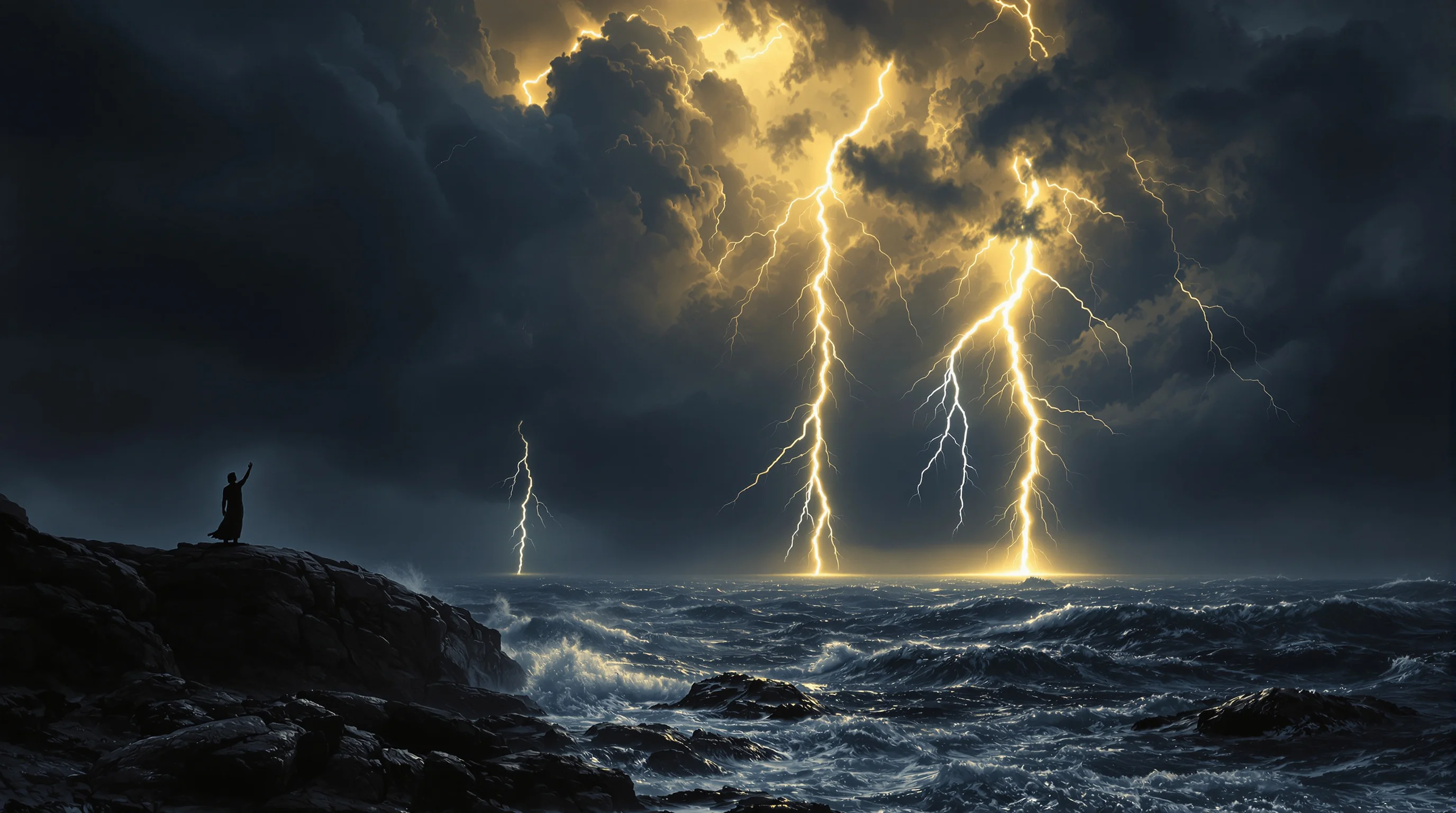
He plants one foot on the sea and one foot on the land, then cries out "as when a lion roars," and the seven thunders answer (NKJV Revelation 10:3). The Greek word brontai (thunders) carries theophany associations stretching back to Sinai and the Psalms, moments where God speaks in a way His people could hear but not fully grasp.
These thunders are not background sound effects but articulate divine speech, since John understood them well enough to begin writing them down. Grant Osborne notes that the thunders function structurally to heighten anticipation for the seventh trumpet while preserving the mystery native to apocalyptic literature (Osborne, BECNT). That tension between anticipation and restraint shapes everything that follows in the chapter.
Why John Was Told to Seal the Seven Thunders in Revelation
This command carries real force. Sphragizō means to seal, close up, and make secure, language that stands in direct tension with a book whose Greek title, apokalypsis, means "unveiling." This tells readers the text stays comfortable holding both disclosure and restraint in the same vision.
Immediately after the sealing, the angel swears by Him who lives forever that "there should be delay no longer" (NKJV Revelation 10:5-6), tying the sealed material to God's own timetable rather than to human curiosity. Revelation 10:7 points forward: at the seventh trumpet "the mystery of God would be finished," signaling that whatever stays hidden here still resolves within God's completed plan. For the fuller picture of what that resolution looks like, see what the seventh trumpet in Revelation announces.
Daniel offers a direct precedent. He was told to "shut up the words, and seal the book until the time of the end" (NKJV Daniel 12:4, 9), a pattern John's first readers would recognize instantly. Sealing the seven thunders tells readers that God's revelation is generous but not exhaustive, and the difference is intentional. Craig Keener observes that John's audience would have read this scene as an affirmation of God's sovereignty over what remains unrevealed, rather than as a puzzle to solve (Keener, NIVAC).
Three Explanations Scholars Weigh
Commentators generally offer three accounts of what the thunders may have contained.
- A withheld judgment cycle: a further series of judgments paralleling the seals and trumpets, perhaps shortened or cancelled in mercy
- Details reserved for God's timing: content sealed like Daniel's prophecy until the appointed end
- A literary signal of mystery: the act of sealing is itself the message, marking the boundary of what apocalyptic literature discloses (Osborne, BECNT)
What Sealed Thunders Teach About Curiosity and Trust
Perhaps you've wondered whether these sealed verses hide some secret meant only for a select few. God discloses what His people need for faithfulness and withholds what would only feed speculation. It's okay if this passage still leaves you with questions. Faithful readers have wrestled with the sealed thunders for centuries, and that wrestling is part of taking Scripture seriously rather than a sign you're missing something obvious.
Keener's background work shows that first-century Asia Minor was saturated with mystery religions promising secret knowledge to paying initiates (Keener, NIVAC), and the sealed thunders stand in sharp contrast to that culture of purchased secrets. The angel standing with one foot on sea and one on land also claimed cosmic authority in a world where Rome advertised its own dominion over land and sea on its coinage. The image quietly insists that ultimate authority belongs to heaven, not Caesar.
A common misapplication treats the thunders as a code to crack through numerology or extrabiblical sources, an approach that directly contradicts the text's own instruction to seal rather than explore. The right response to the seven thunders is obedience to what God has revealed, since John kept prophesying with a sealed mystery still ringing in his ears. He ate the little scroll, found it sweet then bitter (NKJV Revelation 10:10), and was commissioned to "prophesy again" (NKJV Revelation 10:11). Robert Mounce notes that this kind of prophetic commissioning always carries both delight and cost (Mounce, NICNT). Readers wanting to trace this pattern across the wider trumpet sequence may find the overview of the seven trumpets in Revelation helpful for seeing how this interlude fits the larger structure. For a verse-by-verse treatment of how this scene connects to the surrounding chapters, Revelation Explained: Verse by Verse walks through the little scroll and its context in detail.
Where the Four Interpretive Schools Agree
Despite different timelines, the major interpretive approaches converge on this passage.
- Preterist and historicist readings see details withheld because they were unnecessary for the original audience or the unfolding era
- Futurist readings reserve the judgments for a yet-future tribulation, paralleling Daniel's sealed prophecies
- Idealist readings treat the thunders as a timeless principle that divine providence always exceeds human comprehension
Why This Vision Matters
Believers are not responsible for knowing everything about God's plan, only for receiving and proclaiming what He has made plain. In an age of prophecy charts and date-setting, the sealed thunders model restraint and humility instead. This moment matters because it frees you from the pressure of needing to understand every mystery before you can trust God with it. The same chapter that withholds also promises completion, since the mystery of God will be finished and "the kingdoms of this world have become the kingdoms of our Lord" (NKJV Revelation 11:15).
Conclusion
The seven thunders in Revelation are genuine divine utterances sealed by God's own instruction, and their silence marks a deliberate limit on what prophecy discloses. You don't need to crack that code to live faithfully. If you came to this passage feeling unsettled by what you couldn't know, let that unsettled feeling rest. A God who withholds some things has already revealed everything you need for faith, obedience, and hope, and His timing needs no improvement from your speculation. For a deeper verse-by-verse exploration of Revelation's symbols and structure, see Revelation Explained: Verse by Verse by Richard French.
Sources
- Revelation 10:1-11 (NKJV)
- Revelation 5:1-14 (NKJV)
- Ezekiel 3:1-3 (NKJV)
- Daniel 12:4, 9 (NKJV)
- Psalm 29:3-9 (NKJV)
- Revelation 11:15-19 (NKJV)
- G.K. Beale, The Book of Revelation: A Commentary on the Greek Text (NIGTC)
- Craig Keener, Revelation (NIV Application Commentary)
- Grant Osborne, Revelation (Baker Exegetical Commentary on the New Testament)
- Robert Mounce, The Book of Revelation (NICNT)
- David Aune, Revelation 6-16 (Word Biblical Commentary)