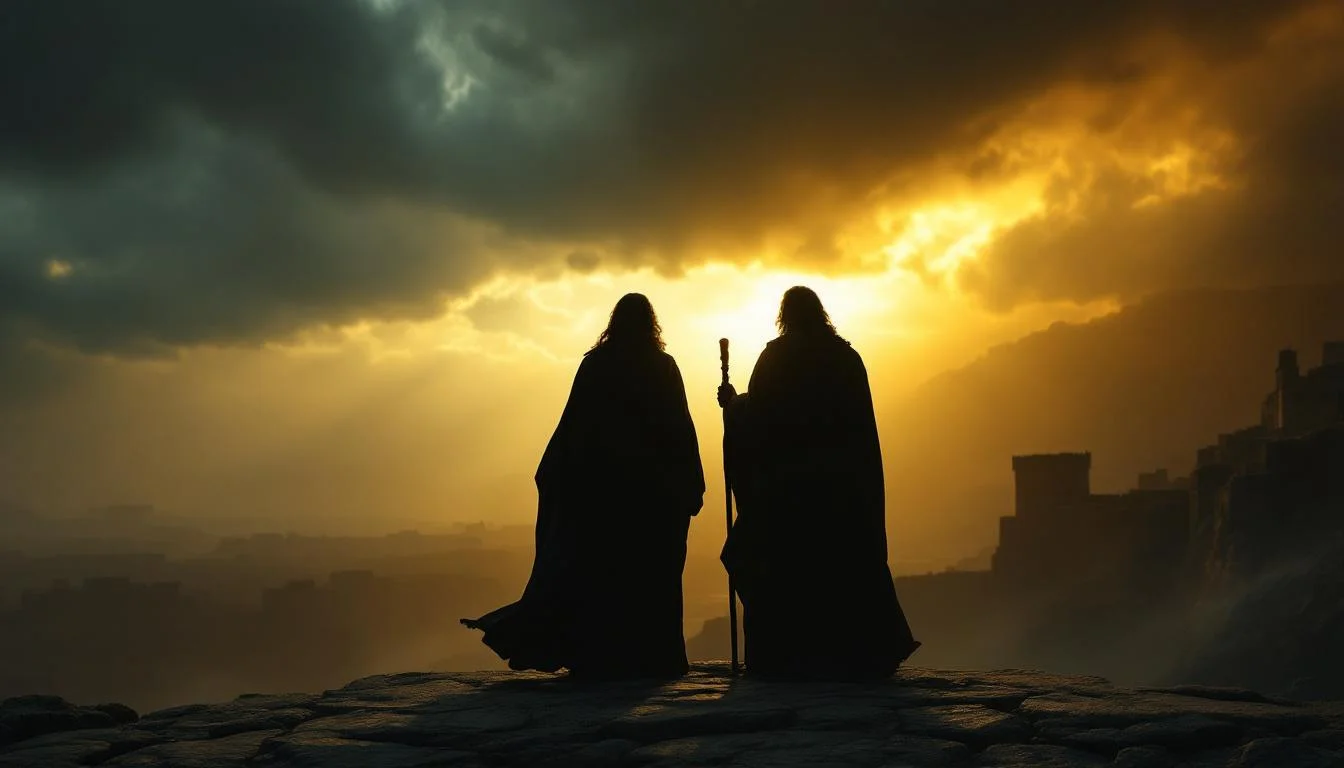
Two witnesses of Revelation 11 in silhouette standing on high ground above an ancient city beneath stormy skies with golden light breaking through behind them

Revelation 11:
The Two Witnesses

Revelation Explained: Verse by Verse by Richard French

This guide draws from Revelation Explained: Verse by Verse by Richard French. The full book includes four foundation chapters, complete verse-by-verse commentary on all 22 chapters of Revelation, Old Testament foundations for each chapter, discussion questions for group study, and practical application sections.

Get the Book

What does Revelation 11 mean?

Most readers come to Revelation 11 trying to put names to the two witnesses, debating whether they're Moses and Elijah or someone else. The verse-by-verse method focuses on what the chapter actually says about their role and the Old Testament patterns John drew on. This page is part of our verse-by-verse Revelation guide.

Quick Answer

Revelation 11 introduces two prophetic witnesses who minister for 1,260 days before being killed by the beast and resurrected after three and a half days. John identifies them as the two olive trees and two lampstands from Zechariah 4. Their power to call down fire, stop rain, and bring plagues echoes Elijah and Moses precisely. The chapter closes with the seventh trumpet announcing Christ's coming reign.

Definition

A vision of two prophetic witnesses empowered for 1,260 days, killed by the beast, and resurrected after three and a half days. The chapter also includes the measuring of God's temple and the seventh trumpet announcement of Christ's coming reign.

Why this matters

The witnesses anchor the chapter between the second and third "woes" of the trumpet judgments. Their ministry, death, and resurrection establish the pattern of testimony, suffering, and vindication that runs through the rest of Revelation.

Context

John writes to readers familiar with Zechariah 4, where two olive trees flank a single lampstand. The witnesses' powers (drought, plagues, fire from heaven) echo Elijah's three-and-a-half-year drought and Moses' plagues against Egypt, two figures who performed those exact signs.

Revelation 11:3-4: The Two Witnesses Introduced

Revelation 11:3-4 (NKJV)

"And I will give power to my two witnesses, and they will prophesy one thousand two hundred and sixty days, clothed in sackcloth."

"These are the two olive trees and the two lampstands standing before the God of the earth."

Old Testament foundations for these verses

The two witnesses fulfill multiple Old Testament promises. When Revelation calls them "two olive trees and two lampstands," it quotes directly from Zechariah 4. In that vision, two olive trees supplied oil (representing the Holy Spirit) to keep God's lampstand burning. They were Zerubbabel and Joshua, leaders God empowered to rebuild His temple after exile. Similarly, these end-times witnesses will be Spirit-empowered servants accomplishing God's purposes during judgment and restoration.

Most striking of all, the Old Testament ends with a promise: God will send "Elijah the prophet before the coming of the great and dreadful day of the Lord" (Malachi 4:5). Jesus Himself confirmed this prophecy, saying Elijah "is coming first and will restore all things" (Matthew 17:11). The two witnesses appear precisely when Scripture says this final Elijah is needed, performing his signature miracles and calling the world to repentance before Christ's return.

Verse-by-verse commentary

Now God introduces two figures who will dominate this chapter. For 1,260 days (the same three and a half years, counted in days), these witnesses will prophesy. The sackcloth they wear wasn't a fashion choice. It was the garment of mourning and repentance, the clothing prophets wore when delivering messages of judgment and calling people to turn back to God.

These aren't casual observers commenting on events. They're anointed prophets empowered directly by God, speaking His message during humanity's darkest hour. Their ministry fulfills Malachi's promise that God would send Elijah before "the great and dreadful day of the Lord." When Jesus was asked if Elijah must return before the end, He gave a two-part answer: John the Baptist came "in the spirit of Elijah" for His first coming, but also "Elijah is coming and will restore all things" (Matthew 17:11), speaking of a future fulfillment.

The image of olive trees and lampstands comes straight from Zechariah 4. In that vision, the prophet saw a golden lampstand with two olive trees supplying it with oil. The angel explained these represented "the two anointed ones who stand by the Lord of the whole earth." In Zechariah's time, they were Zerubbabel and Joshua, empowered by God's Spirit to rebuild the temple after exile.

The image means the witnesses are anointed servants, channels of God's Spirit, keeping the light of truth burning during darkness. The oil represents the Holy Spirit's power flowing through them. Just as Zerubbabel and Joshua accomplished God's purposes through the Spirit's power, not human strength, these witnesses will operate by divine empowerment.
Revelation 11:5-6: Powers Like Moses and Elijah

Revelation 11:5-6 (NKJV)

"And if anyone wants to harm them, fire proceeds from their mouth and devours their enemies. And if anyone wants to harm them, he must be killed in this manner."

"These have power to shut heaven, so that no rain falls in the days of their prophecy; and they have power over waters to turn them to blood, and to strike the earth with all plagues, as often as they desire."

Old Testament foundations for these verses

The powers given to these witnesses are the signature miracles of Moses and Elijah. When Elijah confronted idolatry in Israel, he declared a drought that lasted three and a half years (1 Kings 17:1; James 5:17), the exact length of the witnesses' ministry. When Moses confronted Pharaoh's false gods, he turned Egypt's water to blood (Exodus 7:17-21). These weren't random choices. These specific miracles identify the witnesses as representatives of "the Law and the Prophets," calling the world to repentance just as Moses and Elijah did.

Verse-by-verse commentary

This sounds dramatic because it is. Anyone attempting to harm the witnesses during their ministry will be consumed by fire from their mouths. This isn't a defensive weapon they carry. It's God's supernatural protection ensuring they complete their assigned task.

You might wonder if this seems harsh. But remember the context: these witnesses are calling the world to repentance during the final years before judgment. Those who try to silence them aren't just attacking two people. They're attempting to stop God's final warning to humanity. The protection isn't about the witnesses' personal safety. It's about preserving God's message until the appointed time.

Whether these are literally Moses and Elijah, or others empowered to minister in their spirit and authority, their powers make their role unmistakable. They can stop rain. They can turn water to blood. They can bring plagues "as often as they desire." This isn't about vindictive use of power. It's about bringing judgment that calls people to recognize God's authority and turn to Him before it's too late.

Revelation 11:7-10: The Witnesses Killed and the World Celebrates

Revelation 11:7-10 (NKJV)

"When they finish their testimony, the beast that ascends out of the bottomless pit will make war against them, overcome them, and kill them."

"And their dead bodies will lie in the street of the great city which spiritually is called Sodom and Egypt, where also our Lord was crucified."

"Then those from the peoples, tribes, tongues, and nations will see their dead bodies three-and-a-half days, and not allow their dead bodies to be put into graves."

"And those who dwell on the earth will rejoice over them, make merry, and send gifts to one another, because these two prophets tormented those who dwell on the earth."

Old Testament foundations for these verses

The "beast that ascends out of the bottomless pit" is the same beast John describes in greater detail in Revelation 13, drawn from Daniel 7's vision of a fourth empire that defies description. For the verse-by-verse treatment of that figure, see Revelation 13: The Beast and the Mark. The "great city" called Sodom and Egypt connects to Old Testament typology: Sodom representing sexual immorality and rebellion (Genesis 19), Egypt representing oppression and slavery to sin (Exodus 1-12). Jerusalem becomes spiritually identified with both during the world's final rebellion.

Verse-by-verse commentary

Notice the timing: "When they finish their testimony." Not before. Not during. Only when God's appointed time for their ministry ends will the beast, the Antichrist empowered by Satan, be permitted to kill them. Until that moment, they're untouchable. But once their mission is complete, God allows their martyrdom.

This teaches us something about God's protection. It's not about making us invincible forever. It's about preserving us until we complete what He's called us to do. The beast has been wanting to stop them for three and a half years. Only now, when God permits it, can he succeed.

The "great city" is Jerusalem, though it's symbolically called Sodom and Egypt. This isn't just geographical identification. It's spiritual commentary. The city where Jesus was crucified has become so corrupt it resembles Sodom and Egypt. In ancient Middle Eastern culture, leaving bodies unburied was the ultimate act of contempt and dishonor. A proper burial was considered essential for dignity. Leaving the witnesses' bodies in the street broadcasts to the world: "We've silenced God's message. We've won."

In John's day, the idea of the whole world seeing something simultaneously would have seemed impossible. Today, we understand it perfectly. Live satellite feeds, streaming video, social media, 24-hour news cycles. The entire planet will watch the bodies of these witnesses lying in the streets of Jerusalem.

This is one of the most chilling verses in Revelation. The death of God's prophets becomes a global holiday. People celebrate. They exchange gifts, like a twisted Christmas. The world throws a party because the messengers calling them to repentance have been silenced. Why such celebration? Because "these two prophets tormented those who dwell on the earth." Not because the witnesses physically harmed anyone, but because their message convicted consciences. Their call to repentance, their exposure of sin, their warnings of judgment, these "tormented" people who wanted to live without accountability to God.

Revelation 11:11-12: Resurrection and Ascension

Revelation 11:11-12 (NKJV)

"Now after the three-and-a-half days the breath of life from God entered them, and they stood on their feet, and great fear fell on those who saw them."

"And they heard a loud voice from heaven saying to them, 'Come up here.' And they ascended to heaven in a cloud, and their enemies saw them."

Old Testament foundations for these verses

"The breath of life from God" echoes Genesis 2:7, where God breathed life into Adam, and Ezekiel 37, where the same breath enters dry bones and they live. The pattern of resurrection by divine breath sits at the center of Old Testament hope. The cloud-ascension echoes Elijah's earlier ascension in 2 Kings 2:11 and prefigures Jesus' own ascension pattern in Acts 1:9-11. After resurrection comes public ascension in a cloud while enemies watch.

Verse-by-verse commentary

Just when the world is convinced these witnesses are permanently silenced, God does what only He can do. The breath of life from God enters them. They stand up. In front of the cameras. In front of the crowds. In front of the whole watching world.

Imagine the scene. Three and a half days of celebration suddenly interrupted. The "dead" prophets rising to their feet. The parties stop. The laughter dies. "Great fear fell on those who saw them." The same people who were celebrating moments ago are now terrified.

This resurrection serves multiple purposes. It vindicates the witnesses' message. It demonstrates God's power over death. It proves that silencing God's messengers is impossible. And it offers one final testimony to the watching world that these prophets spoke for the living God.

"Come up here," the voice from heaven commands. And they ascend. Not secretly. Not privately. In full view of the cameras, the crowds, the world that just celebrated their deaths. Their enemies watch them go. This public ascension serves as God's exclamation point on their ministry. Their message was true. Their power was real. Their God is alive. And now they're vindicated before the entire world.

Revelation 11:15: The Seventh Trumpet and Christ's Coming Reign

Revelation 11:15 (NKJV)

"Then the seventh angel sounded: And there were loud voices in heaven, saying, 'The kingdoms of this world have become the kingdoms of our Lord and of His Christ, and He shall reign forever and ever!'"

Old Testament foundations for these verses

The announcement echoes Daniel 7:13-14, where one like a Son of Man receives an everlasting kingdom that will never be destroyed. It also fulfills Psalm 2's prophecy that God will give His Anointed One the nations for an inheritance. What David sang and Daniel saw, John now hears proclaimed: the kingdom belongs to the Lord and to His Christ.

Verse-by-verse commentary

This is the moment everything has been building toward. The seventh trumpet sounds. Loud voices in heaven proclaim the transfer of power. The kingdoms of this world, which have been under Satan's influence and human rebellion, now become the kingdoms of our Lord and His Christ.

This announcement doesn't mean every detail of Christ's kingdom is immediately established on earth. What follows are the seven bowl judgments, the final outpouring of God's wrath. But the announcement is made because the outcome is certain. From heaven's perspective, it's already done.

Think of it like a championship team that's ahead with seconds left on the clock. The celebration starts before the buzzer because the outcome is assured. Heaven celebrates because Christ's victory is guaranteed, even though the final judgments still need to unfold on earth.

Take the method further

The same verse-by-verse method that opened up Revelation 11 applies to all 22 chapters. The seventh trumpet announcement in 11:15 connects directly to the bowl judgments in chapter 16, which the book also covers verse by verse. Each judgment series builds on the one before. The book applies the same method across every chapter, with Old Testament foundations, theological synthesis, and discussion questions for group study throughout. For the full method and the chapter-by-chapter directory, see the complete verse-by-verse study guide.

Revelation Explained: Verse by Verse book cover

There's Much More in the Complete Book

This spoke covers five critical verses from Revelation 11. Chapter 15 of the complete book walks through all nineteen verses with full Old Testament foundations from Zechariah, Daniel, and Malachi, theological synthesis on faithful witness and Christ's coming reign, practical application sections, and discussion questions for group study. The book also includes the same depth of treatment for all 22 chapters of Revelation.

Related Resources

Frequently Asked Questions

The two witnesses are prophetic figures God empowers to minister for 1,260 days during the final years before Christ's return. The text presents them as two specific people who perform literal miracles, are literally killed by the beast, and are literally resurrected. Their signature powers (controlling rain and turning water to blood) match Elijah and Moses precisely. They may be those two prophets returned, or others ministering in their spirit and authority. What's certain is that they fulfill Malachi 4:5's promise of Elijah before "the great and dreadful day of the Lord."

1,260 days equals exactly three and a half years, the same period given as 42 months in Revelation 11:2 and as "a time, times, and half a time" in Daniel 7:25 and 12:7. Daniel foretold a final ruler would persecute God's people for precisely this length of time. Revelation 11 uses both month-counts and day-counts to confirm this is the fulfillment of Daniel's ancient vision. The witnesses minister for the entire 1,260 days, a fixed window that ends only when their testimony is complete.

The text doesn't name them, but the powers it describes are the signature miracles of Moses and Elijah. Elijah declared a drought that lasted three and a half years, the exact length of the witnesses' ministry. Moses turned Egypt's water to blood. These specific miracles identify the witnesses as representatives of "the Law and the Prophets," calling the world to repentance just as Moses and Elijah did. Whether these are literally Moses and Elijah, or others empowered to minister in their spirit and authority, their powers make their role unmistakable.

In ancient Middle Eastern culture, leaving bodies unburied was the ultimate act of contempt. A proper burial was considered essential for dignity. Leaving the witnesses' bodies in the street broadcasts to the world: "We've silenced God's message. We've won." The world watches for three and a half days, exchanging gifts and celebrating like a twisted holiday because the prophets calling them to repentance have been silenced. The refusal to bury them isn't just contempt. It's certainty. They want everyone to see the bodies are truly dead. That detail makes the resurrection in verse 11 even more powerful.

The image comes straight from Zechariah 4, where the prophet saw a golden lampstand with two olive trees supplying it with oil. The angel explained the trees represented "the two anointed ones who stand by the Lord of the whole earth." In Zechariah's time, they were Zerubbabel and Joshua, leaders God empowered by His Spirit to rebuild the temple after exile. In Revelation 11, the same imagery means the witnesses are anointed servants, channels of the Holy Spirit, keeping the light of truth burning during the world's darkest hour.

The seventh trumpet in Revelation 11:15 is the announcement that "the kingdoms of this world have become the kingdoms of our Lord and of His Christ." It marks the moment heaven proclaims the transfer of power from human rebellion and satanic influence to Christ's rule. The announcement doesn't mean every detail of the kingdom is immediately established on earth. The seven bowl judgments still follow in chapter 16. But the outcome is certain. Heaven celebrates because Christ's victory is guaranteed, even though the final judgments still need to unfold on earth.