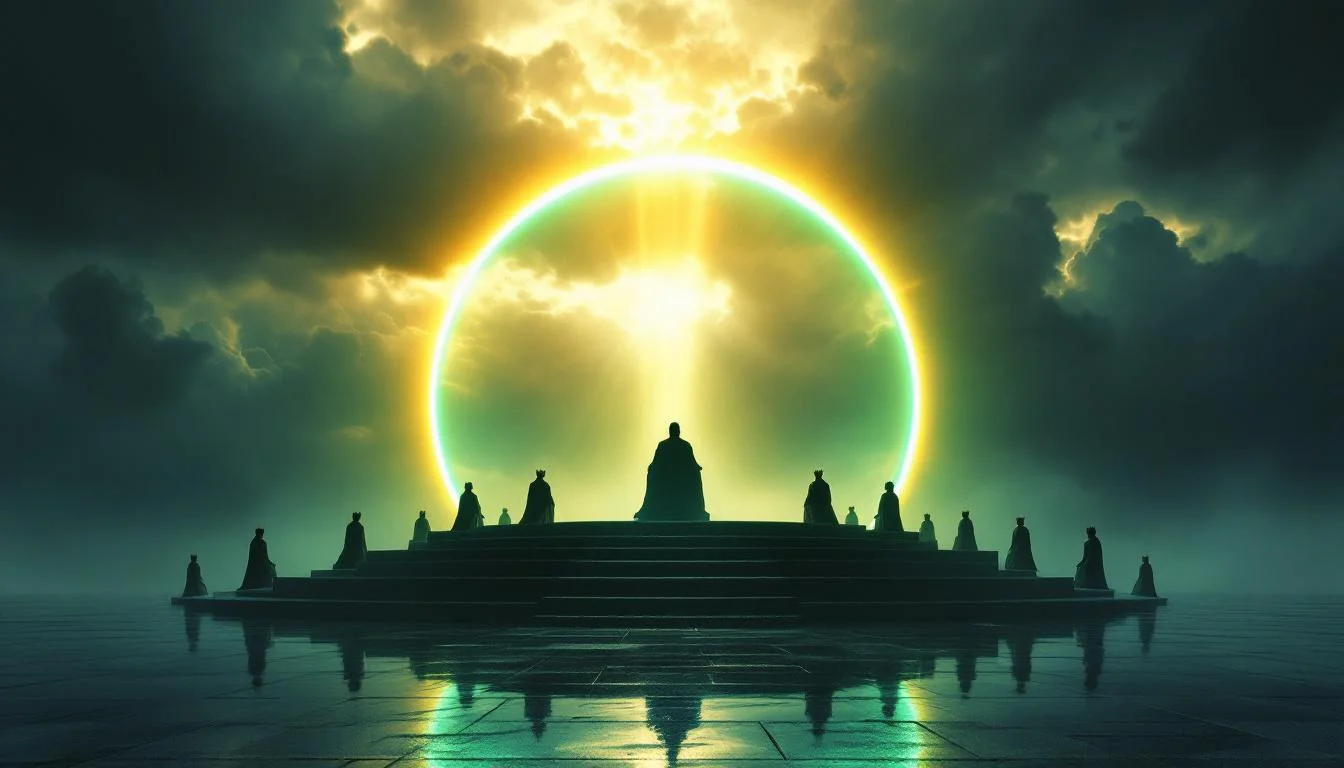
Throne room of Revelation 4 with central throne encircled by an emerald rainbow halo and twenty-four elder thrones in silhouette, with a sea of glass reflecting golden light in the foreground

Revelation 4:
The Throne Room of Heaven

Revelation Explained: Verse by Verse by Richard French

This guide draws from Revelation Explained: Verse by Verse by Richard French. The full book includes four foundation chapters, complete verse-by-verse commentary on all 22 chapters of Revelation, Old Testament foundations for each chapter, discussion questions for group study, and practical application sections.

Get the Book

What does Revelation 4 mean?

Most readers come to Revelation 4 expecting end-times drama and find themselves in a throne room instead. The verse-by-verse method shows you why the throne comes first, before any judgment falls, and what John saw that changed how he understood everything that followed. This page is part of our verse-by-verse Revelation guide.

Quick Answer

Revelation 4 takes you through an open door into heaven's throne room, where John sees the One seated on the throne surrounded by jasper, sardius, and an emerald rainbow. Twenty-four elders cast their crowns, four living creatures cry "Holy, holy, holy," and all heaven declares God worthy because He created all things. Before any judgment falls, John sees the throne. The order matters: worship anchors everything that follows.

Definition

A vision of heaven's throne room where John sees the One seated on the throne, the twenty-four elders on surrounding thrones, the four living creatures, and the eternal worship that defines heaven's reality.

Why this matters

Revelation 4 anchors the entire book. Before John witnesses any seal, trumpet, or bowl judgment, he sees the throne. This sequence teaches that judgment flows from God's character, not His mood. Worship precedes judgment, always.

Context

John writes to readers who knew Ezekiel's throne vision (Ezekiel 1), Isaiah's "Holy, holy, holy" call (Isaiah 6), and Moses' Sinai encounter (Exodus 19, 24). Each prophet saw fragments. John sees the same eternal throne in fullness.

Revelation 4:1-3: The Open Door, the Throne, the Emerald Rainbow

Revelation 4:1-3 (NKJV)

"After these things I looked, and behold, a door standing open in heaven. And the first voice which I heard was like a trumpet speaking with me, saying, 'Come up here, and I will show you things which must take place after this.'"

"Immediately I was in the Spirit; and behold, a throne set in heaven, and One sat on the throne."

"And He who sat there was like a jasper and a sardius stone in appearance; and there was a rainbow around the throne, in appearance like an emerald."

Old Testament foundations for these verses

Even Moses encountered this throne room glory. When God came down on Mount Sinai to give the Law, thunder crashed, lightning flashed, and a thick cloud covered the mountain (Exodus 19:16-19). Later, Moses and Israel's elders saw God with "under His feet as it were a paved work of sapphire stone, and it was like the very heavens in its clarity" (Exodus 24:10). The God who met Moses at Sinai is the God John sees on the throne.

The emerald rainbow connects back to Genesis. When God first placed a rainbow in the sky after the flood, He made a promise: never again would He destroy all life with water (Genesis 9:13-16). That rainbow appears here in the throne room, reminding us that even when God judges, His mercy remains. Judgment never eclipses His covenant faithfulness.

Verse-by-verse commentary

Notice the shift. "After these things" marks a clear transition from the letters to the seven churches. John has finished delivering Christ's messages to His people. Now something new begins. A door opens in heaven. Not a crack. Not a window. An open door, an invitation to enter. This matters more than you might think. In the Old Covenant, approaching God's presence meant death for anyone except the high priest, and even he could enter the Most Holy Place only once a year. But here's John, a fisherman turned apostle, being invited to "come up here."

The writer of Hebrews explains this stunning access: through Jesus, believers now approach "the heavenly Jerusalem" and "God, the Judge of all" (Hebrews 12:22-24). What was once forbidden is now open. The invitation John receives foreshadows the privilege every believer has through Christ. We can approach God's throne with confidence, not because we're worthy, but because Jesus made a way.

John finds himself "in the Spirit." This phrase describes a state where the Holy Spirit enables a prophet to receive divine revelation beyond normal human perception. The first thing John sees? A throne. Not streets of gold. Not reunions with loved ones. A throne. This positioning is deliberate. Everything that follows flows from this central reality: God rules. His throne sits secure in heaven while earth churns with chaos. Before John witnesses any judgment, any suffering, or any end-time drama, he sees the throne. The message is clear: no matter what happens on earth, someone sits on heaven's throne, and His authority never wavers.

John can't fully describe God's appearance, so he uses precious stones to convey what he sees. Jasper, probably a clear stone in ancient times, represents purity and holiness. Sardius, a deep red stone, suggests justice and judgment. Together, they reveal God's character: perfectly holy and perfectly just. Then John notices the rainbow, emerald in appearance, encircling the throne. This isn't decoration. It's a declaration. The same God who saved Noah's family still keeps His promises.
Revelation 4:4: The Twenty-Four Elders

Revelation 4:4 (NKJV)

"Around the throne were twenty-four thrones, and on the thrones I saw twenty-four elders sitting, clothed in white robes; and they had crowns of gold on their heads."

Old Testament foundations for these verses

The twenty-four elders connect to the structure of God's people across both covenants. The number twenty-four likely represents the twelve tribes of Israel plus the twelve apostles (Ephesians 2:20), symbolizing all of God's redeemed people from both Old and New Covenants. The thrones echo Jesus' promise that His followers would sit on thrones (Matthew 19:28; Luke 22:30), and the victory crowns connect back to the promises throughout the prophets and the New Testament that the faithful will be vindicated and rewarded.

Verse-by-verse commentary

Who are these twenty-four elders? Several clues help us understand. First, they wear crowns, but the Greek word here is stephanos, the victory crown given to believers (Revelation 2:10; 3:11; James 1:12), not diadema, the royal crown worn by kings. Second, they sit on thrones, fulfilling Jesus' promise that His followers would sit on thrones (Matthew 19:28; Luke 22:30). Third, they cast their crowns before God's throne in verse 10, an act of worship acknowledging that any reward comes from Him alone.

The number twenty-four likely represents the twelve tribes of Israel plus the twelve apostles (Ephesians 2:20), symbolizing all of God's redeemed people from both Old and New Covenants. This matters because it shows redeemed humanity already present in heaven before the judgments begin in chapter 6. The church isn't abandoned during tribulation. We're represented in God's throne room, participating in heavenly worship. For the verse-by-verse treatment of those judgments that follow, see Revelation 6: The Four Horsemen and the Seven Seals.

Their white robes represent the righteousness of Christ, not their own merit. Their golden crowns show victory already won. Notice they're not standing anxiously, waiting to see what happens. They're seated, at rest, their position secure.

Revelation 4:6-7: The Sea of Glass and the Four Living Creatures

Revelation 4:6-7 (NKJV)

"Before the throne there was a sea of glass, like crystal. And in the midst of the throne, and around the throne, were four living creatures full of eyes in front and in back."

"The first living creature was like a lion, the second living creature like a calf, the third living creature had a face like a man, and the fourth living creature was like a flying eagle."

Old Testament foundations for these verses

The prophet Ezekiel, six hundred years before John, saw four living creatures with faces like a lion, ox, man, and eagle, covered with eyes and surrounded by wheels within wheels (Ezekiel 1:4-28). These weren't random symbols. They were throne guardians, beings who attended God's glory wherever it appeared. When John sees nearly identical creatures in Revelation 4, he recognizes them immediately. The same throne room Ezekiel glimpsed during Israel's exile is the throne room John now enters. God's heavenly court hasn't changed. His glory remains constant across the centuries.

Verse-by-verse commentary

Picture this: before the throne stretches a sea of glass, crystal clear, perfectly transparent. Throughout Scripture, the sea often represents chaos and turmoil. The nations are like "the tossing sea, which cannot rest" (Isaiah 57:20). But here? Perfect calm. Perfect order. The sea has become glass, reflecting God's peace. Where He rules, chaos becomes clarity. Turbulence transforms into tranquility.

Four living creatures surround the throne, covered with eyes. These aren't new to heaven's throne room. The prophet Ezekiel saw nearly identical beings six hundred years earlier, with faces like a lion, ox, man, and eagle, surrounded by eyes (Ezekiel 1:4-28). The many eyes represent complete awareness. Nothing escapes their notice. Nothing surprises them. They see everything from every angle, perfectly vigilant in God's presence.

Each creature embodies different aspects of creation. The lion represents strength and majesty, the king of beasts. The calf (or ox) symbolizes service and sacrifice, the beast of burden. The man represents intelligence and relationship, made in God's image. The eagle represents sovereignty and swiftness, soaring above all. Together, they encompass the breadth of God's creation, all united in worship. The mightiest and the meekest, the noble and the humble, all bow before the throne. This foreshadows Philippians 2:10, where "every knee should bow" at Jesus' name. Creation itself testifies to God's worthiness.

Revelation 4:8: Holy, Holy, Holy

Revelation 4:8 (NKJV)

"The four living creatures, each having six wings, were full of eyes around and within. And they do not rest day or night, saying: 'Holy, holy, holy, Lord God Almighty, Who was and is and is to come!'"

Old Testament foundations for these verses

Isaiah received a similar invitation when he "saw the Lord seated on a throne, high and exalted" (Isaiah 6:1-4). Six-winged beings called seraphim surrounded the throne, calling out, "Holy, holy, holy is the LORD of hosts; The whole earth is full of His glory!" The temple shook. Smoke filled the room. Isaiah felt undone in the presence of such holiness. When John hears "Holy, holy, holy" in Revelation 4, he's hearing the same eternal song Isaiah heard. This threefold repetition matters in Hebrew thought. Saying something once makes it true. Twice emphasizes it. Three times? That declares the absolute maximum, the ultimate reality. God isn't just holy. He is holy, holy, holy.

Verse-by-verse commentary

Six wings each, like the seraphim Isaiah saw (Isaiah 6:2). Eyes covering them, even within. And a song that never stops: "Holy, holy, holy."

This threefold "holy" isn't mere repetition. In Hebrew thought, saying something three times declares absolute truth, the highest degree possible. God isn't just holy. He is holy, holy, holy. Completely set apart. Utterly pure. Perfectly righteous. This holiness defines everything else about Him. His love flows from holiness. His justice springs from holiness. His mercy operates within holiness.

And here's what we must understand: God's holiness necessitates judgment. Holiness can't coexist with sin any more than light can blend with darkness. When we wonder why Revelation contains such severe judgments, remember this throne room scene. God judges because He is holy, holy, holy. Not because He's cruel or capricious, but because His nature demands purity. The coming judgments, terrible as they are, flow from His perfect holiness meeting human rebellion.

The title "Lord God Almighty" emphasizes His omnipotence. Nothing limits His power. The phrase "Who was and is and is to come" declares His eternality. He existed before time, exists now, and will exist when time ends. Past, present, future: He holds them all. This eternal God, the One who never changes, sits on the throne John sees.

Revelation 4:9-11: Casting Crowns, "You Are Worthy"

Revelation 4:9-11 (NKJV)

"Whenever the living creatures give glory and honor and thanks to Him who sits on the throne, who lives forever and ever, the twenty-four elders fall down before Him who sits on the throne and worship Him who lives forever and ever, and cast their crowns before the throne, saying:"

"'You are worthy, O Lord, to receive glory and honor and power; for You created all things, and by Your will they exist and were created.'"

Old Testament foundations for these verses

The pattern of created beings worshiping the Creator runs through the Psalms, especially Psalm 19 ("The heavens declare the glory of God") and Psalm 96 ("Sing to the LORD, all the earth"). The Old Testament consistently grounds worship in creation: God is worthy because He made all things. The elders' declaration in Revelation 4:11 echoes that ancient pattern, gathering the witness of every Psalm that called creation to praise its Maker.

Verse-by-verse commentary

Watch what happens. The living creatures worship. The elders respond. This isn't scattered, random praise. It's choreographed, intentional, responsive worship. The living creatures initiate by giving glory, honor, and thanks. The twenty-four elders answer by falling down and casting their crowns before God.

Why does this pattern matter? Because it establishes something critical for understanding Revelation: worship precedes judgment. Before God acts in judgment, heaven worships Him for who He is. Before the seals open in chapter 6, the throne room resonates with praise. This sequence teaches us that judgment never flows from divine anger alone. It comes from the settled, worshipful recognition that God is worthy, holy, and just. Heaven worships, then God judges. Never the reverse.

The elders cast their crowns before the throne. Though they wear victory crowns, they acknowledge the source of their victory. Any authority they possess, any reward they've received, comes from God's grace. The crowns belong at His feet, not on their heads. This is the posture of the redeemed: receiving with gratitude, giving back with worship.

Here's the core declaration, the reason for all the worship: "You created all things." Everything exists because God willed it into being. Mountains didn't form by accident. Oceans didn't fill themselves. Stars didn't light themselves. Humans didn't evolve their souls. God created it all, and He created it for a purpose: His pleasure. This challenges our human-centered thinking. We assume the universe revolves around us, that God exists to serve our needs. But no. Creation exists "by Your will." We're here for God's pleasure, not the other way around.

Take the method further

The same verse-by-verse method that opened up Revelation 4 applies to all 22 chapters. Revelation 4's throne room sets the stage for the next scene, where the Lamb takes the scroll in Revelation 5, and from there the seal judgments begin in Revelation 6. The chapter sequence is intentional. The book covers each chapter using the same verse-by-verse method, with Old Testament foundations, theological synthesis, and discussion questions for group study throughout. For the full method and the chapter-by-chapter directory, see the complete verse-by-verse study guide.

Revelation Explained: Verse by Verse book cover

There's Much More in the Complete Book

This spoke covers five critical verse units from Revelation 4. Chapter 8 of the complete book walks through all eleven verses with full Old Testament foundations from Ezekiel, Isaiah, and Exodus, theological synthesis on God's holiness and worship, practical application sections, and discussion questions for group study. The book also includes the same depth of treatment for all 22 chapters of Revelation.

Related Resources

Frequently Asked Questions

The strongest evidence points to the elders representing redeemed humanity from both Old and New Covenants. They wear the victory crowns (stephanos) promised to believers, sit on thrones promised to Jesus' followers, and worship in ways angels don't typically do in Scripture. The number twenty-four likely symbolizes the twelve tribes plus the twelve apostles, representing all of God's people. The text's main emphasis isn't identifying them precisely but showing that redeemed humanity participates in heavenly worship. Whether you read them as representing the church specifically or all the redeemed generally, the encouragement remains: God's people are secure in His presence.

Some interpreters see John's summons to heaven as a picture of the rapture. The view is held by many, but the text doesn't explicitly say so. What we know for certain is that John receives an invitation to witness heavenly realities. Whether this symbolizes the rapture or simply represents John's visionary experience is debated among faithful Christians. What matters most is this: believers have access to God's presence through Christ. Whether that access is fully realized through a pre-tribulation rapture or through our eternal state, our hope remains secure. The four views guide walks through how each interpretive school reads this passage.

The four living creatures, with faces like a lion, calf, man, and eagle, embody different aspects of creation united in worship. The lion represents strength and majesty, the king of beasts. The calf symbolizes service and sacrifice, the beast of burden. The man represents intelligence and relationship, made in God's image. The eagle represents sovereignty and swiftness, soaring above all. Together, they encompass the breadth of God's creation, all bowing before the throne. They're also throne guardians, the same beings Ezekiel saw 600 years earlier in Ezekiel 1, attending God's glory wherever it appears.

In Hebrew thought, saying something three times declares absolute truth, the highest degree possible. Saying something once makes it true. Twice emphasizes it. Three times declares the maximum. God isn't just holy. He is holy, holy, holy. Completely set apart. Utterly pure. Perfectly righteous. This holiness defines everything else about Him. His love flows from holiness. His justice springs from holiness. His mercy operates within holiness. The same threefold "Holy" Isaiah heard from the seraphim in Isaiah 6 still echoes in the throne room. The song never changes because God's holiness never changes.

Throughout Scripture, the sea often represents chaos and turmoil. The nations are like "the tossing sea, which cannot rest" in Isaiah 57:20. But before God's throne, the sea has become glass: perfect calm, perfect order, crystal clear. Where God rules, chaos becomes clarity. Turbulence transforms into tranquility. Moses and Israel's elders saw something similar at Sinai, with "under His feet as it were a paved work of sapphire stone, and it was like the very heavens in its clarity" in Exodus 24:10. The crystal sea John sees reflects that same throne-room clarity.

Before John witnesses any seal, trumpet, or bowl judgment, he sees the throne. The order is deliberate. The living creatures initiate worship by giving glory, honor, and thanks. The twenty-four elders answer by falling down and casting their crowns. Heaven worships, then God judges. Never the reverse. The sequence teaches that judgment never flows from divine anger alone. It comes from the settled, worshipful recognition that God is worthy, holy, and just. Worship anchors everything that follows in Revelation. When the seals open in chapter 6 and judgment begins, the throne room's worship has already framed why the judgment matters.