The full chapter walks all 18 verses in order. These five carry the weight of the chapter's argument: the beast's emergence, his composite identity, the spiritual stakes, the false prophet's arrival, and the mark and number that seal the system.
Revelation 13:1: The Emergence of the First Beast
Revelation 13:1 (NKJV)
"Then I stood on the sand of the sea. And I saw a beast rising up out of the sea, having seven heads and ten horns, and on his horns ten crowns, and on his heads a blasphemous name."
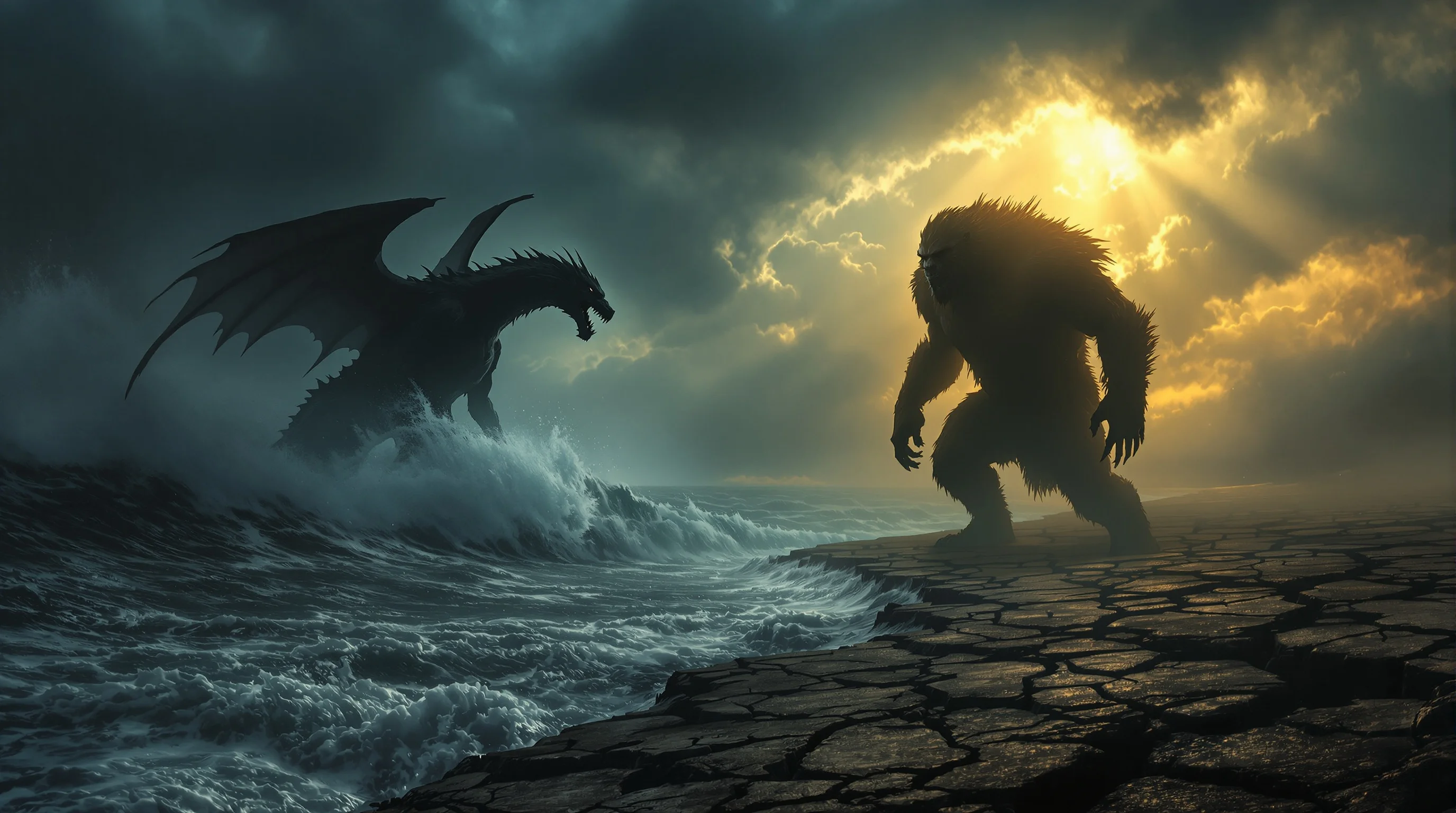
Picture John standing on the shoreline, watching as something monstrous rises from the churning waters. The sea in biblical symbolism often represents chaos, the Gentile nations, or the tumultuous domain from which godless powers emerge. What comes forth is a beast of nightmarish proportions: seven heads, ten horns, and on each horn a crown of authority.
The imagery is deliberately shocking. Seven heads suggest completeness of earthly wisdom and power, though it's a completeness twisted toward evil. Ten horns represent rulers or kings who will align themselves with this beast's agenda. The crowns on the horns indicate actual ruling authority, not just potential power. But here's what makes this truly blasphemous: on the beast's heads are written names that directly challenge God's authority.
You might wonder why John describes such a strange creature. Remember Daniel's vision where he saw four separate beasts representing four successive empires. John sees one beast that combines them all, showing us that the final manifestation of anti-God power will possess all the worst characteristics of every empire that ever persecuted God's people. This beast represents the culmination of human rebellion under satanic influence.
This is the same beast who appears earlier in Revelation 11, ascending from the bottomless pit to make war on God's prophets. For the verse-by-verse treatment of the two witnesses he kills earlier in Revelation 11, see the chapter 11 spoke.
Revelation 13:2: The Beast's Composite Attributes
Revelation 13:2 (NKJV)
"Now the beast which I saw was like a leopard, his feet were like the feet of a bear, and his mouth like the mouth of a lion. The dragon gave him his power, his throne, and great authority."
Here's where Daniel's prophecy comes into sharp focus. The beast John sees has the body of a leopard (representing the speed and cunning of the Greek empire under Alexander), the feet of a bear (symbolizing the crushing strength of Medo-Persia), and the mouth of a lion (showing the devouring dominance of Babylon). This composite nature reveals something chilling: the final beast will be swift like Greece in conquest, strong like Persia in military might, and authoritative like Babylon in its claims.
But notice the crucial detail: the dragon gives the beast its power, throne, and authority. The dragon is Satan, explicitly identified in Revelation 12:9. This isn't a merely human ruler working alone. This is a satanically empowered figure operating as Satan's primary agent on earth. The beast receives delegated authority from the dragon the way Christ receives authority from the Father, but this is an unholy imitation. Satan is building his own counterfeit kingdom.
The implications are sobering. When you face the spirit of antichrist in any form, you're not just facing human evil. You're facing demonic power working through human vessels. This is why Scripture tells us our struggle isn't against flesh and blood but against spiritual forces of wickedness.
Many scholars trace this beast figure back to the white horse rider of seal one in Revelation 6, who carries a bow without arrows and conquers through deception. For the verse-by-verse treatment of those judgments, see the four horsemen and the seven seals.
Revelation 13:8: All Will Worship Except the Lamb's Own
Revelation 13:8 (NKJV)
"All who dwell on the earth will worship him, whose names have not been written in the Book of Life of the Lamb slain from the foundation of the world."
Here's the great dividing line of humanity. The phrase "all who dwell on the earth" doesn't mean every single person without exception. It means all whose names are not written in the Book of Life. In Revelation, "earth dwellers" is a technical term for those whose hope, identity, and treasure are entirely earthly, with no heavenly citizenship or eternal perspective.
In contrast, those whose names are written in the Book of Life will not worship the beast, no matter what pressure they face. Their names were written there before the foundation of the world, secured by the Lamb who was slain. This isn't just about a future event; it's about God's eternal plan of salvation through Christ.
Notice the order: the Lamb was slain from the foundation of the world, meaning God's plan to save humanity through Christ's sacrifice existed before Creation itself. Before Adam sinned, before the world fell into chaos, God had already planned redemption. Your salvation isn't a divine afterthought or emergency response. It's the eternal purpose of God.
This truth should anchor you when facing pressure to compromise. If your name is written in the Book of Life, you won't worship the beast. Not because you're stronger than others, but because God's electing grace keeps you faithful. The same power that raised Christ from the dead works in you to preserve you for eternal life.
Revelation 13:11: The False Prophet Appears
Revelation 13:11 (NKJV)
"Then I saw another beast coming up out of the earth, and he had two horns like a lamb and spoke like a dragon."
Now a second beast enters the scene, and its introduction is brilliantly deceptive. Unlike the first beast that rose from the chaotic sea, this one comes from the earth, suggesting it has more stable origins, perhaps from within established society or religion. Its appearance is carefully crafted: two horns like a lamb, suggesting gentleness, innocence, or religious authority that mimics the true Lamb of God.
But here's the giveaway: it speaks like a dragon. The mouth reveals what the appearance conceals. No matter how lamb-like the exterior, the words come from Satan himself. This beast, often called the False Prophet in later chapters, represents religious deception that validates and promotes the first beast's political power.
Think about the unholy trinity taking shape here: the dragon mimics God the Father as the source of all authority. The first beast mimics Christ as the wounded-but-resurrected savior-figure demanding worship. And this second beast mimics the Holy Spirit, whose role is to glorify Christ and point people to Him. But instead of pointing people to Jesus, the False Prophet points them to the beast. Satan creates a complete counterfeit religion, not just a political movement.
This explains why religious deception is often more dangerous than political tyranny. People can recognize obvious evil in a brutal dictator, but they struggle to identify evil dressed in religious clothing, speaking spiritual language, performing miracles, and claiming divine authority.
Revelation 13:16–18: The Mark of the Beast and 666
Revelation 13:16–18 (NKJV)
"He causes all, both small and great, rich and poor, free and slave, to receive a mark on their right hand or on their foreheads, and that no one may buy or sell except one who has the mark or the name of the beast, or the number of his name."
"Here is wisdom. Let him who has understanding calculate the number of the beast, for it is the number of a man: His number is 666."
Here we encounter the infamous mark of the beast, perhaps the most discussed and speculated-about element in Revelation. The False Prophet establishes a system requiring everyone, regardless of social status, to receive a mark on their right hand or forehead. Without this mark, people cannot participate in economic life. No buying, no selling, no working, no commerce of any kind.
The location of the mark is significant. Remember God's command in Deuteronomy to bind His words on your hand and forehead, symbolizing that your actions and thoughts belong to Him. The mark on hand or forehead represents total allegiance to the beast, a visible declaration that your actions and thoughts belong to him.
The mark could involve technology we can't yet imagine, or it could be something more traditional. What matters isn't the specific mechanism but what the mark represents: a public, irrevocable pledge of loyalty to the beast and rejection of God. Taking the mark isn't just getting an identification number. It's an act of worship, a conscious choice to align with the beast's system.
The economic control is totalitarian. Without the mark, you can't feed your family, pay rent, or buy necessities. The pressure to conform will be overwhelming. But Scripture is clear: taking the mark means eternal condemnation (Revelation 14:9–11). There's no middle ground, no way to take the mark pragmatically while remaining loyal to Christ. You must choose: economic survival by worshiping the beast, or economic hardship by trusting God.
The chapter ends with a puzzle: the beast's number is 666. This number has generated endless speculation throughout church history, with various methods proposed for calculating it and countless figures suggested as candidates. John says understanding the number requires wisdom. What we know for certain: 666 is described as "the number of a man," suggesting it's human, not divine. The number seven represents completeness and perfection in Scripture, particularly divine perfection. Six falls short of seven, representing human imperfection and failure. Triple six emphasizes absolute human failure, humanity claiming divinity while falling utterly short.
For deeper coverage of the mark of the beast specifically, including modern misconceptions, see Richard French's standalone article on the mark and 666.
The beast's reign ends with judgment. He's cast into the lake of fire at the beast's defeat in Revelation 19, and Satan joins him there in Revelation 20:10. For the verse-by-verse treatment of the millennium and the Great White Throne, see the chapter 20 spoke.