Revelation 19:11-13 (NKJV)
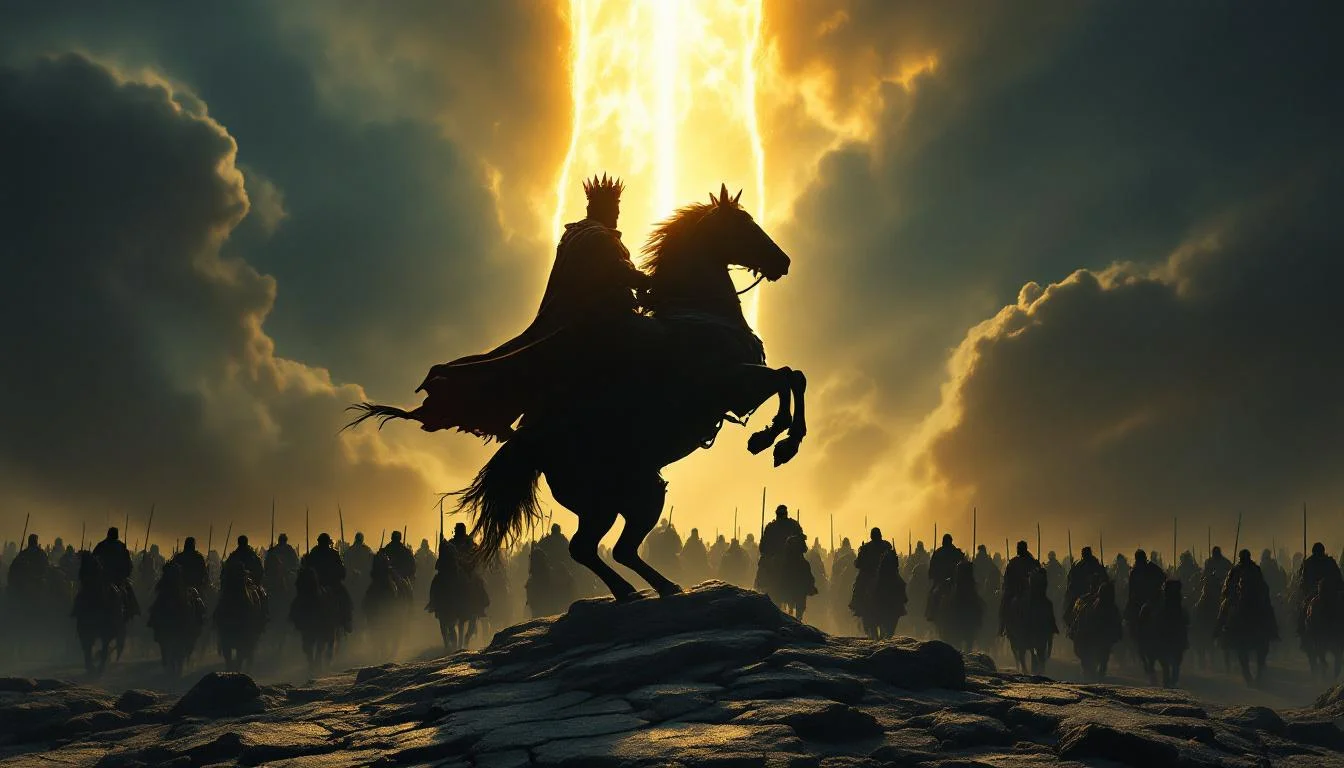
"Now I saw heaven opened, and behold, a white horse. And He who sat on him was called Faithful and True, and in righteousness He judges and makes war."
"His eyes were like a flame of fire, and on His head were many crowns. He had a name written that no one knew except Himself."
"He was clothed with a robe dipped in blood, and His name is called The Word of God."
Old Testament foundations for these verses
Isaiah 63:1-3 asks, "Who is this who comes from Edom, With dyed garments from Bozrah, This One who is glorious in His apparel, Traveling in the greatness of His strength?" God answers that He has trodden the winepress alone, with enemies' blood spattering His garments. This warrior imagery appears here in Revelation 19:13. What Isaiah saw in prophetic vision, John now sees fulfilled in Christ. The blood-dipped robe and winepress aren't random symbols. They reveal Jesus as the divine Judge Isaiah foretold.
Verse-by-verse commentary
The scene shifts dramatically. Heaven itself opens, not just a window, but a complete opening. And there, on a white horse, sits Jesus Christ. But this isn't the gentle shepherd or the suffering servant of the gospels. This is Christ in His role as righteous Judge and warrior King. The same Lamb who took the scroll in Revelation 5 now returns as the warrior King to execute the judgments authorized there.
The titles "Faithful and True" reveal His character. Everything He promised, He fulfills. Every word He spoke, He means. He judges "in righteousness." His justice is perfect. And yes, He "makes war," but this is righteous war against evil, not conquest for selfish ambition.
Those eyes like flames of fire see everything. No hidden sin, no secret rebellion, no disguised evil escapes His gaze. The many crowns on His head signify His authority over all earthly kingdoms. While earthly rulers wear single crowns representing limited authority, Christ wears many crowns because all authority belongs to Him. The mysterious name that no one knows represents His divine nature that transcends human comprehension. We can know Christ truly, but we can never know Him exhaustively. There remain depths to His identity that only He fully understands.
The robe dipped in blood fulfills Isaiah 63:1-3, where God appears as a warrior with garments stained from treading the winepress of judgment. The blood on Christ's robe represents both His sacrificial death (where He shed His own blood) and His role as Judge (where He executes judgment on His enemies). Both meanings coexist. He is simultaneously the Lamb who was slain and the Lion who conquers. The title "The Word of God" identifies Christ as the divine Word, the one through whom God speaks and acts. John began his gospel by declaring, "In the beginning was the Word, and the Word was with God, and the Word was God." Now that same Word returns in power to complete God's plan.