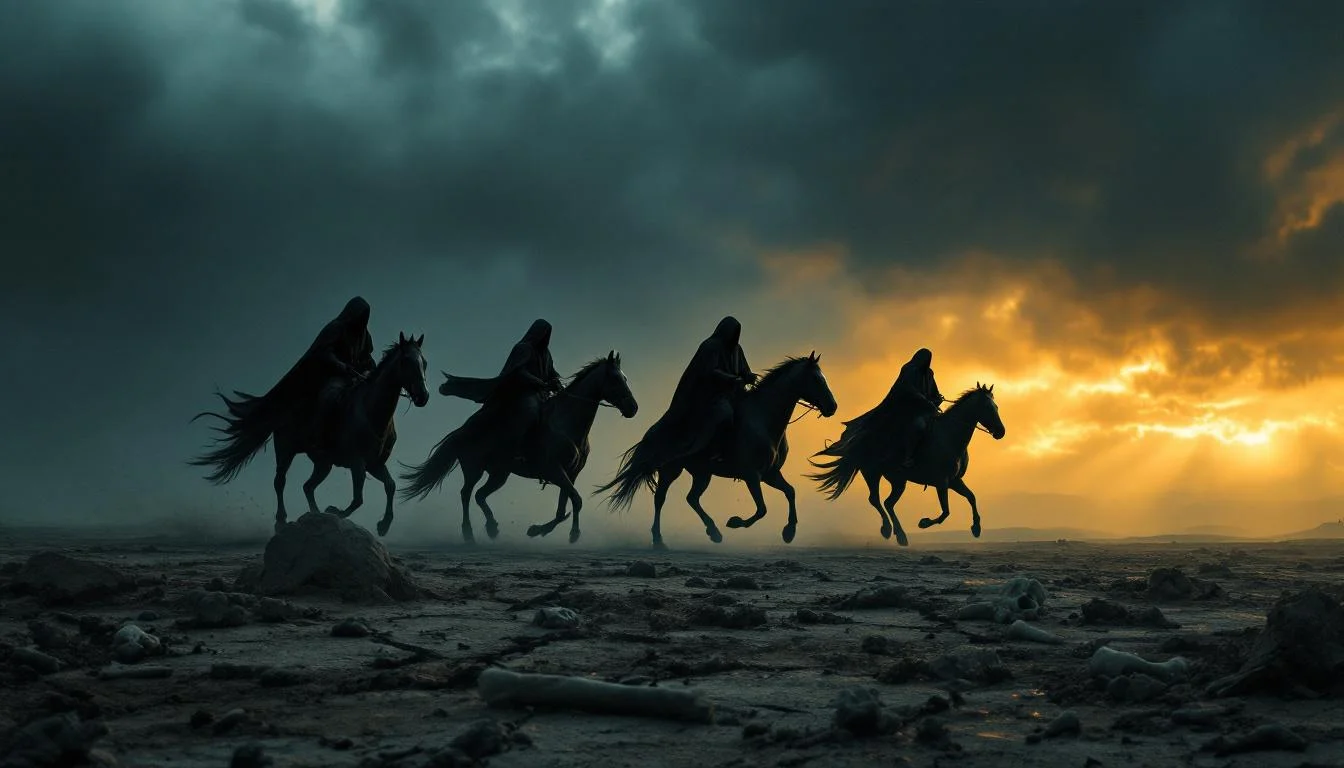
Four horsemen of Revelation 6 in silhouette riding across an apocalyptic landscape beneath stormy skies with golden light breaking through

Revelation 6:
The Four Horsemen and the Seven Seals

Revelation Explained: Verse by Verse by Richard French

This guide draws from Revelation Explained: Verse by Verse by Richard French. The full book includes four foundation chapters, complete verse-by-verse commentary on all 22 chapters of Revelation, Old Testament foundations for each chapter, discussion questions for group study, and practical application sections.

Get the Book

What does Revelation 6 mean?

Most readers come to Revelation 6 expecting a timeline of end-times disasters with the four horsemen at the center. The verse-by-verse method roots the horsemen in Zechariah's earlier visions and shows what each color and rider actually represents. This page is part of our verse-by-verse Revelation guide.

Quick Answer

Revelation 6 unveils the opening of six of the seven seals during the Tribulation. Four horsemen ride forth bringing conquest, war, famine, and death. The fifth seal reveals martyrs crying out for justice under heaven's altar, and the sixth seal brings cosmic upheaval as the world hides from "the wrath of the Lamb." Each judgment fulfills Old Testament prophecies given to Ezekiel, Joel, and Isaiah centuries earlier.

Definition

A vision of the Lamb opening six of the seven seals during the Tribulation. Each seal releases a specific wave of judgment, building from the four horsemen through the cry of the martyrs to cosmic upheaval and the recognition of God's wrath.

Why this matters

The seal judgments establish the pattern of Revelation's prophetic visions. Understanding the seals shapes how you read the trumpets in chapters 8 and 9 and the bowls in chapter 16, where judgment intensifies in the same pattern.

Context

John drew the four horsemen directly from Zechariah's earlier visions of colored horses, the four methods of death from Ezekiel 14:21, and the cosmic signs from Joel's prophecy of the day of the Lord. The Old Testament patterns were already familiar to John's readers.

Revelation 6:1-2: The First Seal and the White Horse

Revelation 6:1-2 (NKJV)

"Now I saw when the Lamb opened one of the seals; and I heard one of the four living creatures saying with a voice like thunder, 'Come!'"

"And I looked, and behold, a white horse. He who sat on it had a bow; and a crown was given to him, and he went out conquering and to conquer."

Old Testament foundations for these verses

The colored-horse imagery doesn't begin in Revelation. Zechariah saw colored horses going out to patrol the earth in his visions centuries earlier (Zechariah 1:8 and 6:1-8), and his readers would have recognized horses as messengers of divine purpose. John's audience knew the Old Testament pattern: when colored horses ride forth in a prophetic vision, God is moving in history.

The white horse rider connects forward as well as backward. Many scholars identify him with the Antichrist, who appears later in Revelation as the beast from the sea. For the full treatment of that figure, see Revelation 13: The Beast and the Mark.

Verse-by-verse commentary

The Lamb (Jesus Christ) breaks the first seal. Only He has the authority to do this because only He proved worthy through His sacrificial death (the Lamb declared worthy in Revelation 5). When the seal breaks, one of the four living creatures speaks with a voice like thunder, commanding the first horseman to appear. The Greek text simply says "Come!" not "Come and see." The living creature isn't inviting John to observe. It's summoning the judgment to go forth, showing that all creation participates in executing God's purposes.

The first horseman rides a white horse and carries a bow, but notice what's missing: no arrows. He wears a crown, symbolizing authority given to him. This rider conquers not through warfare but through diplomacy, deception, and false promises. Many scholars identify this rider as the Antichrist, who will initially appear as a peacemaker bringing solutions to the world's problems.

This deceptive peace fulfills Paul's warning in 1 Thessalonians 5:3: "For when they say, 'Peace and safety!' then sudden destruction comes upon them." The white horse seems to promise peace, but it's the calm before the storm. The bowless bow represents conquest without immediate violence: a peace treaty, perhaps, or a political alliance that gives the Antichrist power over nations.

Revelation 6:3-4: The Red Horse Brings War

Revelation 6:3-4 (NKJV)

"When He opened the second seal, I heard the second living creature saying, 'Come!' Another horse, fiery red, went out. And it was granted to the one who sat on it to take peace from the earth, and that people should kill one another; and there was given to him a great sword."

Old Testament foundations for these verses

Zechariah's horse visions again provide the imagery. Red horses appeared among the colored riders in his prophecy (Zechariah 1:8), and red consistently signals blood and warfare across the prophetic literature. Where Zechariah saw the horses patrolling, John sees them riding out to execute the judgment that the patrols had announced.

Verse-by-verse commentary

The false peace of the first seal crumbles quickly. The second horseman rides a fiery red horse (the color of blood) and carries a great sword. He's given authority to remove peace from the earth, leading to global conflict. People will kill one another in wars, ethnic conflicts, civil unrest, and terrorism. The great sword suggests violence on a massive scale.

Notice the passive voice: peace is "taken" and authority is "granted." God remains in control even of these judgments. Nothing happens outside His sovereign permission. The horseman can only do what God allows him to do.

Revelation 6:5-6: The Black Horse Brings Famine

Revelation 6:5-6 (NKJV)

"When He opened the third seal, I heard the third living creature say, 'Come!' So I looked, and behold, a black horse, and he who sat on it had a pair of scales in his hand. And I heard a voice in the midst of the four living creatures saying, 'A quart of wheat for a denarius, and three quarts of barley for a denarius; and do not harm the oil and the wine.'"

Old Testament foundations for these verses

The Old Testament regularly pairs scales with judgment, especially economic judgment. Famine itself is one of God's recurring covenant warnings throughout the Law and the Prophets. The denarius detail draws on the New Testament economic context (Matthew 20:2 confirms it as a day's wage for a laborer), but the underlying pattern of famine following war is woven through every prophetic warning Israel ever received.

Verse-by-verse commentary

War leads to famine. The black horse symbolizes scarcity and starvation. The rider carries scales, showing that food will be rationed carefully. The prices reveal the severity: a quart of wheat or three quarts of barley for one denarius.

Here's why this matters: a denarius was a day's wage for a laborer (Matthew 20:2). A quart of wheat was barely enough to feed one person for one day. Under this judgment, a worker's entire daily earnings will buy only enough food to feed himself (nothing left for family, rent, or other necessities). Barley was cheaper grain, usually fed to animals, but even buying barley would leave a worker's family on the edge of starvation.

The statement about oil and wine suggests that luxury items will remain available to the wealthy. This creates a stark picture: massive economic inequality during the Tribulation, with the poor starving while the rich continue in relative comfort.

Revelation 6:7-8: The Pale Horse Brings Death

Revelation 6:7-8 (NKJV)

"When He opened the fourth seal, I heard the voice of the fourth living creature saying, 'Come!' So I looked, and behold, a pale horse. And the name of him who sat on it was Death, and Hades followed with him. And power was given to them over a fourth of the earth, to kill with sword, with hunger, with death, and by the beasts of the earth."

Old Testament foundations for these verses

Centuries earlier, Ezekiel prophesied about God's judgment on Jerusalem using four specific methods: "For thus says the Lord GOD: 'How much more it shall be when I send My four severe judgments on Jerusalem, the sword and famine and wild beasts and pestilence, to cut off man and beast from it?'" (Ezekiel 14:21). The fourth seal uses these exact same four judgments, but now God applies them to the entire earth rather than one city. What Ezekiel saw in miniature, John sees on a global scale.

Verse-by-verse commentary

The fourth horse is pale (the Greek word means "greenish," the sickly color of a corpse). This is death personified, riding through the earth with Hades (the grave) following behind to collect the victims. The combination of sword (war), hunger (famine), death (pestilence or disease), and wild beasts will kill one-fourth of the world's population.

These four means of death come directly from Ezekiel 14:21, where God describes His "four severe judgments." John shows that God's end-times judgment follows the same pattern as His historical judgments, but now extends to the entire earth. If the current world population is eight billion, this seal alone will claim two billion lives.

Revelation 6:12-17: The Sixth Seal and the Wrath of the Lamb

Revelation 6:12-17 (NKJV)

"I looked when He opened the sixth seal, and behold, there was a great earthquake; and the sun became black as sackcloth of hair, and the moon became like blood. And the stars of heaven fell to the earth, as a fig tree drops its late figs when it is shaken by a mighty wind. Then the sky receded as a scroll when it is rolled up, and every mountain and island was moved out of its place."

"And the kings of the earth, the great men, the rich men, the commanders, the mighty men, every slave and every free man, hid themselves in the caves and in the rocks of the mountains, and said to the mountains and rocks, 'Fall on us and hide us from the face of Him who sits on the throne and from the wrath of the Lamb! For the great day of His wrath has come, and who is able to stand?'"

Old Testament foundations for these verses

Joel prophesied about the cosmic signs that would precede God's intervention: "The sun shall be turned into darkness, And the moon into blood, Before the coming of the great and awesome day of the Lord" (Joel 2:31). When John describes the sun turning black and the moon becoming like blood in the sixth seal, he's witnessing the fulfillment of Joel's ancient prediction. These aren't random natural disasters. They're God's appointed signals that His day of judgment has arrived.

Isaiah predicted how people would respond to God's coming judgment. He wrote: "They shall go into the holes of the rocks, And into the caves of the earth, From the terror of the Lord And the glory of His majesty, When He arises to shake the earth mightily" (Isaiah 2:19). At the end of Revelation 6, John sees this exact scene unfold as people from every social class hide in caves and cry out to the rocks to fall on them. What Isaiah foretold, John now witnesses.

Verse-by-verse commentary

The sixth seal brings cosmic disturbances that signal God's direct intervention. A massive earthquake shakes the earth. The sun turns black. The moon appears blood-red. Stars fall from the sky like figs shaken from a tree by strong wind. The sky itself seems to roll up, and mountains and islands shift from their positions.

These cosmic signs fulfill Joel's prophecy directly. Jesus also predicted these signs in His Olivet Discourse, describing what would happen "immediately after the tribulation of those days" (Matthew 24:29). The universe itself testifies that God's day of judgment has arrived.

The world's response to these cosmic signs reveals the terror of facing God's judgment. Notice who hides: kings, great men, rich men, commanders, mighty men, slaves, and free people. No social class escapes the terror. The powerful and the powerless, the wealthy and the poor: all recognize that they're facing divine judgment and seek to hide desperately.

They flee to caves and cry out to the mountains and rocks to fall on them, fulfilling Isaiah 2:19. They would rather be crushed by rocks than face the One who sits on the throne. Their words reveal a startling recognition: they know this is God's wrath. They call it "the wrath of the Lamb" (acknowledging that Jesus, the Lamb of God, is the source of this judgment). They ask the crucial question: "Who is able to stand?"

Jesus answered this question already. In Luke 21:36, He said: "Watch therefore, and pray always that you may be counted worthy to escape all these things that will come to pass, and to stand before the Son of Man." The way to stand before God's wrath isn't through hiding in caves. It's through faith in the Lamb, received before His day of judgment arrives.
Take the method further

The same verse-by-verse method that opened up Revelation 6 applies to all 22 chapters. The seal judgments here connect directly to the trumpet judgments in Revelation 9 and the bowl judgments in Revelation 16. Each series intensifies the pattern of judgment that began with the seals. The book applies the same method across every chapter, with Old Testament foundations, theological synthesis, and discussion questions for group study throughout. For the full method and the chapter-by-chapter directory, see the complete verse-by-verse study guide.

Revelation Explained: Verse by Verse book cover

There's Much More in the Complete Book

This spoke covers five critical verses from Revelation 6. Chapter 10 of the complete book walks through all seventeen verses with full Old Testament foundations from Ezekiel, Joel, and Isaiah, theological synthesis on the wrath of the Lamb, practical application sections, and discussion questions for group study. The book also includes the same depth of treatment for all 22 chapters of Revelation.

Related Resources

Frequently Asked Questions

The four horsemen ride forth as the Lamb opens the first four seals. The white horse rider carries a bow without arrows and conquers through deception and false promises (many scholars identify him with the Antichrist). The fiery red horse takes peace from the earth and brings global war. The black horse holds scales of famine, with prices high enough that a day's wage buys barely enough food to feed one person. The pale horse carries Death, with Hades following behind, and is given authority over a fourth of the earth to kill with sword, hunger, pestilence, and wild beasts.

The "wrath of the Lamb" is the phrase humanity uses in Revelation 6:16 when the sixth seal opens and they hide in caves. It might seem contradictory: how can the gentle Lamb who died for sins have wrath? The answer is that the same Savior who said "Come to Me, all you who labor" also described the final judgment where He separates sheep from goats. The wrath of the Lamb is the righteous response to those who reject His mercy. God offers salvation through Christ's sacrifice freely. Those who refuse must face the consequences of their choice.

The detail is deliberate. The first horseman carries a bow but Revelation 6:2 mentions no arrows. This rider conquers through diplomacy, deception, and false promises rather than immediate warfare. The crown signifies authority given to him. Many scholars identify this figure as the Antichrist, who initially appears as a peacemaker bringing solutions to the world's problems. The bowless bow represents conquest without immediate violence: a peace treaty or political alliance that gives him power over nations. Paul's warning in 1 Thessalonians 5:3 captures the deception: "When they say, 'Peace and safety!' then sudden destruction comes upon them."

The fifth seal shifts the scene from earth to heaven. John sees the souls of martyrs under the altar, believers killed for their faith in Christ during the Tribulation. They cry out, "How long, O Lord, holy and true, until You judge and avenge our blood?" God's answer comes in two parts. He gives each martyr a white robe symbolizing righteousness and vindication. He then tells them to rest a little longer until the full number of martyrs is complete. God has a specific number in mind, and He won't allow one more death than necessary. The fifth seal sits between the four horsemen and the cosmic upheaval of the sixth seal.

The seal judgments belong specifically to the Tribulation period, which has not yet begun. While we see wars, famines, and diseases throughout history, the seals represent judgments of unprecedented scale during the specific time of God's wrath. Jesus described similar events as "the beginning of sorrows" in Matthew 24:8, meaning these patterns intensify as we approach the end times. The actual seal judgments await the Tribulation. The current world is not yet under the seal judgments, but it is moving toward the day when they break.

In Ezekiel 14:21 God describes "four severe judgments" against Jerusalem: the sword, famine, wild beasts, and pestilence. The fourth seal in Revelation 6:8 uses these exact same four judgments, but God now applies them to the entire earth rather than one city. What Ezekiel saw in miniature, John sees on a global scale. The connection demonstrates God's faithfulness across the centuries: He told His prophets what would happen, and now the events unfold exactly as He said. The pattern of His historical judgment reappears in the end-times judgment.