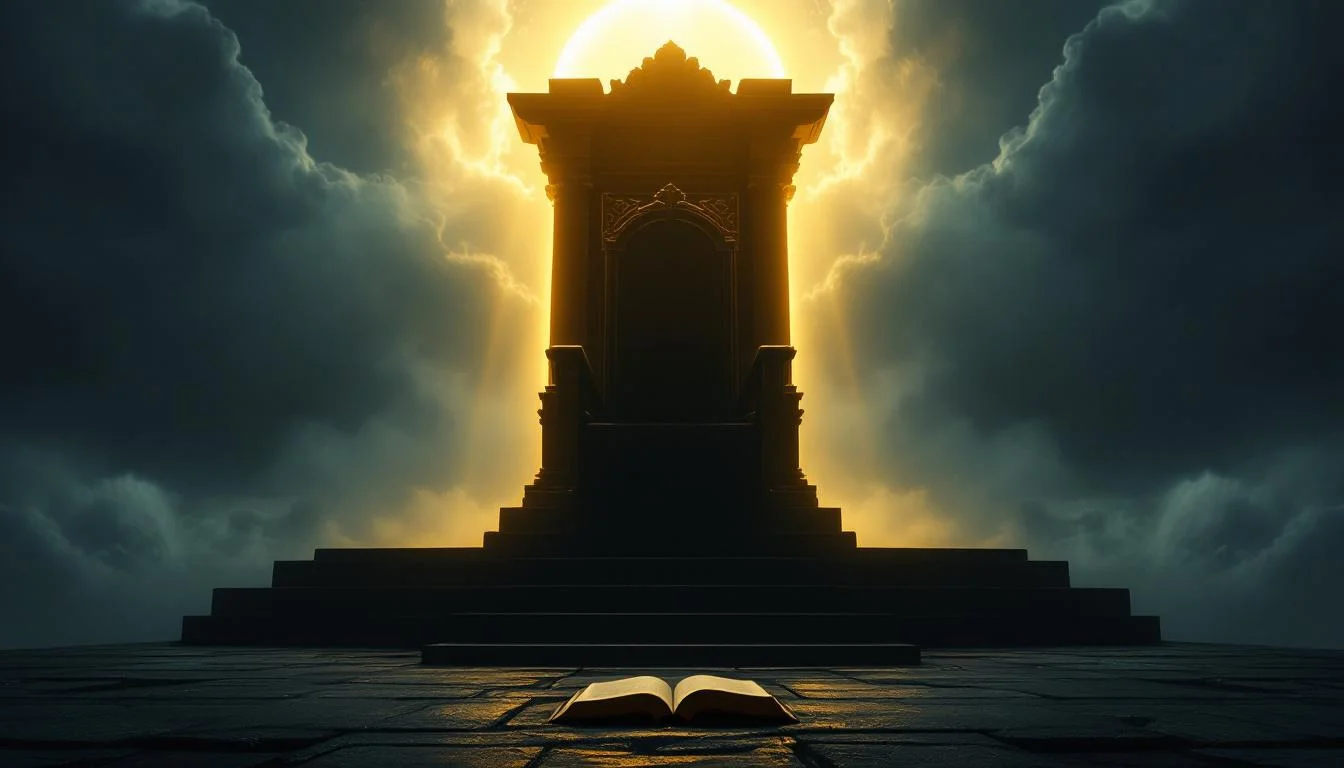
Great White Throne of Revelation 20 silhouetted against radiant golden light beneath stormy skies, with open books of judgment visible at its base

Revelation 20:
The Millennium and the Great White Throne

Revelation Explained: Verse by Verse by Richard French

This guide draws from Revelation Explained: Verse by Verse by Richard French. The full book includes four foundation chapters, complete verse-by-verse commentary on all 22 chapters of Revelation, Old Testament foundations for each chapter, discussion questions for group study, and practical application sections.

Get the Book

What does Revelation 20 mean?

Most readers come to Revelation 20 already holding a position on the millennium, with each interpretive school finding what it brought. The verse-by-verse method shows you what the chapter actually says about the thousand years, Satan's defeat, and the Great White Throne. This page is part of our verse-by-verse Revelation guide.

Quick Answer

Revelation 20 describes Satan bound for a thousand years while believers reign with Christ, then briefly released to test the hearts of those born during the millennial reign before his final defeat. The Great White Throne judgment follows, where the dead stand before God and are judged from the books opened before Him. The chapter ends with death itself thrown into the lake of fire.

Definition

A vision of three closing acts: Satan bound for a thousand years while believers reign with Christ, Satan's brief release and final defeat, and the Great White Throne where every person who ever lived stands before God for judgment.

Why this matters

Revelation 20 brings the prophetic visions to their judicial climax. The chapter resolves the cosmic conflict introduced in chapter 12, completing the defeat of Satan and the beasts whose work began in chapters 12 and 13.

Context

John draws the Great White Throne imagery directly from Daniel 7:9-10, where the Ancient of Days takes his seat and the books are opened. The Book of Life appears throughout the Old Testament, from Moses (Exodus 32:32) to David (Psalm 69:28).

Revelation 20:1-3: Satan Bound for a Thousand Years

Revelation 20:1-3 (NKJV)

"Then I saw an angel coming down from heaven, having the key to the bottomless pit and a great chain in his hand."

"He laid hold of the dragon, that serpent of old, who is the Devil and Satan, and bound him for a thousand years;"

"and he cast him into the bottomless pit, and shut him up, and set a seal on him, so that he should deceive the nations no more till the thousand years were finished. But after these things he must be released for a little while."

Old Testament foundations for these verses

Isaiah prophesied the two-stage defeat of evil powers. In Isaiah 24:21-22, God promised that evil forces would be "gathered together, as prisoners are gathered in the pit" and "shut up in the prison," then "after many days they will be punished." Notice the pattern: imprisonment first, then final punishment later. This explains why Satan must be bound for a thousand years before facing his ultimate judgment. God announced this plan through Isaiah centuries before it happens.

When Satan is called "that ancient serpent," John connects us back to the very beginning. In Genesis 3, the serpent deceived Eve, and God promised that the woman's offspring would crush the serpent's head. The ancient serpent who brought sin into the world is finally bound here, with his complete destruction still to come.

Verse-by-verse commentary

Picture this: an angel descends from heaven carrying two items that represent absolute authority. The key to the bottomless pit shows he has control over the abyss itself. The great chain demonstrates his power to restrain even the most powerful enemy. This isn't just any angel. He carries God's authority to do what no human could ever accomplish.

The angel seizes Satan, who is identified by four names that tell his whole story. He's "the dragon" (a fierce, destructive creature), "that serpent of old" (the deceiver from Eden), "the Devil" (the slanderer), and "Satan" (the adversary). Each name reveals a different aspect of his character and history.

The binding lasts for a thousand years. Christians throughout history have understood this time period differently. Some believe it's a literal future reign of Christ on earth. Others see it as representing the church age between Christ's first and second comings. Still others understand it as a future golden age before Christ returns. Faithful, Bible-believing Christians hold all these views. What's certain is this: Christ will reign, Satan will be defeated, and God's people will share in His victory. For the broader interpretive landscape, see the four views of Revelation.

The angel doesn't just bind Satan. He throws him into the abyss, shuts it, and seals it. This triple action ensures Satan cannot escape or influence anyone. The purpose is clear: he cannot deceive the nations anymore. For a thousand years, the world experiences what life looks like without Satan's influence.

But notice the startling end of verse 3: Satan must be released for a short time. Why would God do this? The release serves a divine purpose. It will test the hearts of those living during the thousand-year reign, revealing who truly chooses to follow God when given complete freedom. This matches what Isaiah prophesied: imprisonment first, then final judgment "after many days."

Revelation 20:4-6: The Millennial Reign and the First Resurrection

Revelation 20:4-6 (NKJV)

"And I saw thrones, and they sat on them, and judgment was committed to them. Then I saw the souls of those who had been beheaded for their witness to Jesus and for the word of God, who had not worshiped the beast or his image, and had not received his mark on their foreheads or on their hands. And they lived and reigned with Christ for a thousand years."

"But the rest of the dead did not live again until the thousand years were finished. This is the first resurrection."

"Blessed and holy is he who has part in the first resurrection. Over such the second death has no power, but they shall be priests of God and of Christ, and shall reign with Him a thousand years."

Old Testament foundations for these verses

Daniel saw this scene 600 years before John. In Daniel 7:9-10, the prophet watched as "thrones were put in place, and the Ancient of Days was seated" with "the books were opened." When you read about thrones in Revelation 20, you're witnessing what Daniel foresaw. This isn't new information. It's the fulfillment of an ancient promise that judgment would come and that God's faithful would share in His authority.

Verse-by-verse commentary

John sees thrones occupied by those given authority to judge. Who are these people? They're the martyrs who were executed for their faith during the Great Tribulation. They refused to worship the beast or take his mark, choosing death over compromise. Their reward for faithfulness is to reign with Christ during the thousand years.

This scene fulfills Daniel's vision. In Daniel 7:9, the prophet saw "thrones were put in place" before God's judgment. What Daniel saw in prophecy, John now sees in fulfillment. The thrones represent the authority believers will share in Christ's kingdom.

Here's where Jesus' own teaching becomes crucial. In John 5:28-29, Jesus said there would be two resurrections: "those who have done good, to the resurrection of life, and those who have done evil, to the resurrection of condemnation." Revelation 20 shows this fulfilled. The "first resurrection" raises believers who will reign with Christ. "The rest of the dead" refers to unbelievers, who won't be resurrected until after the thousand years for final judgment. Two resurrections, separated by a thousand years, just as Jesus taught.

Verse 6 introduces a term that needs explanation: "the second death." Physical death is the first death, the separation of body and soul. The second death is spiritual death, eternal separation from God in the lake of fire (which we'll see in verse 14). Those who participate in the first resurrection are immune to this second death. They will serve as priests, connecting people to God, and reign with Christ.

Think about this blessing: while Satan is bound and unable to deceive, faithful believers rule alongside Christ in perfect righteousness. They experience what humanity was always meant to be, reigning over creation in harmony with God.

Revelation 20:7-10: Satan's Final Rebellion and Defeat

Revelation 20:7-10 (NKJV)

"Now when the thousand years have expired, Satan will be released from his prison"

"and will go out to deceive the nations which are in the four corners of the earth, Gog and Magog, to gather them together to battle, whose number is as the sand of the sea."

"They went up on the breadth of the earth and surrounded the camp of the saints and the beloved city. And fire came down from God out of heaven and devoured them."

"The devil, who deceived them, was cast into the lake of fire and brimstone where the beast and the false prophet are. And they will be tormented day and night forever and ever."

Old Testament foundations for these verses

The names "Gog and Magog" come straight from Ezekiel 38-39. There God described a future battle where a massive army from "the four corners of the earth" would attack His people, only to be destroyed by fire from heaven. When Satan gathers armies called Gog and Magog for one last rebellion, this is that ancient prophecy reaching its final fulfillment.

The beast and false prophet who already occupy the lake of fire were introduced earlier in Revelation, with the beast and false prophet cast there in Revelation 19:20. For the verse-by-verse treatment of those figures themselves, see Revelation 13: The Beast and the Mark.

Verse-by-verse commentary

After a thousand years of peace, Satan is released. This brief release serves a crucial purpose: it reveals the true condition of human hearts. Even after experiencing Christ's perfect reign, some will still choose rebellion when given the chance. This tests who genuinely loves God versus who merely complied with His rule.

Satan immediately returns to his old pattern: deception. He gathers armies from across the earth, and John uses names from Ezekiel's prophecy to describe them. In Ezekiel 38-39, God foretold a massive coalition attacking Israel, only to be destroyed by fire from heaven. John shows this is that ultimate fulfillment of Ezekiel's vision.

The number of deceived people is staggering: "as the sand of the sea." Even after witnessing Christ's perfect reign, countless people still choose to follow Satan. This demonstrates the depth of human rebellion and the stubbornness of sin. Who are these people? They're those born during the thousand-year reign who never personally chose to follow Christ. Living in a perfect world under Christ's rule, they outwardly complied but never truly submitted their hearts. When Satan appears and offers an alternative, their true loyalty surfaces.

The rebel armies march against the "camp of the saints" and the "beloved city" (Jerusalem). Their rebellion is short-lived. God intervenes with fire from heaven, instantly consuming them. There's no prolonged battle. No struggle. Just swift, decisive judgment. This fulfills exactly what Ezekiel prophesied.

Here's Satan's final destination. He's thrown into the lake of fire, joining the beast and false prophet who were cast there at the end of Revelation 19. This is eternal, conscious torment. Satan's influence ends forever. He will never deceive, tempt, or destroy again. Throughout history, he could only do what God permitted. He was bound for a thousand years. He was released for a short time. Now he's permanently confined. Satan was never God's equal. He was always a defeated enemy operating on borrowed time, and now his time is up.

Revelation 20:11: The Great White Throne

Revelation 20:11 (NKJV)

"Then I saw a great white throne and Him who sat on it, from whose face the earth and the heaven fled away. And there was found no place for them."

Old Testament foundations for these verses

The throne scene fulfills Daniel 7:9-10, where the Ancient of Days takes His seat with thousands ministering before Him and the books are opened. What Daniel saw 600 years before Christ, John now witnesses at history's climax. The new heavens and new earth that will replace what passes away here are themselves promised in Isaiah 65:17 and 66:22.

Verse-by-verse commentary

John sees the Great White Throne, the final judgment seat of God. "White" represents absolute purity and perfect justice. The One seated on it is God Himself, whose presence is so overwhelming that earth and heaven flee away.

Peter helps us understand this moment. In 2 Peter 3:10, he wrote, "The heavens will pass away with a great noise, and the elements will melt with fervent heat." This isn't symbolic. The present creation dissolves before God's throne, preparing for the new heavens and new earth described in Revelation 21-22, including the New Jerusalem that descends from God after this judgment is complete.

Revelation 20:12-15: The Books, the Book of Life, and the Second Death

Revelation 20:12-15 (NKJV)

"And I saw the dead, small and great, standing before God, and books were opened. And another book was opened, which is the Book of Life. And the dead were judged according to their works, by the things which were written in the books."

"The sea gave up the dead who were in it, and Death and Hades delivered up the dead who were in them. And they were judged, each one according to his works."

"Then Death and Hades were cast into the lake of fire. This is the second death."

"And anyone not found written in the Book of Life was cast into the lake of fire."

Old Testament foundations for these verses

Even the Book of Life has Old Testament roots. Moses spoke of being blotted out of God's "book" (Exodus 32:32), and David wrote about the wicked being "blotted out of the book of the living" (Psalm 69:28). This book isn't a new concept John invented. It's God's ancient record of those who belong to Him through faith.

The scene also fulfills Daniel's vision. In Daniel 7:10, the prophet saw "the court was seated, and the books were opened." What Daniel foresaw 600 years before Christ, John now witnesses at the end of history. The judgment Daniel prophesied is taking place.

Verse-by-verse commentary

Every person who ever lived now stands before God. "Small and great" means social status doesn't matter here. The powerful and the powerless, the famous and the forgotten, all stand as equals before the throne.

Two sets of records are opened. First, books containing everyone's deeds. Every action, word, and thought is recorded and will be judged. Second, the Book of Life, which Moses and David wrote about centuries earlier. This book contains the names of all who belong to God through faith in Christ.

This is a comprehensive resurrection. Those who died at sea, those in graves, those in the realm of the dead, everyone is resurrected for this final judgment. No one escapes. No one is forgotten. Death and Hades must surrender everyone they've held. Each person is judged individually according to their works. You won't be judged based on your parents' faith, your church membership, or your cultural background. Your own choices, actions, and response to God determine your eternal destiny.

Here's one of the most profound moments in Scripture. Death itself dies. The "last enemy," as Paul called it in 1 Corinthians 15:26, is destroyed. When Paul wrote, "The last enemy that will be destroyed is death," he was prophesying this very moment. After Revelation 20:14, death no longer exists. It's thrown into the lake of fire and can never threaten anyone again.

This is what "the second death" means. Physical death (the first death) separates body and soul temporarily. The second death separates people from God eternally. But notice: the second death has no power over believers (verse 6). Christ's victory means death itself becomes a defeated enemy.

Verse 15 provides the final verdict. The standard is simple and absolute: if your name is in the Book of Life, you have eternal life with God. If your name is not in the Book of Life, you face eternal separation from Him in the lake of fire. This isn't about good works outweighing bad works. It's about whether you belong to God through faith in Christ. The Book of Life contains the names of all who have trusted in Jesus for salvation. Those whose names are written there are secure forever. Those whose names are absent face the terrifying reality of eternal judgment.
Take the method further

The same verse-by-verse method that opened up Revelation 20 applies to all 22 chapters. This chapter brings the conflict that began in chapters 12 and 13 to its judicial climax. Revelation 21 and 22 follow immediately: the new heavens and new earth, and the New Jerusalem descending from God. The book applies the same method to those final chapters as well, with Old Testament foundations, theological synthesis, and discussion questions for group study throughout. For the full method and the chapter-by-chapter directory, see the complete verse-by-verse study guide.

Revelation Explained: Verse by Verse book cover

There's Much More in the Complete Book

This spoke covers five critical verse units from Revelation 20. Chapter 24 of the complete book walks through all fifteen verses with full Old Testament foundations from Daniel, Ezekiel, Isaiah, and Genesis, theological synthesis on Satan's defeat and final judgment, practical application sections, and discussion questions for group study. The book also includes the same depth of treatment for all 22 chapters of Revelation.

Related Resources

Frequently Asked Questions

The millennium is the thousand-year period described in Revelation 20:1-6 during which Satan is bound and believers reign with Christ. Faithful Christians hold different views on the timing. Some read it as a literal future thousand-year reign of Christ on earth. Others see it as representing the church age between Christ's first and second comings. Still others understand it as a future golden age before Christ returns. What's certain is what the chapter teaches: Christ will reign, Satan will be defeated, and God's people will share in His victory. The four views guide on this site walks through each interpretive school.

The Great White Throne judgment is the final judgment scene described in Revelation 20:11-15. Every person who ever lived stands before God. "Small and great" stand together as equals before the throne. Two sets of records are opened: books containing each person's deeds, and the Book of Life containing the names of all who belong to God through faith in Christ. The standard is simple: those whose names are in the Book of Life have eternal life with God; those whose names are absent face the lake of fire. The scene fulfills Daniel 7:9-10's vision of the Ancient of Days and the books opened.

Physical death (the first death) is the separation of body and soul. It's temporary and will end with resurrection. The second death is eternal spiritual death, permanent separation from God in the lake of fire. Revelation 20:14 says Death and Hades themselves are cast into the lake of fire, which is "the second death." Believers are promised immunity from the second death in verse 6, but those whose names are not found in the Book of Life experience it in verse 15. The first death is temporary and will end. The second death is final.

The Book of Life is God's record of all who belong to Him through faith in Christ. The image isn't new in Revelation. Moses spoke of being "blotted out of God's book" in Exodus 32:32, and David wrote about the wicked being "blotted out of the book of the living" in Psalm 69:28. By Revelation 20:12 and 20:15, the book functions as the final standard at the Great White Throne. Names found in it secure eternal life with God. Names absent face the lake of fire. The standard isn't about good works outweighing bad. It's about whether you belong to God through faith in Jesus.

Revelation 20:3 says Satan "must be released for a little while" after the thousand years end. The release serves a divine purpose: it tests the hearts of those born during the millennial reign. Living under Christ's perfect rule, they outwardly complied but never personally chose to follow Him. When Satan appears with an alternative, their true loyalty surfaces. The rebellion that follows in verses 7-10 reveals how deep human rebellion can run, even after a thousand years of peace under Christ. The release also matches Isaiah 24:21-22's pattern: imprisonment first, then final punishment "after many days."

The names Gog and Magog come straight from Ezekiel 38-39, where God describes a future battle in which a massive army from "the four corners of the earth" attacks His people, only to be destroyed by fire from heaven. In Revelation 20:8, when Satan gathers armies for one last rebellion after his release, John uses the same names. The deceived include those born during the millennial reign who never truly submitted their hearts to Christ. The number is "as the sand of the sea." When they march on the camp of the saints in verse 9, fire from heaven consumes them, fulfilling exactly what Ezekiel prophesied.